About Bugeranus carunculatus (Gmelin, 1789)
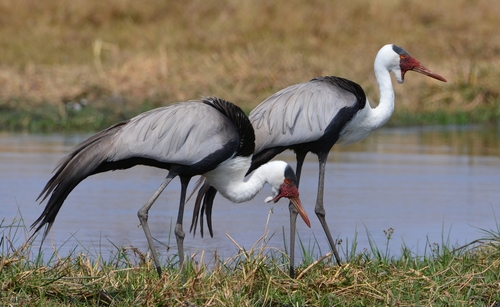
This species, the wattled crane, has the scientific name Bugeranus carunculatus (Gmelin, 1789). Standing 150 to 175 cm (4 ft 11 in to 5 ft 9 in) tall, it is the largest crane in Africa and the second tallest crane species globally, surpassed only by the sarus crane. It is also the tallest flying bird native to Africa; among all African birds, only the two ostrich species are taller. Despite a gracile appearance from its sharp slim beak, slender neck, and slender legs, it is the heaviest on average of Africa’s several very large long-legged waders, which include the two largest African storks, the shoebill, the greater flamingo, and the goliath heron. Among African flying birds, it is roughly the fourth heaviest, following the great white pelican, the much more sexually dimorphic kori bustard, and the cape vulture. Its wingspan measures 230–260 cm (7 ft 7 in – 8 ft 6 in), its total body length is typically 110 to 140 cm (3 ft 7 in to 4 ft 7 in), and its weight ranges from 6.4–8.28 kg (14.1–18.3 lb) for females and 7.5–9 kg (17–20 lb) for males. Standard measurements include a wing chord length of 61.3–71.7 cm (24.1–28.2 in), an exposed culmen of 12.4–18.5 cm (4.9–7.3 in), and a tarsus of 23.2–34.2 cm (9.1–13.5 in). Based on these standard measurements, it is the second largest proportioned crane after the sarus crane, and it out measures even the noticeably heavier red-crowned crane. On average, three adult wattled cranes weighed 8.15 kg (18.0 lb). The species’ back and wings are ashy gray. The feathered part of its head is dark slate gray above the eyes and on the crown, while the rest of the feathered head, including the almost fully feathered wattles that hang down from under the upper throat, is white. Its breast, primaries, secondaries, and tail coverts are black. The secondaries are long and nearly reach the ground. The upper breast and neck are white all the way to the face. The bare skin extending from in front of the eye to the base of the beak and the tip of the wattles is red and covered in small round wart-like bumps. Wattled cranes have long bills, and their legs and toes are black. Males and females are nearly identical in appearance, though males tend to be slightly larger. Juveniles have tawny body plumage, lack the species’ characteristic bare facial skin, and have less prominent wattles. This species has a generation length of 13 years. The wattled crane lives in eleven countries across eastern and southern Africa, with an isolated population in the Ethiopia Highlands. More than half of the world’s total wattled crane population is found in Zambia, while the single largest concentration of the species occurs in Botswana’s Okavango Delta. The species was first recorded in Uganda in 2011, when it was spotted in the Kibimba Rice region in eastern Uganda; this sighting brought Uganda’s total confirmed bird species count to 1040. A new population of wattled cranes was discovered in Angola in April 2018. Under most conditions, wattled cranes inhabit relatively inaccessible wetlands. They require shallow marsh-like habitats with abundant sedge vegetation. Like all cranes, wattled cranes are omnivorous. Their diet consists primarily of aquatic plant material: specifically the tubers and rhizomes of submerged sedges and water lilies, making the wattled crane one of the most herbivorous of living crane species. The next main component of their diet is aquatic insects. They will supplement their diet with snails, amphibians, and snakes when these prey are available. Approximately 90% of this species’ foraging activity takes place in shallow water. They typically forage by digging vigorously into muddy soil with their bills. They occasionally eat grain and grass seed as well, but do so much less frequently than the other three African crane species.