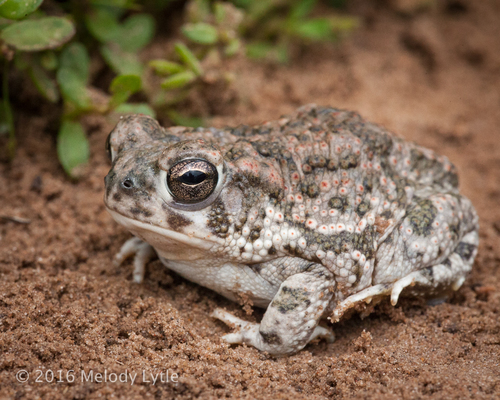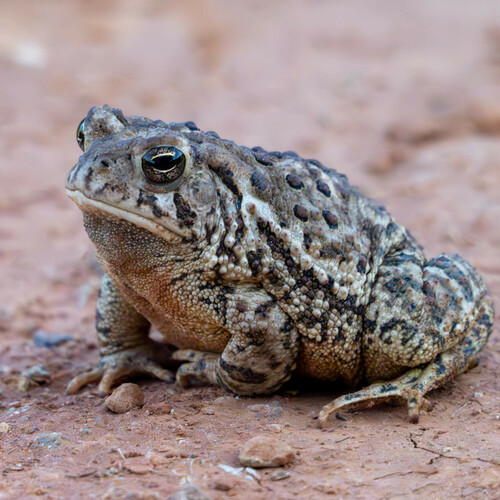
About Bufo bufo (Linnaeus, 1758)
Nomenclature & Size
The common toad, scientifically named Bufo bufo (Linnaeus, 1758), can grow to around 15 cm (6 in) in length. Females are usually stockier than males, and specimens from southern areas tend to be larger than those from northern areas.
Head Structure
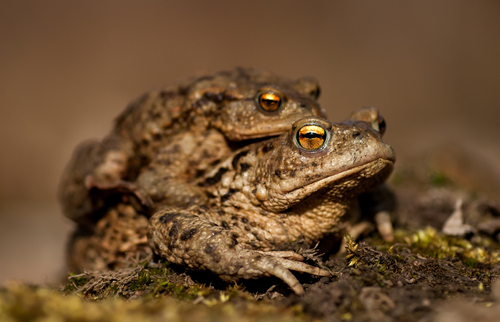
Its head is broad, with a wide mouth below the terminal snout which has two small nostrils. There are no teeth. The bulbous, protruding eyes have yellow or copper-coloured irises and horizontal, slit-shaped pupils.
Paratoid Glands
Just behind the eyes are two obliquely positioned bulging regions called paratoid glands, which secrete a noxious substance called bufotoxin to deter potential predators. The head joins the body without a noticeable neck, and there is no external vocal sac.
Body Shape
The broad, squat body is held close to the ground. The forelimbs are short, and the toes of the front feet turn inwards.
Breeding Forelimb Modifications
During the breeding season, males develop nuptial pads on their first three fingers, which they use to grasp the female during mating. Its hind legs are shorter than those of other frogs, and its hind feet have long, unwebbed toes.
Tail & Skin
There is no tail. The skin is dry and covered in small, wart-like lumps.
Dorsal Coloration
Its base color is a fairly uniform shade of brown, olive-brown or greyish-brown, and it is sometimes partly blotched or banded with a darker shade. The common toad is sexually dimorphic: females are typically browner, while males are typically greyer.
Ventral Coloration
The underside is a dirty white speckled with grey and black patches.
Similar Sympatric Toad Species
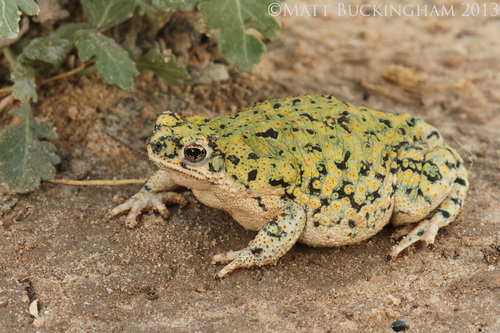
Several species can be confused with the common toad. The natterjack toad (Bufo calamita) is usually smaller and has a yellow band running down its back, while the European green toad (Bufo viridis) has a distinctive mottled pattern. Unlike the common toad's slanted paratoid glands, both species have paratoid glands that run parallel to each other.
Similar Sympatric Frog Species
The common frog (Rana temporaria) is also similar in appearance, but it has a less rounded snout, damp smooth skin, and usually moves by leaping.
Lifespan
Common toads can live for many years; they have survived 50 years in captivity, and are thought to live 10 to 12 years in the wild. Their age can be determined by counting the number of annual growth rings in the bones of their phalanges.
European Abundance
After the common frog (Rana temporaria), the edible frog (Pelophylax esculentus) and the smooth newt (Lissotriton vulgaris), the common toad is the fourth most common amphibian in Europe. It is found throughout the continent except in Iceland, the cold northern parts of Scandinavia, Ireland, and a number of Mediterranean islands including Malta, Crete, Corsica, Sardinia and the Balearic Islands.
Global Range
Its easterly range extends to Irkutsk in Siberia, and its southerly range includes parts of northwestern Africa in the northern mountain ranges of Morocco, Algeria and Tunisia. A closely related variant lives in eastern Asia, including Japan.
Altitudinal Range
In the southern part of its range, the common toad is found at altitudes of up to 2,500 metres (8,200 ft).
Habitat Preferences
It is largely found in forested areas including coniferous, deciduous and mixed woodland, especially in wet locations. It also lives in open countryside, fields, copses, parks and gardens, and is often found in dry areas far from standing water.
Breeding Migration
The common toad emerges from hibernation in spring, and migrates in large groups to breeding sites. They converge on certain favoured ponds while avoiding other seemingly suitable bodies of water.
Breeding Site Fidelity
Adults return to the same breeding location year after year; over 80% of males marked as juveniles have been found to return to the pond where they were spawned. They navigate to these sites using a combination of orientation cues: olfactory cues, magnetic cues, and visual cues all help guide their journey.
Navigation Ability
Experiments with tracked toads moved to new locations found they can locate their chosen breeding pond even when displaced more than three kilometres (two miles). Males arrive at breeding sites first and stay for several weeks, while females only stay long enough to mate and spawn.
Male Mating Disputes
Instead of fighting to mate with a female, male toads often resolve disputes through the pitch of their voice: croak pitch reliably indicates body size, and thus mating prowess. Even so, fights still occur in some cases.
Male Combat Frequency
A study of one pond, where there were four to five times as many males as females, found that 38% of males won mating opportunities by defeating rivals in combat or displacing other males already mounted on females. Male toads generally outnumber females at breeding ponds.
Female Breeding Frequency
A Swedish study found female toads have higher mortality rates than males, with 41% of females not coming to the breeding pond in spring and skipping a year before reproducing again. Males mount females' backs and grasp them under the armpits with their forelimbs, a grip called amplexus.
Amplexus Behavior
Males can be very enthusiastic, and will try to grasp fish or inanimate objects, as well as mount other males. Sometimes several toads form a heap, with each male trying to grasp the female at the base. This is a stressful period, with high mortality among breeding toads.
Egg Laying
A successfully mating male stays in amplexus for several days while the female lays a long, double string of small black eggs. He fertilises the eggs with his sperm as they are laid.
Egg String Characteristics
As the pair moves piggyback around the shallow edges of the pond, the gelatinous egg strings—which can contain 1,500 to 6,000 eggs and measure 3 to 4.5 metres (10 to 15 ft) in length—become tangled in plant stalks. The egg strings absorb water and swell in size.
Early Tadpole Development
Small tadpoles hatch after 10 days. At first, they cling to the remains of the egg strings and feed on the jelly. They later attach to the underside of water weed leaves before becoming free-swimming.
Tadpole Identification
Young common toad tadpoles look similar to common frog (Rana temporaria) tadpoles, but they are darker: blackish above and dark grey below. They can be distinguished from tadpoles of other species by the fact that their mouth is the same width as the distance between their eyes, which is twice the width of the space between their nostrils.
Metamorphosis
Over a few weeks, the tadpoles develop legs, and their tails gradually reabsorb. By twelve weeks of age, they become miniature toads about 1.5 cm (0.6 in) long, ready to leave the pond.