About Buddleja asiatica Lour.
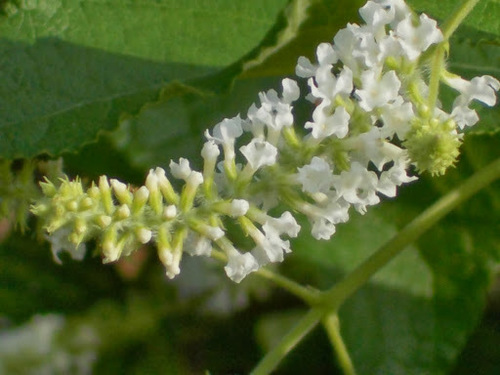
Buddleja asiatica Lour. is a somewhat tender deciduous shrub. In the wild, it can grow to less than 7 meters tall. Its leaves are typically narrowly lanceolate to ovoid, less than 30 centimeters long, and attached by 15 millimeter-long petioles to branches that are round in cross-section. The sweetly scented flowers are most often white, and occasionally pale violet. They are produced in late winter at the ends of long, lax branches, arranged in slender panicles, whose size can vary widely depending on the source. The ploidy of this species is 2n = 38, meaning it is diploid. Buddleja asiatica is native to Assam, Bangladesh, Borneo, Cambodia, North-Central, South-Central, and Southeast China, East Himalaya, West Himalaya, Hainan, India, Java, Laos, the Lesser Sunda Islands, Malaysia, the Maluku Islands, the Mariana Islands, Myanmar, Nepal, New Guinea, Pakistan, the Philippines, Sulawesi, Sumatra, Taiwan, Thailand, Tibet, and Vietnam. It has been introduced to the East Aegean Islands, Hawaii, and Vanuatu. Buddleja asiatica is not fully hardy in the United Kingdom, but can be grown successfully against a south-facing wall in coastal areas of southern and western UK, where it tolerates temperatures down to approximately 0 °C (32 °F). A specimen is grown under glass at Longstock Park Nursery, near Stockbridge, Hampshire, which is one of the four NCCPG national collection holders for this genus. Its hardiness rating is RHS H3, and it is suited to USDA zones 9–10. Due to its broad ecological range, ability to adapt to disturbed areas, and tolerance of a wide range of elevations and rainfall levels, it easily naturalizes in tropical regions and can become invasive. In Nepal, the leaves of Buddleja asiatica are collected for use as fodder for domesticated animals, and its trunk is harvested for firewood. During traditional Thangmi wedding rituals, female relatives of the groom wear necklaces made from the plant's white flowers.