About Bucorvus abyssinicus (Boddaert, 1783)
Taxonomy and Classification
The Abyssinian ground hornbill, scientifically named Bucorvus abyssinicus (Boddaert, 1783), is a large, terrestrial hornbill.
Plumage Overview
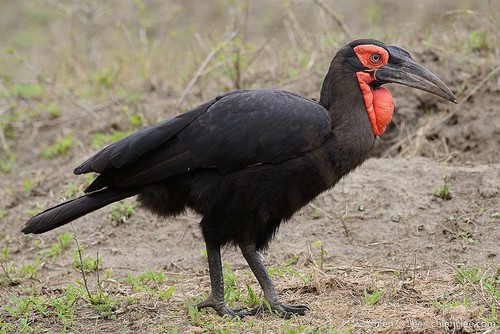
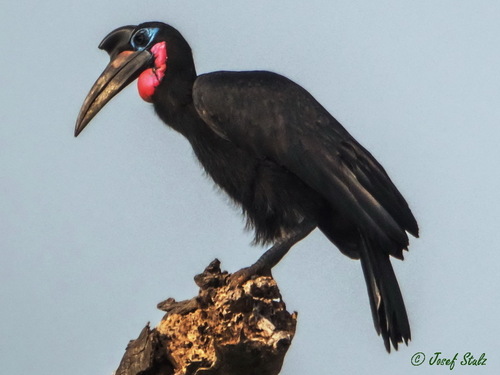
It has black body feathers and white primary feathers that are visible when in flight.
Adult Male Skin and Head Features
Adult males have a patch of bare blue skin around the eye, and an inflatable patch of bare skin on the neck and throat that is mostly red, with blue skin on the upper throat.
Adult Male Bill Structure
The long bill is black, except for a reddish patch at the base of the mandible.
Adult Male Casque Structure
A short, open-ended black casque sits on top of the bill.
Adult Female Appearance
Females are similar in appearance but smaller, and all of their bare skin is entirely dark blue.
Juvenile Appearance
Juvenile birds are dark sooty-brown, with a smaller bill and an incipient (developing) casque.
Maturation Timeline
Maturation to full adult plumage, bare skin coloration, and casque development typically takes 3 years, during which the juvenile gradually gains these adult traits.
Total Length
The species has a total length of 90 to 110 cm (35 to 43 in).
Eye Protection Features
It also has long eyelash-like feathers surrounding the eyes, which protect the eyes from injury.
Standard Body Measurements
Reported average measurements are around 90 to 100 cm (35 to 39 in) tall, a wingspan around 110 cm (43 in), and an approximate weight of 4 kg (8.8 lb).
Size Comparison to Southern Ground Hornbill
According to Stevenson and Fanshawe, the Abyssinian ground hornbill is a larger species on average than the southern ground hornbill, with an average length of 102 cm (40 in); however, published weights and standard measurements show the opposite, indicating that the southern ground hornbill is slightly larger.
Native Distribution Range
In the wild, the Abyssinian ground hornbill occurs in northern sub-Saharan Africa, ranging from southern Mauritania, Senegal, and Guinea eastward to Eritrea, Ethiopia, northwestern Somalia, northwestern Kenya, and Uganda.
Native Habitat Preferences
It inhabits open habitats including savanna, sub-desert scrub, and rocky areas, and prefers short vegetation that suits its visual foraging method.
Habitat Dryness Comparison
The habitats it occupies are generally drier than the preferred habitat of the southern ground hornbill.
Nest Site Requirements
It can tolerate disturbed areas, but requires large trees to use as nest sites.
Non-Native Occurrence in Florida
Escaped or deliberately released Abyssinian ground hornbills have been recorded in Florida, USA, but there is no evidence of a breeding population, and any existing birds likely persist only due to ongoing new releases or escapes.