About Buckinghamia celsissima F.Muell.
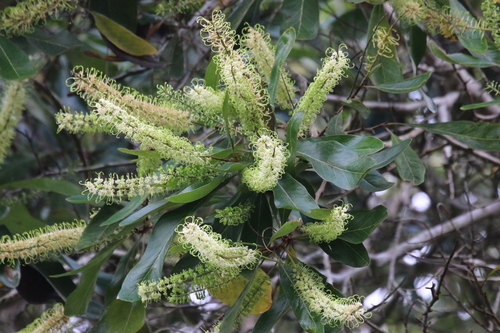
Buckinghamia celsissima is a large tree that reaches up to 30 m (98 ft) tall in its native rainforest habitat, and grows much smaller when cultivated. Its leaves are dark green on the upper surface and somewhat glaucous or whitish on the lower surface, attached to petioles 10–20 mm (0.4–0.8 in) long. The first few leaves on a new shoot may be deeply lobed, while leaves on older twigs are simple with entire margins. Mature leaves are elliptic, growing up to around 20 cm (7.9 in) long and 7 cm (2.8 in) wide. Showy cream-coloured flowers bloom through summer and autumn, borne on axillary or terminal pendant raceme inflorescences up to 27 cm (11 in) long. Individual flowers cluster densely along the inflorescence axis, growing on pedicels about 8 mm (0.3 in) long, with tepals 7–10 mm (0.3–0.4 in) long. Fruits of this species, commonly called the ivory curl tree, are follicles. They are green while developing, and turn brown or black when mature. Mature fruits reach up to 30 mm (1.2 in) long by 20 mm (0.8 in) wide, and hold up to 6 small brown seeds that are released when the fruit splits open. In the wild, Buckinghamia celsissima occurs naturally in northeastern Queensland, Australia, from near Rossville to the Paluma Range north of Townsville, growing at altitudes between 200 m (660 ft) and 1,000 m (3,280 ft). It grows in well-developed rainforest on deep red volcanic soils, and also occurs in drier rainforest types associated with kauri pine. Ecologically, the ivory curl tree is a host species for larvae of the cornelian butterfly. When flowering, its inflorescences attract a wide variety of insects, including the beetle Dilochrosis brownii, which in turn attracts insectivorous birds. Its seeds are eaten by crimson rosellas (Platycercus elegans). The ivory curl tree is now a widely popular planted tree for parks, streets, and private gardens in regions far outside its natural native range. Its popularity stems from its ease of cultivation, abundant mass flowering, and varied foliage shape and colour. It grows well as far south as Sydney and Melbourne, but only reaches 7–8 m (23–26 ft) tall in these regions.