About Buchwaldoboletus lignicola (Kallenb.) Pilát
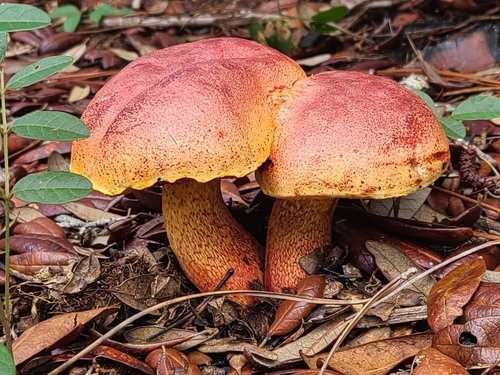
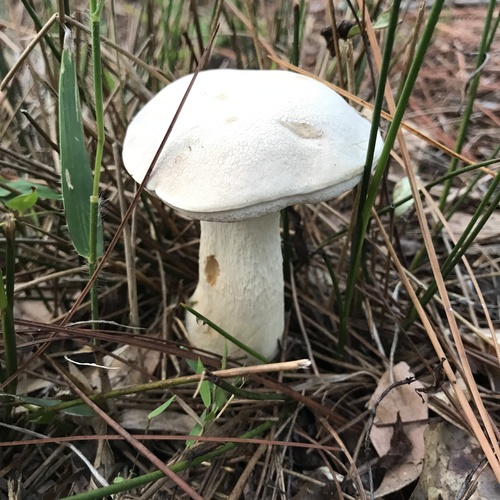
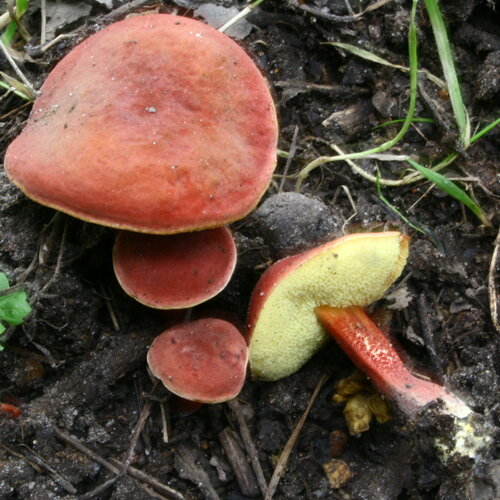
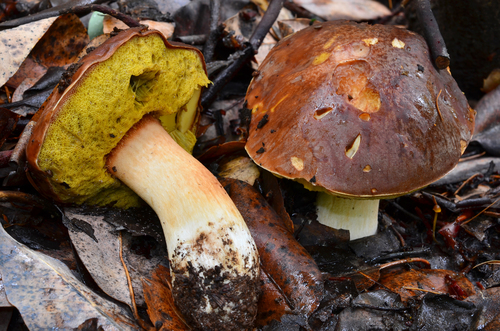
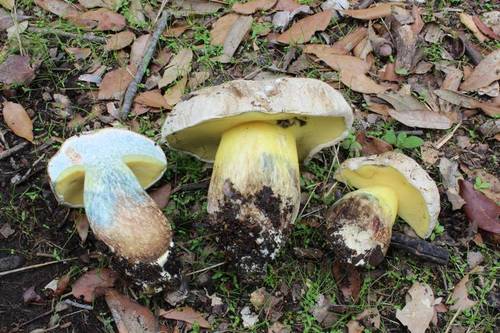
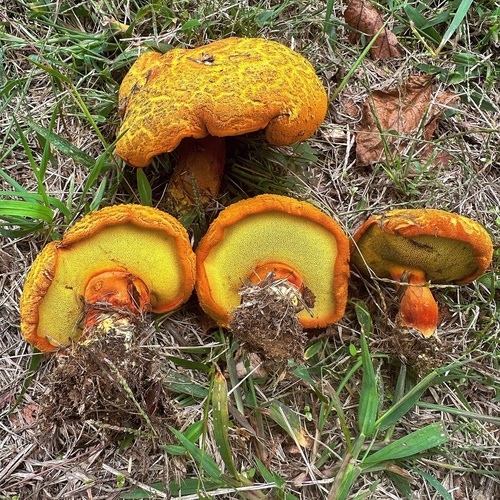
The cap of Buchwaldoboletus lignicola starts convex and becomes broadly convex as it ages, with a diameter of 2.5–10 cm (1.0–3.9 in). When young, the cap margin has an inward-rolled band of sterile tissue. The cap surface is finely velvety at first, but often develops fine cracks as it matures, and is colored rusty brown to yellow brown. The cap skin peels easily from the mushroom; it is separated from the underlying yellow flesh by a thin gelatinous layer, and can actually be moved back and forth across the cap. The flesh may stain blue when cut or injured, though this staining reaction develops slowly, or may not appear at all. The pores are small and angular, with 1–3 pores per millimeter, while the tubes attached to the pores are 3–12 mm long. The pore surface is yellowish to brownish yellow when mature, and stains bluish-green when injured. The stipe measures 3–8 cm (1.2–3.1 in) long by 0.6–2.5 cm (0.2–1.0 in) thick; it is roughly the same width along its entire length, or narrower at the base, and yellow mycelium grows at the stipe base. The scent is mild and sweet, though old specimens have occasionally been described as having a foul smell. The edibility of B. lignicola is not known with certainty. The species produces an olive-brown spore print. Its spores are ellipsoid, smooth, and measure 6–10 by 3–4 μm. Buchwaldoboletus lignicola has been recorded across Europe, from far northern subarctic regions south to Switzerland, and in North America from Ontario and Quebec south to Pennsylvania. It is considered endangered in the Czech Republic. It only grows where the fungus Phaeolus schweinitzii grows, and microscopic examination has confirmed it is parasitic on that species. Both fungi are found associated with coniferous trees such as Scots pine (Pinus sylvestris), eastern white pine (P. strobus) and European larch (Larix decidua), and less commonly associated with deciduous trees such as wild cherry (Prunus avium).