About Buchnera americana L.
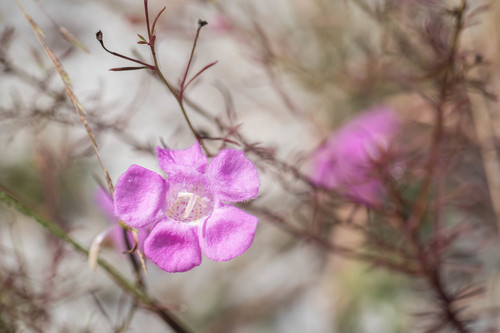
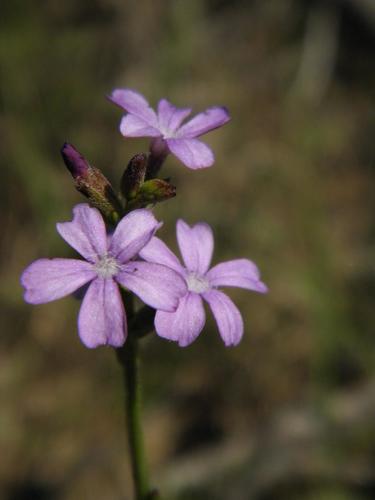
Buchnera americana L., commonly called bluehearts, is a perennial flowering plant with underground rhizomes and an above-ground stem. Its stem is usually covered in trichomes, which are small hair-like projections, and reaches 40 to 80 cm (16 to 31 in) tall. Its leaves grow oppositely, meaning they emerge in pairs directly across from each other on the stem. The flowers are bilaterally symmetrical, can be purple or white, and have five petals that form a narrow tube that suddenly bends outward at a right angle. Fruits are dark purple, held in capsules 7 mm (0.28 in) long. This plant blooms year-round, with peak flowering occurring between June and September; in the remaining months of the year, petals darken and dry out. Bluehearts are found across 12 U.S. states, ranging from Ohio to Florida. They are most common and abundant in Missouri and Tennessee, where they grow primarily in moist environments. They also occur in a small area of southwestern Ontario, 10 km (6.2 mi) from Lake Huron. This species is most often found along the edges of wet depressions, in limestone glades, prairies, moist sandy soils, and open woods. It sometimes forms a hemiparasitic relationship with roots of several tree species. As hemiparasites, bluehearts are able to grow independently without a host, but grow more vigorously when a host is present. They attach to host plants using specialized parasitic roots called haustoria. During stressful conditions such as drought, large groups of bluehearts may increase their parasitic activity enough to damage small trees. Common host trees include white oak (Quercus alba), eastern white pine (Pinus strobus), green ash (Fraxinus pennsylvanica), and cottonwood (Populus deltoides). Caterpillars of the common buckeye (Junonia coenia) feed on bluehearts. Bluehearts can grow in a wide range of soil types, including clay, acidic sandy soils, dry sandy loam, moist black sandy peat, and seasonally damp areas. They prefer open, sunny conditions. Buchnera americana has no known medicinal uses. When grown in gardens, it is highly attractive to bees, butterflies, and birds.