About Bucephala islandica (J.F.Gmelin, 1789)
The scientific name of this species is Bucephala islandica (J.F.Gmelin, 1789), commonly known as Barrow's goldeneye. Adults are similar in overall appearance to the common goldeneye. On average, adult males measure 19.2 inches (49 cm) long and weigh 2.13 pounds (970 g), while females are typically 17 inches (43 cm) long and weigh 1.31 pounds (590 g). The wingspan of Barrow's goldeneye ranges from 27.6 to 28.7 inches (70 to 73 cm).
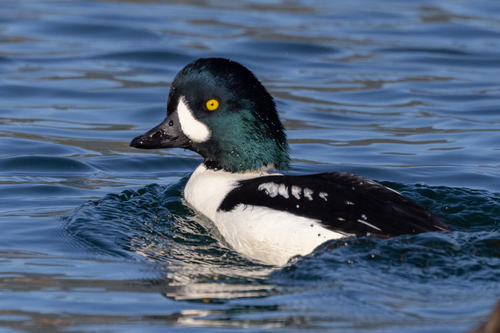
Adult males have a dark head with a purplish gloss, and a white crescent at the front of the face. Adult females have a mostly yellow bill. Male Barrow's goldeneye can be distinguished from male common goldeneye by several features: common goldeneye males have round white face patches, less black on their back, a greenish head gloss, and a larger bill. Female common goldeneye differ from female Barrow's goldeneye in having a less rounded head, and a bill where only the tip is yellow.
Their breeding habitat is wooded lakes and ponds, located primarily in northwestern North America, with scattered breeding locations also found in eastern Canada and Iceland. Females return to the same breeding sites each year, and tend to reuse the same nesting sites annually. Males stay with their mate through the winter, and defend their territory during the breeding season, before leaving to go to molting sites. Mating pairs often remain intact even when the male and female are separated for long periods over the summer during molting, and the pair reunites at wintering areas.
In Iceland, this species is called húsönd, which means house-duck. It is a common species at Lake Mývatn in northern Iceland. There have been three accepted records of vagrant individuals in Scotland, and these are the only accepted records of this species as a wild bird in Europe outside of Iceland.