About Bubo virginianus (J.F.Gmelin, 1788)
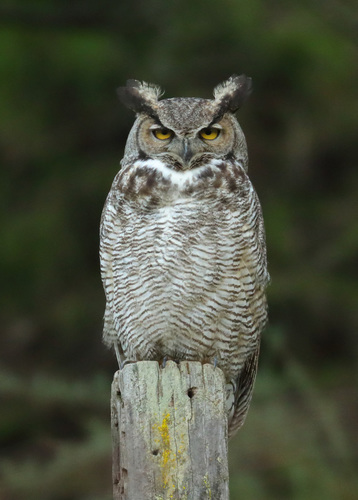
The great horned owl (Bubo virginianus) has plumage generally colored for camouflage. Its underparts are usually light with brown horizontal barring, while upper parts and upper wings are typically mottled brown with heavy, complex darker markings. All subspecies have some degree of dark barring along their sides. The species has a variable-sized white patch on the throat; this white marking may extend as a streak down the center of the breast even when the owl is not displaying, and can widen into a large white area on the belly in particularly pale individuals. South American great horned owls usually have a smaller white throat patch that is often only visible when actively displaying, and they rarely have a white chest patch. Overall color varies individually and regionally: subarctic individuals have a washed-out light-buff color, while owls from the Pacific Coast of North America, Central America, and most of South America are dark brownish with overlying blackish blotches. The skin of the feet and legs is black, though it is almost entirely hidden by feathers; even tropical great horned owls have feathered legs and feet. The foot feathers of the great horned owl are the second-longest recorded among any owl species, after those of the snowy owl. The bill and talons are both dark gunmetal-gray. All great horned owls have a facial disc, which can be reddish, brown, or gray depending on geographic and subspecies variation, and is outlined by a dark rim that ends in bold blackish side brackets. The species' distinctive eyebrow-like "horns" are feather tufts called plumicorns. The function of plumicorns is not fully understood, but the hypothesis that they act as a visual cue in territorial and sociosexual interactions with other owls is generally accepted.
For species identification, the great horned owl is distinguished across most of its range by its large body size, prominent ear tufts, and barred plumage. It can easily be confused with the lesser horned owl (B. magellanicus, also called Magellanic horned owl), whose range may overlap with it. The Magellanic horned owl was once classified as a subspecies of the great horned owl, but is now almost universally recognized as a separate distinct species supported by genetic evidence, with the great horned owl considered its paraspecies. While overall coloration is similar between the two, the Magellanic horned owl is noticeably smaller, with smaller feet and a smaller head, and has finer but more numerous brownish bars on its underside, rather than the blotchy, irregular barring that is typical of great horned owls. Other eagle-owls may look superficially similar, but the great horned owl is generally geographically separated from them, with the exception of wintering snowy owls. Other tropical owl species with ear tufts, such as the stygian owl (A. stygius) and striped owl (A. clamator), are much smaller than the great horned owl, and other large owls do not have ear tufts.
The great horned owl's breeding range extends far into the North American subarctic, reaching as far north as the northwestern and southern Mackenzie Mountains, Keewatin, Ontario, northern Manitoba, Fort Chimo in Ungava, Okak, Newfoundland and Labrador, Anticosti Island, and Prince Edward Island. It is distributed across most of North America, occurs very sparsely in Central America, and extends south through South America to upland regions of Argentina, Bolivia, and Peru, where its range ends and is replaced by the Magellanic horned owl, which continues south to Tierra del Fuego at the continent's southern tip. The species is absent or rare from southern Guatemala, El Salvador, Nicaragua, and Costa Rica through Panama, where only two records exist, as well as from the mangrove forests of northwestern South America. It is also absent from the West Indies, Haida Gwaii, and almost all offshore islands in the Americas; its ability to colonize islands is considerably lower than that of barn owls and short-eared owls. After the division into two distinct species, the great horned owl is the second most widely distributed owl in the Americas, ranking only after the barn owl.
The great horned owl is one of the most habitat-adaptable owls, and even bird species, in the world. It can live in trees bordering a wide range of habitat types, including deciduous, coniferous, and mixed forests, tropical rainforests, pampas, prairie, mountainous areas, deserts, subarctic tundra, rocky coasts, mangrove swamp forests, and some urban areas. It is less common in more extreme regions of the Americas. In the Mojave and Sonora Deserts, it is absent from the desert cores and only found on vegetated or rocky fringes. Even in North America, it is rare in landscapes with more than 70% old-growth forest, such as the aspen forests of the Rockies. It has only been recorded a small number of times in true rainforests like the Amazon rainforest. In the Appalachian Mountains, it appears to use old-growth forest, but in Arkansas it is often found near temporary agricultural openings within large stretches of woodland. Similarly, in south-central Pennsylvania, the owls use cropland and pasture more often than deciduous forest and complete forest cover, indicating a preference for fragmented landscapes. In prairies, grasslands, and deserts, they can live year-round successfully as long as rocky canyons, steep gullies, and/or wooded coulees with shade-providing trees are available to supply shelter and nesting sites. In North American mountainous areas, they are usually absent above the tree line, but can be found up to 2,100 m (6,900 ft) in California and 3,300 m (10,800 ft) in the Rockies. In the Andean Mountains, by contrast, the species has adapted to be a true montane species, often found at least 3,300 m (10,800 ft) above sea level, and is regularly recorded in treeless Puna grassland zones at 4,100 to 4,500 m (13,500 to 14,800 ft) in Ecuador and Peru. It is generally rare in non-tidal wetland habitat, and is replaced in high Arctic tundra by snowy owls. It prefers areas where open hunting habitats and woodland for roosting and nesting are positioned next to each other, so lightly populated rural regions are often ideal. This species can occasionally be found in urban or suburban areas, but seems to prefer areas with less human activity and is most likely found in park-like settings in these developed areas, unlike eastern and western screech owls (Megascops asio & M. kennicottii) which regularly occur in busy suburban settings. All mated great horned owls are permanent residents of their territories, but unmated younger owls move freely to find mates and a territory, and leave regions with low winter food availability.
Great horned owl prey varies widely based on opportunity; one author has stated that "Almost any living creature that walks, crawls, flies, or swims, except the large mammals, is the great horned owl's legitimate prey". In fact, the great horned owl has the most diverse prey profile of any raptor in the Americas. Over 500 species have been identified as great horned owl prey, with dozens more identified only to genus or general type, especially numerous invertebrates, and presumably several more remain unknown from the relatively little-studied Neotropical populations. Mammals, more than 200 species, and birds, nearly 300 species, make up the majority of their diet. In North America, their diet is 87.6% mammals, 6.1% birds, 1.6% reptiles and amphibians, with the remaining 4.7% made up of insects, other assorted invertebrates, and fish. The estimated mass of individual prey items ranges from as little as 0.4 g (0.014 oz) to as much as 6.8 kg (15 lb). Most prey falls between 4 g (0.14 oz, the size of shrews) to 2,300 g (5.1 lb, the size of jackrabbits). A single great horned owl needs about 50 to 100 g (1.8 to 3.5 oz) of food per day, and can survive on one large kill for several days. Despite the wide diversity of prey taken, across most of the continental United States from the East to the Midwest, as well as Canada and Alaska, great horned owls rely mostly on just a handful of prey species: three lagomorph species (eastern cottontail Sylvilagus floridanus, snowshoe hare Lepus americanus, and black-tailed jackrabbit Lepus californicus); two New World mouse species (white-footed mouse and North American deermouse, Peromyscus leucopus & P. maniculatus); approximately three vole species (meadow, prairie, and woodland voles, Microtus pennsylvanicus, M. ochrogaster & M. pinetorum); and one introduced pest, the brown rat.
Great horned owls are among the earliest breeding birds in North America, which is thought to be partly due to long nights at this time of year, and also gives them a competitive advantage over other raptors. In most of North America, courtship occurs from October to December, and mates are selected by December to January. The species was once thought to be strictly monogamous, but recent analysis shows one male may mate with two females at the same time; this was first documented in 2018 in Reno, Nevada. During late fall or early winter courtship, the male attracts a mate by hooting loudly while leaning over, with his tail folded or cocked, and puffing up his white throat to look like a ball. The white throat may act as a visual stimulus in the low light conditions typical of this owl's courtship. The male often flies up and down a perch while approaching a potential mate, eventually approaching the female and attempting to rub his bill against hers while repeatedly bowing. If receptive, the female hoots back when the pair meet, but her hoot and display are more subdued. The male may win the female over by bringing her freshly caught prey, which the pair will share. While males often hoot loudly for about a month to six weeks toward the end of the year, females only hoot during this period for one week to ten days. Pairs typically breed together year after year and may mate for life, though they associate more loosely once their young are mostly independent. Pairs rekindling their reproductive bond in winter may perform a milder courtship to strengthen their pair bond before producing young.
Males select nesting sites and draw females' attention to them by flying to the nest then stomping on it. Due to the owls' large size, nests with open access are preferred over those enclosed by surrounding branches. Like all owls, great horned owls do not build their own nests. They tend to search for abandoned nests, usually built by larger birds like hawks, and take over these nests to raise their own young. They nest in a wider variety of sites than any other North American bird. Many nests are in large hollows of dead trees or their branches, especially in southern U.S. states in large trees along the edge of old-growth stands. In mountainous or hilly areas, especially in canyons of the Southwest and Rocky Mountains, cliff ledges, small caves, and other sheltered depressions may be used. Owls living in prairie regions, when other animals' nests, riparian tree hollows, or man-made structures are not available, will use boulders, buttes, railroad cuts, low bushes, and even bare ground as nest sites. Ground nests have also been recorded in tall grasses in Florida and in brushy spots on desert ground. Even burrow entrances of American badger and coyote dens have reportedly been used as nests, despite the inherent risk of sharing space with these potentially dangerous co-inhabitants. Nesting behavior for great horned owls appears to be more closely linked to prey availability than seasonal conditions. There is some evidence that if prey availability is low enough, the species will skip breeding entirely for a season. Both male and female great horned owls have been observed helping incubate eggs once they have been laid.
Most tree nests used by great horned owls are built by other animals, and are usually located 4.5 to 22 m (15 to 72 ft) above the ground. The owls often take over a nest used by another large bird, sometimes adding feathers to line the nest but usually making few other changes. There are reportedly some cases where owls have reinforced a nest structure or appeared to reconstruct it, but as a rule, no owl species is known to actually build a nest. Great horned owls in the Southwest may also use nests built by Harris's hawks and red-tailed hawks in cacti, as well as large hollows in cacti. The nests they use are often made by most larger types of accipitrids, from species as small as Cooper's hawks to bald eagles and golden eagles, though they most often use nests of red-tailed hawks and other buteonines. The second most commonly used nests are those built by crows and ravens (Corvus ssp.). Even nests of Canada geese, black-crowned night herons (Nycticorax nycticorax), and great blue herons have been used; great blue heron nests are sometimes used right in the middle of an active heronry. Leaf nests built by squirrels are also regularly used, but great horned owls generally prefer stick nests because they provide a much firmer, safer foundation.
The timing of egg laying varies across North America. In southern Florida, eggs may be laid as early as late November and as late as early January. In the southeast, from south Texas to Georgia, egg laying may begin from late December to early February. From southern California to northern Louisiana, egg laying occurs from early February to late March. The largest contiguous area of egg-laying owls, stretching from central California to South Carolina and as far north as Ohio and Massachusetts, lays eggs from late February to early April. In the Rocky Mountains, northwestern United States, northern New England, and eastern Canada, egg laying takes place from early March to late April. In the rest of Canada and Alaska, egg laying may occur from late March to early May. The latest recorded egg laying date was mid-June in Saskatchewan and the Yukon Territory. In northwestern Utah and north-central Alberta, egg laying can happen 3–4 weeks earlier than usual when food is abundant and weather is favorable. For owls in tropical climates, breeding season dates are somewhat undefined. Clutches usually contain 2 eggs, but range in size from 1 to 6 eggs; clutches over 3 are uncommon, and clutches over 4 are very rare, with size varying based on environmental conditions. The average egg width is 46.5 mm (1.83 in), average length is 55 mm (2.2 in), and average weight is 51 g (1.8 oz); this weight figure comes from relatively small owls in Los Angeles County, CA, so average mass may be slightly higher elsewhere. The incubation period ranges from 28 to 37 days, averaging 33 days. Usually the female does all incubation alone and rarely leaves the nest, while the male captures food and brings it to her; the first nightly food delivery typically occurs shortly after dark.
On average, hatchlings weigh 34.7 g (1.22 oz) at birth, and gain about 33 g (1.2 oz) per day for the first four weeks of life. By 25–29 days old, males typically weigh around 800 g (1.8 lb) and females around 1,000 g (2.2 lb). When first hatched, young are covered in whitish gray down, with some brown coloring on the wings. Gradually soft juvenile downy plumage grows in, which is typically cinnamon-buff, with variable hues that predict the mature owl's eventual color. The extent of down gradually lessens, and mature-looking plumage develops by late summer, though many first-year birds still have scattered bits of down into autumn. By late autumn, first-year birds look similar to adults, but have a slightly warmer reddish tinge, less developed ear tufts, and a smaller white throat patch. Nestling owls develop most key behaviors between two weeks and two months of age; during this period they develop the ability to defend themselves, grasp food, and climb. While still in the egg, young can produce weak chips vocally, and develop a raspy chirp shortly after hatching. The calls of young increase rapidly in intensity, pitch, and complexity; some juvenile males mimic their father's hooting in fall, but usually end with various odd gurgling notes. Juvenile owls do not produce competent hooting until January. Young owls move to nearby branches at 6 weeks old, and start flying about a week later. However, young are not usually competent fliers until they are about 10 to 12 weeks old. The age when young leave the nest varies based on food abundance. Young birds stay in an area ranging from 13 to 52 hectares from the nest through fall, but usually disperse up to several thousand hectares by the end of fall. Offspring have been observed still begging for food in late October, 5 months after leaving the nest, and most do not fully leave their parents' territory until just before the parents begin reproducing for the next clutch, usually December to January. Young birds may not breed for another one to two years, and are often vagrants called "floaters" until they establish their own territories. Based on bursa development, great horned owls reach sexual maturity at two years of age.