About Bubo scandiacus (Linnaeus, 1758)
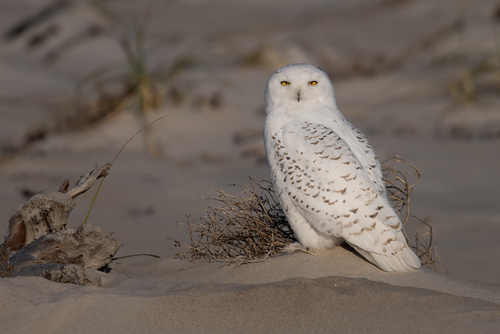
The snowy owl, Bubo scandiacus, is predominantly white in plumage, even purer white than predatory Arctic mammals like polar bears and Arctic foxes. When spotted in the wild, they often blend in, resembling a pale rock or a clump of snow on the ground. They appear to lack visible ear tufts at first glance, but very short, likely vestigial tufts can be raised in certain situations—most often by nesting females. These small ear tufts measure 20 to 25 mm, and are made up of around 10 small feathers. Snowy owls have bright yellow eyes, a relatively small head, and even for a Bubo owl which already has a simply adapted hearing mechanism, their facial disc is shallow and their ear structure is uncomplicated. One measured male had left ear slits of 21 mm × 14 mm, and right ear slits of 21 mm × 14.5 mm. Females of the same age are almost always more darkly patterned than males. Mature males have plain white upperparts, usually with only a few dark spots on their tiny ear tufts, around the head, and at the tips of some primary and secondary flight feathers, while their underside is often pure white. Contrary to their reputation for being entirely white, only 3 out of 129 adult male Russian museum specimens showed almost no dark spots at all. Adult females are typically much more heavily spotted, and often have faint dark brown barring on their crown and underparts. Their flight and tail feathers have faint brown barring, while their underparts are white at the base, with brown spotting and barring on the flanks and upper breast. For snowy owls with confusing plumage, sex can be determined by the shape of wing markings: females have more barring, while males have spots. However, the darkest males and lightest females are nearly impossible to tell apart by plumage alone. On rare occasions, females have been recorded being almost pure white in both wild and captive settings. There is some evidence that individuals grow paler with age after reaching maturity. One study concluded that while males are usually but not always lighter, correctly aging snowy owls from appearance is extremely difficult, as individuals may get lighter, darker, or stay the same as they age. With close observation, individual snowy owls can be identified by the unique pattern of markings on their wings. After a fresh moult, some adult females that previously looked relatively pale develop new dark, heavy markings. In contrast, some banded individuals showed almost no change in the extent of their markings over at least four years. Unlike the barn owl, another pale owl species where sexual dimorphism in spotting is genetically driven, environmental factors likely dictate this dimorphism in snowy owls. Newly hatched chicks start out grayish white, quickly transitioning to dark gray-brown mesoptile plumage. This plumage effectively camouflages them against the lichen-speckled tundra ground. This juvenile plumage is gradually replaced by plumage with dark barring on a white background. By the time they fledge, their plumage is irregularly mottled or blotched with dark markings; their upperparts are mostly solid dark gray-brown, with white eyebrows and other patches of white on the face. Recently fledged young can already be sexed semi-reliably by the pattern of dark markings on their wings. Juvenile plumage resembles that of adult females, but averages slightly darker overall. By their second moult, fewer or more broken bars appear on the wings. The extent of white and the pattern of wing markings become more sexually dimorphic with each juvenile moult, culminating in the 4th or 5th pre-basic moult, after which the owls are indistinguishable from mature adults. Moults typically occur between July and September; non-breeding birds moult later and more extensively, and moulting is never extensive enough to leave the owls flightless. Evidence suggests most snowy owls reach full adult plumage between 3 and 4 years of age, but incomplete records indicate some males do not finish maturing or reach their maximum white plumage until their 9th or 10th year. Overall, snowy owls complete moulting more quickly than Eurasian eagle-owls. A snowy owl's toes are extremely thickly covered in white feathers, and their claws are black. Their toe feathers are the longest known of any owl, averaging 33.3 mm; in comparison, the great horned owl, which has the second longest toe feathers, averages only 13 mm. Occasionally, snowy owls may have a faint blackish edge around their eyes, a dark gray cere that is often hidden by feathers, and a black bill. Unlike many other whitish birds, snowy owls do not have black wingtips, which is theorized to reduce wing feather wear common in other whitish bird species. Their distinctly notched primaries give them an advantage over similar owls in long-distance flight and more sustained flapping flight. Snowy owls do have the noise-canceling serrations and comb-like wing feathers that make most owls' flight functionally silent, but they have fewer of these adaptations than other related Bubo owls. Combined with their less soft feathers, a snowy owl's flight can be somewhat audible when heard at close range. Their flight is typically steady and direct, reminiscent of a large, slow-flying falcon. They normally use a "flap-and-glide" flight style, and there is no evidence they can soar. Despite their large size, they can occasionally be fast and agile when chasing avian prey, and will sometimes use hovering flight as a hunting method. The species rarely flies higher than around 150 m, even during migration. While their feet are sometimes described as "enormous", the tarsus is relatively short in osteological terms, measuring 68% of the length of a Eurasian eagle-owl's tarsus, but their claws are nearly as large, at 89% of the size of an eagle-owl's claws. Despite its relatively short length, the tarsus has a similar circumference to that of other Bubo owls. Compared to an eagle-owl, the snowy owl has a relatively short curved beak, a proportionately longer interorbital roof, and a much longer sclerotic ring surrounding the eyes; its anterior opening is the largest known of any owl. Owls have extremely large eyes, and the eyes of a large species like the snowy owl are roughly the same size as a human's. A snowy owl's eye is about 23.4 mm in diameter, slightly smaller than the eyes of great horned owls and Eurasian eagle-owls, but slightly larger than the eyes of many other large owls. Snowy owls need to see over great distances in variable conditions, but likely have less acute night vision than most other owls. Studies of owl eye dioptres found that the snowy owl's vision is better suited to long-range perception than close-up object discrimination, while related species like great horned owls are better at distinguishing closer objects. Despite this visual limitation, snowy owls have up to 1.5 times the visual acuity of humans. Like other owls, they can likely perceive all colors, but cannot detect ultraviolet pigments. Owls have the largest brains relative to body size of any bird, with brain size increasing alongside owl species size; brain and eye size relate more to increased nocturnality and predatory behavior than to intelligence. The snowy owl is one of the most easily identifiable owls (and even animals) in the world. No other species has its signature white plumage sparsely stippled with black-brown, which makes its bright yellow eyes even more noticeable, nor does any other owl have its characteristically extremely long toe feathering. The only other owl that breeds in the High Arctic is the short-eared owl. Both species live in open country, overlap in range, and are often active during the day, but the short-eared owl is much smaller, tan or straw-colored with brown streaks on its chest. Even the palest short-eared owls are much darker than snowy owls, and short-eared owls most often hunt during extended flight. More similar owls like the Eurasian eagle-owl and great horned owl can develop a fairly pale, sometimes white-washed plumage in their northernmost populations. These species do not normally breed as far north as snowy owls, but their ranges do overlap with snowy owls when snowy owls move south for winter. Even the palest great horned and Eurasian eagle-owls are still much more heavily marked with darker base colors than snowy owls (the whitest eagle-owls are paler than the whitest great horned owls), have much larger and more prominent ear tufts, and lack the bicolored appearance of the darkest snowy owls. While great horned owls also have yellow eyes like snowy owls, Eurasian eagle-owls have bright orange eyes. The open terrain favored by wintering snowy owls is also distinct from the forest edge and rocky habitats typically preferred by great horned and Eurasian eagle-owls respectively. Snowy owls typically breed in the northern circumpolar region, with their summer range north of latitude 60° north, occasionally extending as far south as 55 degrees north. They are a highly nomadic species, and fluctuations in prey populations can force them to relocate, so they have been recorded breeding at more southerly latitudes. The total breeding range covers just over 12,000,000 km², but only around 1,300,000 km² has a high probability of breeding, meaning breeding occurs there at intervals of no more than 3 to 9 years. Snowy owls nest in the Arctic tundra of the northernmost stretches of Alaska, northern Canada, and the Euro-Siberian region. Between 1967 and 1975, snowy owls bred on the remote island of Fetlar in the Shetland Isles north of mainland Scotland, discovered by Shetland RSPB warden Bobby Tulloch. Females were recorded summering there as recently as 1993, but snowy owls are now only rare winter visitors to Shetland, the Outer Hebrides and the Cairngorms in the British Isles. Vagrant snowy owls have occasionally been found as far south as Lincolnshire. Older records show snowy owls once bred semi-regularly in other parts of Shetland. They are found in northern Greenland (mostly Peary Land), and rarely in isolated parts of Iceland's highlands. They breed at times across northern Eurasia, including Spitsbergen, and western and northern Scandinavia. In Norway, they normally breed in Finnmark, and rarely go as far south as Hardangervidda; in Sweden they sometimes breed as far south as the Scandinavian Mountains, while breeding is very inconsistent in Finland. They also range across much of northern Russia, including northern Siberia, Anadyr, Koryakland, Taymyr Peninsula, Yugorsky Peninsula, Sakha (especially the Chukochya River) and Sakhalin. Breeding has also been reported sporadically further south in the Komi Republic and even along the Kama River in southern Perm Krai. Though considered part of their regular range, the last recorded breeding of snowy owls in the Kola Peninsula was in the early 1980s; similarly, while breeding maps list the species in Arkhangelsk Oblast and the Pay-Khoy Ridge, there have been no breeding records in either area for at least 30 years. They range throughout most of Russia's Arctic islands, such as Novaya Zemlya, Severnaya Zemlya, New Siberian Islands, Wrangel Island, Commander and Hall Islands. In North America, the modern breeding range includes the Aleutian Islands (specifically Buldir and Attu) and much of northern Alaska, most frequently from the Arctic National Wildlife Refuge to Utqiaġvik, and more sporadically down the western coast through Nome, Hooper Bay, the Yukon Delta National Wildlife Refuge, and rarely even as far south as the Shumagin Islands. Snowy owls may breed extensively across northern Canada, largely in the Canadian Arctic Archipelago. Their Canadian breeding range broadly includes Ellesmere Island up to Cape Sheridan, north coastal Labrador, the northern Hudson Bay, most of Nunavut (especially the Kivalliq Region), northeastern Manitoba, most of northern mainland and insular Northwest Territories (including the Mackenzie River delta) and northern Yukon Territory, where breeding is mostly confined to Herschel Island. Since breeding and distribution is very small, local, and inconsistent in northern Europe, the core breeding range for snowy owls is northern Canada, northern Alaska, and several parts of northern, northeastern, and coastal Russia. During winter, many snowy owls leave the dark Arctic to migrate further south. The southern limit of their regular winter range is hard to define due to inconsistent appearances south of the Arctic. Additionally, many snowy owls frequently overwinter in the Arctic, though they rarely do so at the same sites where they bred. Due to the difficulty and danger of biological observation in the harsh Arctic winter, there is very limited data on overwintering snowy owls in the tundra, including how many occur there, where they winter, and their ecology in this season. The regular wintering range has at times been thought to include Iceland, Ireland and Scotland, and across northern Eurasia such as southern Scandinavia, the Baltics, central Russia, southwestern Siberia, southern Sakhalin, southern Kamchatka, and rarely, northern China and sometimes the Altai Republic. In North America, they regularly winter in the Aleutian island chain, and consistently winter across much of southern Canada from British Columbia to Labrador. Recent research shows that snowy owls regularly winter in several northern seas during winter, using sea ice leads as perches and presumably hunting mostly seabirds in polynyas. In February 1886, a snowy owl landed on the rigging of the Nova Scotia steamship Ulunda on the edge of the Grand Banks of Newfoundland, over 800 km from the nearest land. It was captured and later preserved at the Nova Scotia Museum. Surprisingly, some studies have found that after a year with high lemming populations in North America, a higher percentage of snowy owls use marine habitats rather than inland ones. Large winter irruptions into temperate latitudes are thought to be caused by good breeding conditions leading to more juvenile migrants. These irruptions bring snowy owls further south than their typical range in some years. In the contiguous United States, they have been recorded in all northern states, and as far south as Georgia, Kentucky, South Carolina, nearly all of the United States Gulf Coast, Colorado, Nevada, Texas, Utah, California, and even Hawaii. In January 2009, a snowy owl was sighted in Spring Hill, Tennessee, the first reported sighting in the state since 1987. Notable was the mass southern migration in the winter of 2011/2012, when thousands of snowy owls were spotted across the United States. This was followed by an even larger mass southern migration in 2013/2014, which brought the first snowy owls seen in Florida in decades. Irruptions are less well-documented in Eurasia, in part because the species is rare on the European side of the continent, but accidental sightings, presumably during irruptions, have been recorded in the Mediterranean area, France, Crimea, the Caspian region of Iran, Kazakhstan, northern Pakistan, northwestern India, Korea and Japan. Stragglers can also turn up as far south as the Azores and Bermuda. Snowy owls are one of the best-known inhabitants of the open Arctic tundra. The ground at their breeding grounds is often covered with mosses, lichens, and scattered rocks. The species prefers areas with slight elevation, such as hummocks, knolls, ridges, bluffs, and rocky outcrops. Many of these raised areas in the tundra are formed by glacial deposits. The ground is usually fairly dry in the tundra, but some areas of the southern tundra can be quite marshy. They also frequently use varied coastal habitats, often tidal flats, as breeding sites. Breeding sites are usually at low elevations, generally less than 300 m above sea level, but when breeding further south in inland mountains such as in Norway, they may nest at elevations as high as 1,000 m. Outside of the breeding season, snowy owls can occupy almost any open landscape. Wintering sites are typically windswept with sparse vegetation cover. These open areas include coastal dunes, other coastal locations, lakeshores, islands, moorlands, steppes, meadows, prairies, other extensive grasslands, and shrubby areas of the Subarctic. These areas are favored for their vague similarity to the flat openness of the tundra. Human-made open sites are now used even more often than natural ones, including agricultural fields, rangeland, and large areas of cleared forest. During irruption years when they reach the northeastern United States, juvenile snowy owls frequently use developed areas including urban areas and golf courses, in addition to the grasslands and agricultural areas that older birds primarily use. On the plains of Alberta, observed snowy owls spent 30% of their time in stubble fields, 30% in summer fallow, 14% in hayfield, and the rest of their time in pasture, natural grasslands, and sloughs. Agricultural areas, which are largely undisturbed by farmers in winter, may have more concentrated prey populations than other habitats in Alberta. In modern North America, the most consistently popular habitat for wintering snowy owls is airports, which have the flat, grassy characteristics of their preferred tundra habitat, and also host a diverse range of prey in winter: both pests that rely on humans and wildlife attracted to the extensive grassy and marshy strips surrounding large airports. For example, Logan International Airport in Massachusetts has one of the most reliable annual winter populations of snowy owls in the United States. All ages spend a fair amount of time over water in the Bering Sea, the Atlantic Ocean, and even the Great Lakes, mostly resting on ice floes. These marine and large freshwater habitats were found to account for 22–31% of the habitat used by 34 radio-tagged American snowy owls over two irruption years, with tagged owls occurring an average of 3 km from the nearest land, while 35–58% used the preferred habitats of grassland, pasture, and other agricultural land.