About Bubo magellanicus (R.Lesson, 1828)
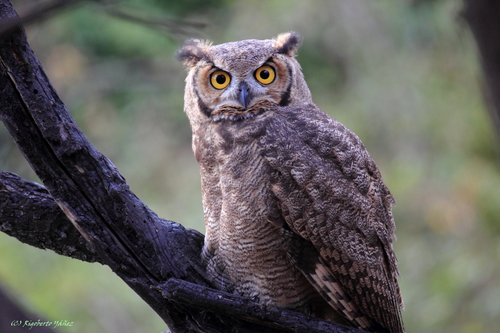
The lesser horned owl, also called the Magellanic horned owl (scientific name Bubo magellanicus), is a large owl species in the genus Bubo that lives in southern South America, with its range extending north into the central Andes. It was traditionally classified as a subspecies of the great horned owl (Bubo virginianus), but is now recognized as a separate species. This reclassification is based on differences in voice, body size, and measurable genetic distance between the two species. The species reaches roughly 45 centimeters (18 inches) in total length, and individuals from the northern part of its range grow larger on average than those from the southern part. It has broad wings, a large head, and two prominent "ear" tufts. Its plumage is predominantly grey-brown, and shows considerable variation in color across individuals. Its underparts are pale, marked with narrow grey-brown bars, and its breast has dark blotches. The facial disc is outlined with a black border, and there are white stripes above its yellow eyes. The similar great horned owl is larger, has stronger feet and a stronger bill, broader underpart bars, and longer ear tufts. The Magellanic horned owl's deep hooting call is made up of a double-note followed by a loud, vibrating note. The local common name for this bird, tucúquere, is an onomatopoeia imitating the sound of its call. The species' range stretches from central Peru and western Bolivia south through Chile and western Argentina all the way to Tierra del Fuego. It can be found in a wide variety of habitats, including open forest, scrubland, farmland, and grassland. It hunts across open country, and is primarily active at night. Most of its diet consists of rodents, but it also preys on other mammals, birds, reptiles, and insects. This owl species nests on cliffs or in gaps between rocks. The female incubates a clutch of two or three eggs, and is provided food by the male during this period.