About Bubo lacteus (Temminck, 1820)
Despite its alternative common name of giant eagle-owl, Verreaux's eagle-owl (Bubo lacteus) is not the largest owl or eagle-owl in the world. It is, however, a very large and powerful owl species. This species is both the largest owl found in Africa and the world's largest owl that occurs in the tropics. Among all living owls, it is the fourth heaviest, after Blakiston's fish owl (Ketupa blakistoni), the Eurasian eagle-owl (Bubo bubo) and the tawny fish owl (Ketupa flavipes). In addition, it is the fourth longest extant owl, measured from bill to tail tip, after the great gray owl (Strix nebulosa), Blakiston's fish owl, and Eurasian eagle-owl.
Based on body mass and wing chord length, Verreaux's eagle-owl is about the same size as medium-sized subspecies of Eurasian eagle-owl, such as Central Asian steppe B. b. turcomanus and Himalayan B. b. hemachalana. It is slightly smaller than most northern Eurasian races, considerably smaller than Siberian and Russian eagle-owls, and somewhat larger than the smallest Eurasian eagle-owl subspecies, such as those from the Iberian Peninsula (B. b. hispanus) and the Middle East (B. b. omissus or nikolskii).
Verreaux's eagle-owl ranges from 58 to 66 cm (23 to 26 in) in total length. The species has been reported to have an average wingspan of 140 cm (4 ft 7 in), though Mikkola noted that this measurement comes from a smaller male. The largest known wingspan from a wild female measured nearly 164 cm (5 ft 5 in). While female owls are almost always larger than males, Verreaux's eagle-owl is one of the most sexually dimorphic living owl species: some studies show the female can average 35% heavier than the male. In comparison, females of the nominate subspecies of Eurasian eagle-owls and great horned owls (Bubo virginianus) are reported to average approximately 20% and 25% heavier than males, respectively.
The full reported range of body mass for the species is 1,615 to 2,000 g (3.6 to 4.4 lb) for males, and 2,475–3,150 g (5.5–6.9 lb) for females. In one study, 4 males averaged 1,704 g (3.8 lb) while 6 females averaged 2,625 g (5.8 lb). Another study found 5 males averaged approximately 1,700 g (3.7 lb) while five females averaged 2,300 g (5.1 lb). Unusually large sizes have been claimed for captive specimens, with reports of individuals up to 75 cm (30 in) in length and 200 cm (6 ft 7 in) in wingspan, but these claims are unverified and possibly misreported, as these figures match the largest Eurasian eagle-owls. Captive males heavier than any wild individuals have been verified, weighing up to 2,200 g (4.9 lb).
Among standard measurements, females have a wing chord ranging from 447 to 490 mm (17.6 to 19.3 in), averaging 465 mm (18.3 in), and a tail length of 230 to 273 mm (9.1 to 10.7 in). For males, the same measurements are 420 to 490 mm (17 to 19 in), averaging 448 mm (17.6 in), for wing chord, and 220 to 275 mm (8.7 to 10.8 in) for tail length. For both sexes, tarsus length measures 73 to 86 mm (2.9 to 3.4 in), and bill length (measured in a small sample) is 51 to 54 mm (2.0 to 2.1 in). Based on wing chord size relative to body mass and other linear dimensions, the Verreaux's eagle-owl averages somewhat larger wings for its body size than most other eagle-owls, excluding the relatively long-winged Asian fish owls.
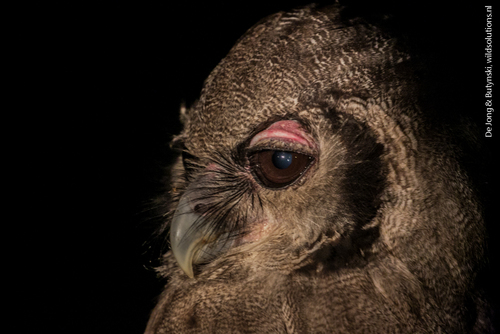
Overall, Verreaux's eagle-owl has fairly uniform, somewhat pale grey plumage, with light, fine brownish vermiculations on the underside. The back is more solidly light brown with white spots on the shoulder. The oval facial disc is paler than the rest of the bird's underparts, sometimes ranging to whitish, with thick black borders on either side. One feature that immediately distinguishes adult Verreaux's eagle-owls in good light is their pink eyelids. The ecological purpose of these colored eyelids is not known; however, Brown (1965) suggested that they replace the yellow to orange eyes of other eagle-owls during breeding and territorial displays, since they are very conspicuous in displaying males. Their eyes are dark-brown, and like all eagle-owls, they have ear-tufts. The ear-tufts are blunter and smaller relative to those of other African eagle-owls, and relatively subtle enough to be missed in the field, especially when held lax. When seen well, the species is quite easy to distinguish. It is much bigger and bulkier than most other co-occurring owls.
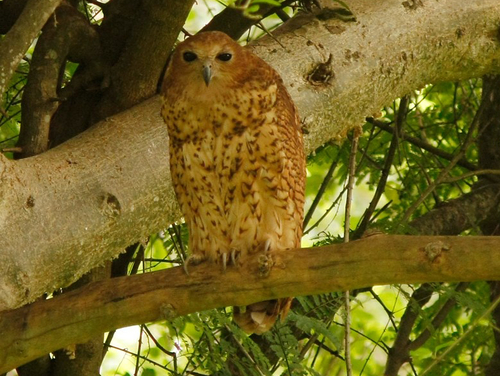
The only eagle-owl species within its range that comes close to its size is Shelley's eagle-owl (Ketupa shelleyi), which may (but this is not confirmed) co-exist with Verreaux's eagle-owl in northern Cameroon and the southern sliver of the Central African Republic, most likely in forest edge and mosaic habitats. Shelley's eagle-owl is much darker sooty overall with broad black bands on the underside, and it has very different habitat preferences, preferring deep primary forest, so it is much more rarely observed in the wild. The next largest owl in sub-Saharan Africa is the Cape eagle-owl (Bubo capensis). The home ranges, if not habitats, of Verreaux's eagle-owl and Cape eagle-owl may adjoin across nearly all of the latter's distribution. Even the largest Cape eagle-owl subspecies, Mackinder's eagle-owl (B. c. mackinderi), is around 30% lighter in average body mass than Verreaux's eagle-owl, and also differs markedly in almost all outward characteristics. Pel's fishing owl (Scotopelia peli), which occurs in west, central and inland southern Africa and may co-exist with Verreaux's eagle-owl across much of its range despite favoring wetlands and riparian zones surrounded by wooded areas, can reach similar sizes to Verreaux's eagle-owl but is dramatically different in color (a brighter rufous-cinnamon hue) and lacks ear-tufts. Taken together, the pink eyelids, dark eyes, relatively uniform plumage, and extremely large size make Verreaux's eagle-owl nearly unmistakable.
Verreaux's eagle-owl is found across most of sub-Saharan Africa, though it is absent from most deep rainforests. The species reaches its highest densities in eastern and southern Africa. Because it avoids primary forests, it occurs very patchily in west Africa. Its western distribution includes The Gambia, Senegal, Guinea and Sierra Leone. Eastward from these countries to the Central African Republic, the species occurs in a narrow transitional zone between the Sahara and rainforests. Isolated populations appear to exist in central Nigeria and central Mali. In south-western Africa, the species ranges as far north as the southern parts of the Republic of the Congo and the Democratic Republic of the Congo, through most of Namibia (excluding coastal regions) and northern South Africa. In east Africa, its distribution is more or less continuous from southern Sudan, Eritrea and inland Somalia down to South Africa, reaching as far south as the region of Durban.
This species mainly inhabits savanna with scattered trees and thorny vegetation. Verreaux's eagle-owls mostly live in fairly dry regions, some bordering semi-arid areas. For example, near the extreme northwestern limit of the species range in central Mali, the habitat that hosts these owls averages less than 55 cm (22 in) of rainfall annually. However, the species requires trees for both nesting and hunting, so it does not occur in completely open habitats or true desert. Some amount of seasonal rain to support tree growth and survival is presumably required. It also occurs in riverine forest adjacent to savanna and small, semi-open woodland surrounded by open country, though it is less likely to live in heavily wooded habitats. In South Africa, Verreaux's eagle-owls are not uncommonly found around floodplains and marshes, which may serve as the primary nesting habitat in some areas. In Uganda, they are largely associated with riparian woodlands.
Verreaux's eagle-owl may live at nearly all elevations, from sea level to near the snow-line at around 3,000 m (9,800 ft) elevation, such as in the Eastern Rift mountains. However, in general, the species only rarely inhabits rocky areas and is generally very scarce in mountainous regions. The bushveld of southern Africa is near-ideal habitat for Verreaux's eagle-owl, and the species may reach peak population numbers here. Historically, the species was rare to absent from the Kalahari Desert, but the human introduction of invasive trees such as conifers, eucalyptus and acacias, plus irrigation areas and prey species, has allowed it to become patchily established in this region.
Verreaux's eagle-owl is considered an avian apex predator, meaning it is at or near the top of the food chain and healthy adults normally have no natural predators. In many known aspects of its hunting behavior, it is typical of members of the genus Bubo. This species hunts predominantly in early evening; however, it has been observed swooping on prey during daylight. It usually flies from its daytime roost to a different perch to use as a regular hunting perch. Verreaux's eagle-owls mostly hunt by gliding down onto prey from a perch. However, it has also been reported hunting on the wing, even catching flying insects. On occasion, it hunts by flying low over a bush to catch prey by surprise, or dashes on the wing into dense foliage or through forests to catch a galago or other arboreal prey item. It will also sometimes run after prey on the ground, flapping its wings rapidly as it walks, or wade into shallow water to pin down fish. The wing size of eagle-owls in general limits their flying speed and ability in open areas, so they require perches to carry out most of their hunting behavior.
Even among Bubo owls, most of which are known to be highly opportunistic predators with generalist diets, Verreaux's eagle-owl is a particularly opportunistic predator. While earlier studies characterized the great horned owl, one of the most well-studied members of the genus Bubo, as hunting whatever random species it encounters first, more modern dietary studies have contrarily shown great horned owl prey selection is not completely random. Regionally, they select cottontails and hares as prey instead of other foods regardless of prey population trends, becoming regional specialists on such prey to the extent that leporid population declines predictably cause owl population declines. Furthermore, across the species' range, great horned owls select mammals as prey around 88% of the time. In contrast, studies indicate that only around 56% of Verreaux's eagle-owl's diet is mammals, and no single prey type predictably dominates prey selection by biomass across multiple regions. To date, more than 100 prey species have been recorded for this eagle-owl, and since only about half a dozen comprehensive dietary studies have been conducted, this total probably represents only a small portion of the full range of prey it selects. Estimated prey size for the species ranges from insects weighing less than 5 g (0.18 oz) to ungulates weighing at least 10 kg (22 lb). This is the second broadest size range positively recorded for prey of a single owl species, after only the Eurasian eagle-owl, and the largest exceptional upper prey size is also second to the Eurasian species.