About Bubo blakistoni Seebohm, 1884
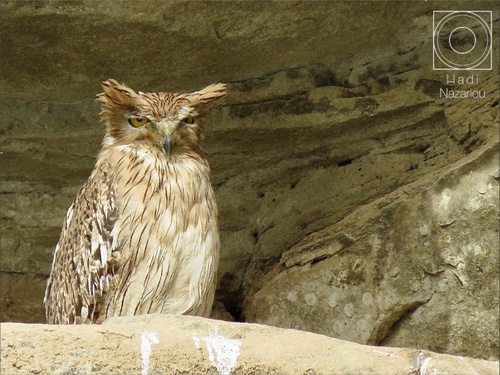
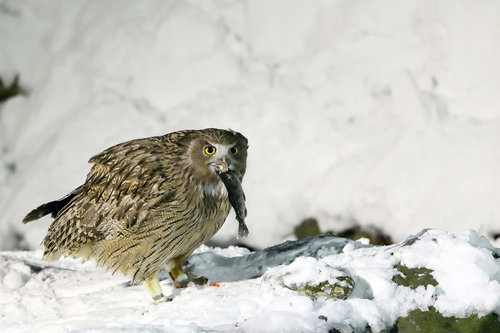
Blakiston's fish owl (Bubo blakistoni Seebohm, 1884) is recognized as the largest living owl species. One pair field study of this species recorded male weights ranging from 2.95 to 3.6 kg (6.5 to 7.9 lb), while females weigh 2.95 to 4.6 kg (6.5 to 10.1 lb) and are approximately 25% larger than males. Around February, which is when this species' body mass reaches its annual lowest point, the average weight of Russian Blakiston's fish owls was 3.1 kg (6.8 lb) for seven males and 3.25 kg (7.2 lb) for five females. Total body length ranges from 60 to 72 cm (24 to 28 in), which is slightly shorter in average and maximum length than the great grey owl (Strix nebulosa), a species with significantly lower body mass. The Eurasian eagle-owl (B. bubo) is sometimes considered the largest overall living owl species; the three largest eagle-owl species, all found in Siberia and the Russian Far East, are close in size to Blakiston's fish owl. According to Heimo Mikkola, the longest recorded Eurasian eagle-owl specimen is 30 mm (1.2 in) longer from bill to tail than the longest Blakiston's fish owl, while the maximum recorded weight of the two species is identical. The longest great grey owl is 120 mm (4.7 in) longer than the largest Blakiston's fish owl, but is roughly 2.5 times lighter than the heaviest female Blakiston's fish owl. However, Blakiston's fish owl surpasses the Eurasian eagle-owl in average measurements for at least two major size categories: weight and wingspan. This makes Blakiston's fish owl the overall largest living owl species. Even the large Siberian subspecies of Eurasian eagle-owl are slightly smaller on average than Blakiston's fish owl, at least in body mass and wing size. For example, the largest recorded mean weights from a Eurasian eagle-owl population are 2.42 kg (5.3 lb) for males and 3.164 kg (6.98 lb) for females. The maximum wingspan of Blakiston's fish owl is also greater than that of any recorded eagle-owl. The known wingspan range for Blakiston's fish owl is 178 to 190 cm (5 ft 10 in to 6 ft 3 in), and the largest individuals may reach a wingspan of approximately 200 cm (6 ft 7 in). Blakiston's fish owl is noticeably larger than the other three living fish owl species. Structurally, Blakiston's fish owl is more similar to eagle-owls than to other fish owls, but it shares a small set of characteristics with both groups. Like all fish owls, it has a relatively long bill, a relatively husky body, and relatively long wings compared to eagle-owls. It also shares a comparatively long tarsi with other fish owls, though the three smaller fish owl species have a proportionally longer tarsus relative to their body size. Aside from these few traits, the skull and skeleton of Blakiston's fish owl is nearly identical to that of the Eurasian eagle-owl. Its talons are similar in shape and size to those of the Eurasian eagle-owl. It has been noted that the combination of wavy cross patterns on the underside of Blakiston's plumage and its huge talons make it look strikingly similar to an oversized great horned owl (B. virginianus) when viewed from below. Two external traits that Blakiston's fish owl shares with eagle-owls, but not with other fish owls, are fully feathered tarsi and silent wing beats, though Blakiston's fish owl appears to have fewer sound-blocking combs on its wing primaries than a similarly sized eagle-owl. Among standard body measurements, which are larger on average and at maximum than any other living owl except tail length, the wing chord measures 447–560 mm (17.6–22.0 in), the tail measures 243–305 mm (9.6–12.0 in), the tarsus measures 73–102 mm (2.9–4.0 in), and the culmen measures around 55 to 71 mm (2.2 to 2.8 in). Superficially, this owl somewhat resembles the Eurasian eagle-owl, but its plumage is more uniformly brown to tan. Like other fish owls, and unlike most eagle-owls, Blakiston's fish owl has relatively broad, ragged ear tufts that hang slightly to the side and do not stand upright. Its upperparts are buff-brown and heavily streaked with darker brown. Its underparts are paler buff brown and less heavily streaked. The throat is white, and the iris is yellow (the Eurasian eagle-owl typically has an orange iris). Blakiston's fish owl and the Eurasian eagle-owl both occur in the Russian Far East and could potentially compete for resources, but no scientifically observed interactions between these two large owl species have been reported. It is likely that food competition is not normally a serious issue, because the two species have very different dietary preferences: Blakiston's fish owl eats mainly aquatic animals, while the Eurasian eagle-owl eats mainly upland, terrestrial species. Confusion between Blakiston's fish owl and other fish owl species is not an issue, as there is an approximately 800 km (500 mi) distribution gap between Blakiston's fish owl and the tawny fish owl (B. flavipes), and an approximately 2,000 km (1,200 mi) gap between the ranges of Blakiston's fish owl and the brown fish owl (Ketupa zeylonensis). Early naturalists incorrectly grouped Blakiston's fish owl and brown fish owls as a single species. Underbody streaking is similar between brown fish owls and Blakiston's fish owls, and their songs are more similar to each other than to the songs of the other two fish owl species. Blakiston's fish owl has a deeper voice and a different vocal pattern than the smaller fish owl species. Vocalizations differ between recognized subspecies. In the nominate subspecies from Japan, the male calls twice and the female responds with a single note. The mainland subspecies has a more elaborate four-note duet, transcribed as HOO-hoo, HOBO-hoooo, where capital letters indicate the male's call and lowercase letters indicate the female's call. Transliterations of calls from Russian populations, which represent the species' vocal variation, include SHOO-boo and FOO-foo-foo. The territorial call from Russian populations has been described as similar to a short, deep Eurasian eagle-owl call. Despite its slightly larger size, the call of Blakiston's fish owl is less resonant and does not carry as far as the Eurasian eagle-owl's call, though the Blakiston's fish owl's voice is deeper than the Eurasian eagle-owl's. Like most owls, Blakiston's fish owl has peak vocal activity directly before nesting begins, which is around February for this species. The pre-breeding duet of mated pairs is so synchronized that people unfamiliar with the call often mistake the duet for a single calling bird. A single individual may call with a hoo-hooo sound. Juveniles have a characteristic shriek, typically a startling, slurred phee-phee-phee. Blakiston's fish owl lives in dense, minimally disturbed or undisturbed old-growth forest near waterways, including floodplains and wooded coastlines. The species needs large, cavernous old-growth tree cavities for suitable nesting sites, and it is one of the largest birds anywhere to use tree hollows for nesting. Though it occurs near the taiga zone, its nest trees are generally deciduous, and the species lives in mixed forests. Blakiston's fish owls require stretches of productive rivers that stay at least partially unfrozen through winter. In cold northern winters, open water only exists where the current is fast enough, or where warm spring water upwells. Both slower-moving streams and main river channels can support these owls; they only need a few meters of open water to survive a winter.