About Bubo bengalensis (Franklin, 1831)
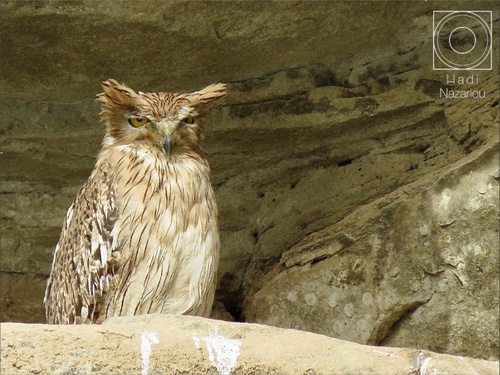
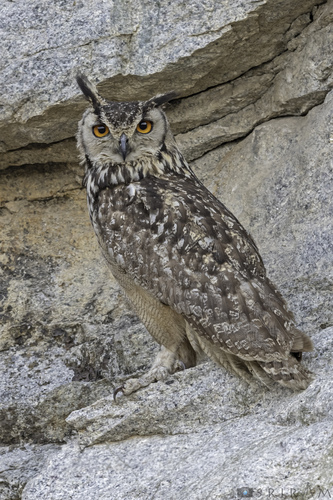
This species, Bubo bengalensis, is often treated as a subspecies of the Eurasian eagle-owl Bubo bubo, and is very similar in overall appearance. It can be distinguished by an unmarked facial disc with a clear black border, a feature that is much less prominent in the Eurasian eagle-owl. The base of its primaries is rufous and unbanded. On its tail, the tawny bands are wider than the black bands. A large pale scapular patch is visible on the folded wing. Its inner claws are the longest, and the last joint of its toes is unfeathered. The taxonomy of this species group is complex due to extensive morphological variation. Dementiev was the first researcher to suggest that B. bengalensis might be a distinct species within the Bubo bubo species group. Later, Charles Vaurie noted that both B. bengalensis and B. ascalaphus appeared to be distinct species, rather than part of a single clinal variation. The species shows considerable colour variation: the upperbody ground colour is dark brown in some individuals, and pale yellowish in others. On dark-coloured individuals, streaks merge on the hind crown and nape, while streaks are narrow in pale-coloured individuals. Despite this variation, Vaurie confirmed that B. bengalensis is distinct from neighbouring subspecies of B. bubo (B. b. tibetanus, B. b. hemachalana, and B. b. nikolskii), being smaller and more richly coloured. Stuart Baker observed two plumage variants found across the species' range: one variant has white spots on the back and scapulars, while the other has fewer white spots on the back feathers, with prominent dark streaking on the back, neck, and scapulars. Newly hatched chicks are covered in white fluff, which is gradually replaced by speckled feathers during the pre-juvenile moult that begins around two weeks after hatching. After about one month, chicks undergo a basic moult and develop a brownish juvenile plumage; the upperparts of this plumage are somewhat similar to adult plumage, but the underside remains downy. Full adult plumage is developed much later. This species occurs in scrub and light to medium forests, and is especially associated with rocky habitats across the mainland of the Indian Subcontinent south of the Himalayas, at elevations below 1,500 m (4,900 ft). It avoids humid evergreen forest and extremely arid areas. Favourite habitats include bush-covered rocky hillocks, ravines, and steep banks of rivers and streams. During the day, it shelters under bushes or rocky projections, or in large, thickly foliaged trees such as mango trees near villages. Its characteristic call is a deep, resonant two-note call; males give these 'long calls' mainly at dusk during the breeding season, with peak calling activity occurring in February. Young birds produce clicking and hissing sounds, and spread their wings to appear larger than they actually are. Nesting adults fly in zig-zag patterns and mob any potential predators, including humans, that approach their nest. For most of the year, its diet is dominated by rodents, but it mainly preys on birds during winter. Recorded avian prey includes francolins, doves, Indian rollers, shikras, black kites, house crows, and spotted owlets; birds as large as peafowl are sometimes attacked. A study in Pondicherry recorded the rodent prey Tatera indica, Golunda ellioti, Rattus sp., Mus booduga, and Bandicota bengalensis. Flying foxes are also hunted as prey. In Pakistan, Nesokia indica is an important prey item. The species can take mammals as large as the Indian hare (Lepus nigricollis), and in Pakistan it has been recorded preying on Lepus capensis and Eupetaurus cinereus. When feeding on rodents, it tears prey apart instead of swallowing it whole. Captive individuals eat approximately 61 g of prey per day. The nesting season runs from November to April. Clutches contain three or four creamy white, broad, rounded oval eggs with a smooth texture. Eggs are laid on bare soil, in a natural recess in an earthen bank, on a cliff ledge, or under the shelter of a bush on level ground. Nest sites are reused each year. Eggs hatch after approximately 33 days of incubation, and chicks remain dependent on their parents for nearly six months.