About Bubo ascalaphus Savigny, 1809
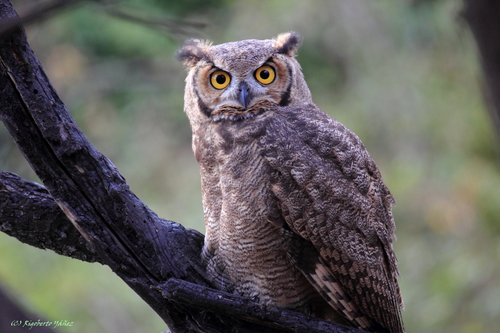
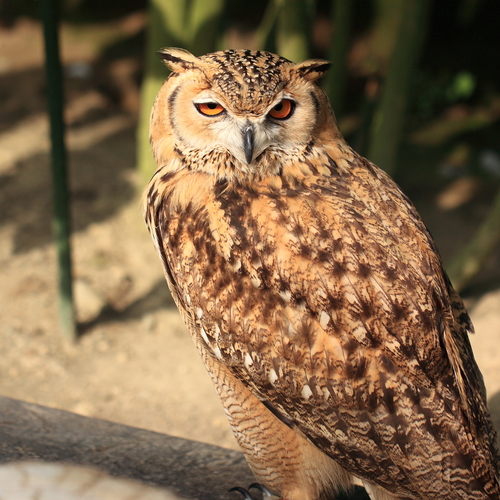
The Pharaoh eagle-owl (scientific name Bubo ascalaphus Savigny, 1809) has mottled plumage and large orange-yellow eyes. Its head and upperparts are tawny, densely marked with black and creamy-white streaks and blotches, while its underparts are pale creamy-white, with black streaks on the upper breast and fine reddish-brown vermiculations on the lower breast and belly. Like most owls, it has a characteristic disc-shaped face outlined by a dark rim. It has a robust, black hooked bill, and small ear tufts crown its head. With a body length of 46–50 cm (18–20 in), it is one of the smaller eagle-owl species. Two subspecies, B. a. ascalaphus and B. a. desertorum, were previously named; B. a. desertorum was formerly described as smaller, paler, and sandier in colour. These are no longer accepted as distinct subspecies, because observed variation is continuous and has no geographic basis, so the species is currently considered monotypic. The Pharaoh eagle-owl is native to most of arid Northern Africa, including the most desolate parts of the central Saharan Desert, where it occurs in Algeria, Chad, Egypt, Eritrea, Libya, Mali, Mauritania, Morocco, Niger, Sudan, Tunisia, and Western Sahara; vagrants have been recorded in Senegal. Its range extends east into the Arabian Peninsula and the Middle East, where it is found in Iran, Iraq, Israel, Jordan, Kuwait, Oman, Palestine, Qatar, Saudi Arabia, Syria, and the United Arab Emirates. It prefers open, barren plains or desert with scattered palms or other native plants, and nests in rocky outcrops, wadis, and cliffs. The Pharaoh eagle-owl is nocturnal, and emerges at dusk to hunt across a range of approximately 5 km2 (1.9 sq mi). It perches on high ground and watches and listens for moving prey before swooping down to catch its victim. It feeds on any small creatures it can find, but favours rodents, especially gerbils. It also hunts other mammals including bats, desert foxes, and hares, as well as small birds, snakes, lizards, beetles, and scorpions. It occasionally preys on other birds of prey such as barn owls, little owls, and common kestrels. This owl is monogamous and forms lifelong pairs. Breeding occurs in late winter; its nest is a simple scrape in a rock crevice or among rocks. The female lays two eggs and incubates them for around 31 days. Both parents feed the chicks. Chicks leave the nest when they are 20 to 35 days old, but stay dependent on their parents for several more months.