About Bubo africanus (Temminck, 1821)
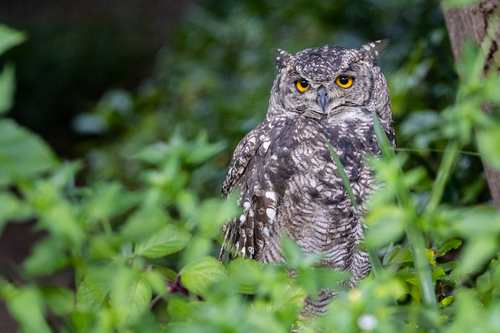
The spotted eagle-owl, with the scientific name Bubo africanus, is also called the African spotted eagle-owl and the African eagle-owl. It is a medium-sized owl species, and one of the smallest among eagle owls. This owl measures 45 cm (18 in) in length, weighs between 454 and 907 grams (1.0 to 2.0 lb), and has a wingspan ranging from 100 to 140 cm (39 to 55 in). Its facial disk ranges from off-white to pale ochre, and it has yellow eyes. It has prominent ear-tufts; its upper body is dusky brown, and its underparts are off-white with brown bars. Before 1999, the spotted eagle-owl was considered to be the same species as the greyish eagle-owl, but it is now classified as a separate species. Spotted eagle-owls are the most common owl species found in Southern Africa, and they maintain a healthy population across most parts of the region. They are often called urban owls, as they live in close proximity to human settlements. Their range covers all of Sub-Saharan Africa and the Arabian Peninsula. They can also be found in thorn savanna and in suburban gardens, for example on the outskirts of Harare, Zimbabwe. Spotted eagle-owls are monogamous, but will quickly take a new mate if their original partner dies. They reach breeding age at around one year old. They usually build their nests on the ground, but have also been recorded nesting on man-made structures such as building window ledges and in purpose-built Owl Houses, and they prefer large cavities. Breeding typically starts in late July and continues through the first weeks of February. The female lays two to four eggs and handles all incubation, only leaving the nest to eat food brought by the male. Incubation lasts approximately 32 days. Owlets that hatch from nests located off the ground will jump out at around five weeks old, then spend around ten days on the ground before they are able to fly. During this period, owlets learn key skills through mock-hunting and catching small prey such as insects. The parents continue to support feeding the young owls at this stage, bringing larger prey like rodents for the owlets to eat. When hungry, owlets make a rasping call that can be heard by their parents over long distances to signal their location. Unknowing people often mistakenly remove owlets from their parents during this ground phase, assuming the owlet is injured or abandoned because it cannot fly yet. Young owls gain the ability to fly at around seven weeks old, but remain with their parents for several more weeks after fledging. They can live up to 10 years in the wild, and up to 20 years in captivity.