About Bryophila raptricula (Denis & Schiffermüller), 1775
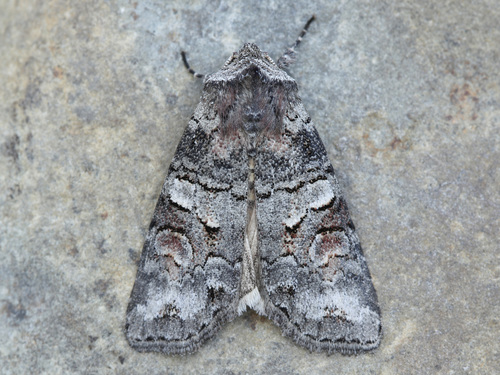
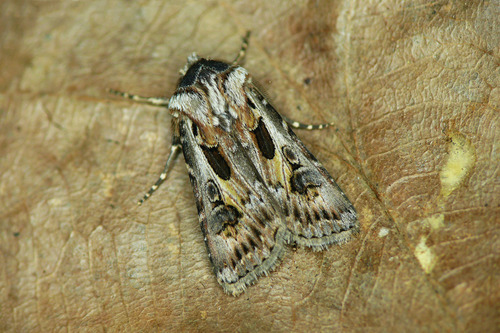
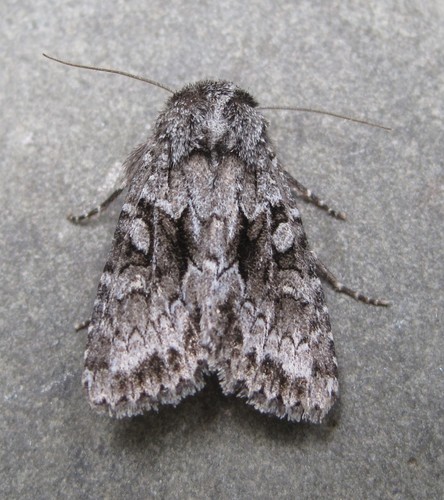
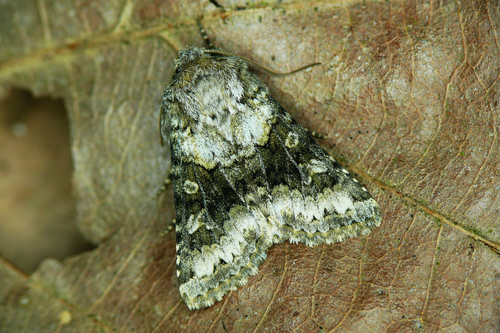
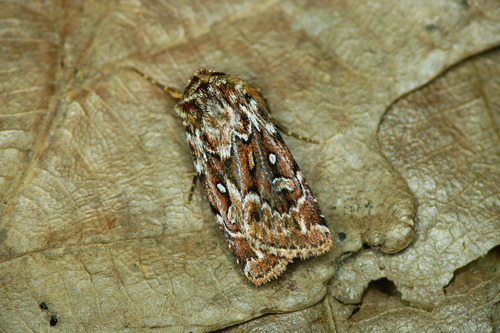
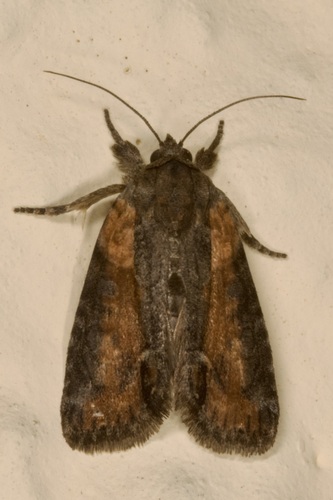
This moth species, scientifically known as Bryophila raptricula (Denis & Schiffermüller), 1775, has the following technical description and variation. The typical form (previously referenced as M. raptricula Hbn. = pomula Bkh.) has elongated forewings that are grey with darker cloud-like markings. The forewing lines are obscure: the inner line is outwardly oblique and doubly curved. The outer line is followed by a white crescent on the submedian fold, beyond which lies a black streak deflected through the fringe. The stigmata are inconspicuous, with dark edges. The hindwings are dull whitish, becoming greyer toward the margin. The aberration ab. carbonis Frr. is black, as its name suggests. The aberration ab. deceptricula Hbn. has a pale brown horizontal streak running from the base of the costa through the cell to the outer line and beyond; this streak is sometimes broken into patches, and the inner margin is darker. The form oxybiensis Mill. is more uniformly grey than the typical type form, while the aberration ab. striata Stgr. is distinguished by a black central streak. Finally, the aberration ab. eretina Calb. strongly resembles ab. deceptricula, and is reported to have yellow, porrect (extending forward) palpi; this characteristic suggests it may be a distinct species. Milliere, who considered his oxybiensis a distinct species, suspected that its larvae feed on lichens growing on old olive trees. The larvae of Bryophila raptricula are blue grey, with two stripes spotted with yellow and white. They feed on Sticta pulmonacea. The wingspan of the adult moth is 29–36 mm, and the length of the forewings is 12–14 mm.