About Bryophila domestica (Hufnagel, 1766)
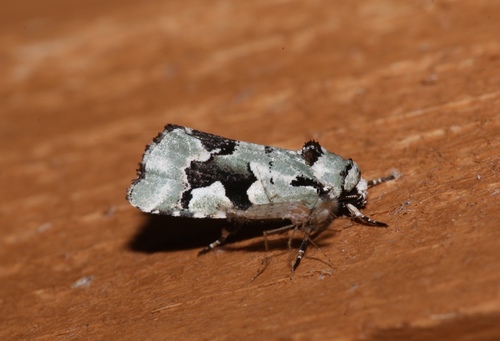
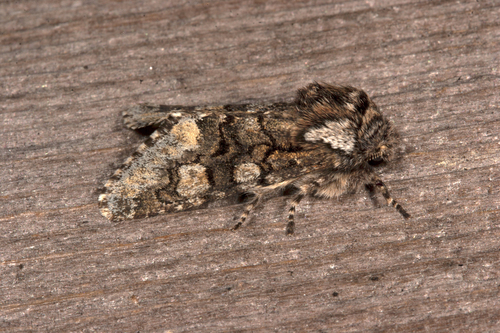
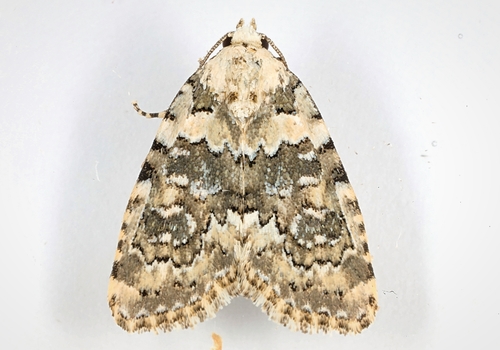
Technical description: The forewing of Bryophila domestica is cream white with slaty-grey markings. The orbicular and club-shaped claviform stigmata connect to form a figure-eight shape. The hindwing is whitish grey with a dark grey cell spot and dark grey outer line. This species shows two opposite directions of variation. In the form ab. lutescens Fuchs, the dark scales on the forewing are more or less reduced, and the entire wing becomes covered in yellow scaling. In the form ab. suffusa Tutt, the whole wing becomes fully suffused with dark tints. Dark specimens from the Pyrenees, which Staudinger referred to this form, are blacker than the darkest British specimens, and their entire hindwing is also blackish. In ab. distincta Tutt, the ground colour of the wing is white, and the discoidal spots are dark grey. The only markings present are four short dark dashes on the central costa, a shade near the apex, a short basal streak, and a shade beneath the orbicular stigma. The larva is bluish grey with orange markings running along its back. It feeds exclusively on lichens, including Lecidea and Xanthoria. This species overwinters in the larval stage. Distribution: Bryophila domestica is found across Europe, occurring as far south as Sicily and as far north as Gotland. Its eastern distribution is uncertain, but it may reach as far east as central Asia. In the Alps, it can be found at elevations over 2000 metres above sea level.