About Brugmansia arborea (L.) Steud.
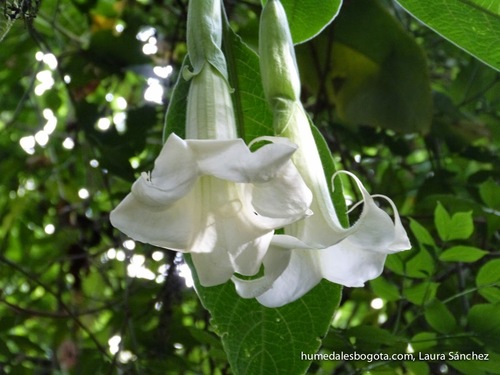
Brugmansia arborea (L.) Steud. is an evergreen shrub or small tree that grows up to 7 metres (23 ft) tall. Its ovate leaves have coarsely toothed margins when fully developed. Fine, velvety white down covers the leaves, flower stalks, fruit, and especially the young shoots of the plant. Its flowers are strongly fragrant, trumpet-shaped, and grow in a nodding to sub-horizontal orientation, with colors ranging from white to ivory-white or cream. At 12–17 centimetres (4.7–6.7 in) long, these flowers are the shortest of all species in the Brugmansia genus. Unlike many other Brugmansia, which produce flowers in large flushes, B. arborea produces flowers almost continuously in smaller numbers. Its ovoid fruit has an average length of 6 centimetres (2.4 in) and width of 4.5 centimetres (1.8 in). The calyx is slit along one side and is very long relative to the rest of the flower; this characteristic is often used as a quick check for correct identification. With a few exceptions, the green calyx usually extends almost all the way down to the mouth of the flower corolla. Brugmansia arborea is native to the Andes mountains of southern Colombia, Ecuador, Peru, western Bolivia, and northern Chile. It is the hardiest of all Brugmansia species when it comes to tolerance to both cold and drought, and it is often found in the drier valleys of the Andes, in areas with an annual rainfall of 400–1,400 millimetres (16–55 in). It occurs at elevations between 2000 and 3000 m, where it often experiences light frosts. Brugmansia arborea is usually pollinated by moths, which are attracted to the white color of its flowers and its fragrance, which becomes stronger in the evenings. This species is invasive in New Caledonia.