About Bruchus pisorum Linnaeus, 1758
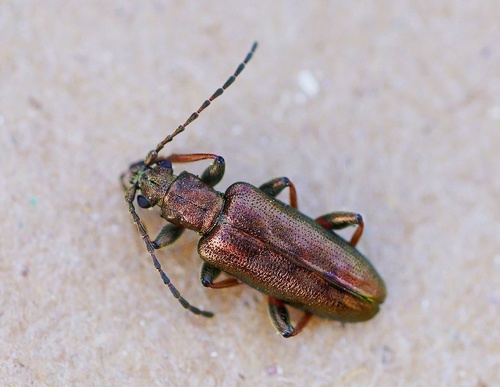
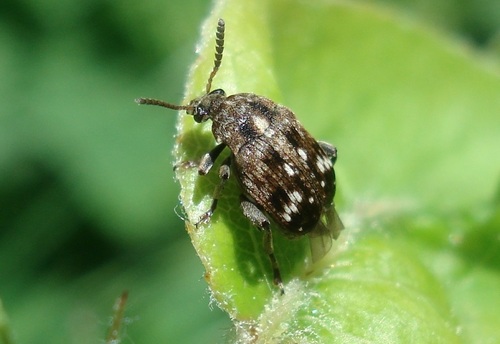
Description: Bruchus pisorum is a short, stout beetle with an oval body approximately 5 millimeters in length. Its color ranges from pale grey to black, with patches of white scales that form white spots on its elytra. The elytra are shorter than the abdomen, exposing large white patches at the abdomen's base. Its head is short and strongly constricted behind the eyes. Antennae extend to less than one-third of the total body length. The pea weevil also has a distinct denticle on the lateral margin of the pronotum. Distribution: The natural range of Bruchus pisorum is Asia Minor, where its host species occurs. Because it can survive in dry pea seeds for extended periods, this species has been transported to other regions via human activity rather than natural migration, and is now considered cosmopolitan. In 1748, during a collecting trip for Linnaeus, Peter Kalm found pea weevils in the United States, where infestation levels were so high that peas could no longer be grown successfully as a crop in several states, as reported by Harris in 1841. The species has since spread and become a pest in all pea-growing areas of the US. Skaife reported the establishment of the pea weevil in South Africa in 1918. This species is a serious pest of peas in most of Southern Russia, per Vasilev 1939. A survey by Borowiec 1987b recorded the pea weevil in southeastern Europe and the Middle East, including Bulgaria, Yugoslavia, Albania, Greece, Turkey, Syria, Lebanon, Israel, Iran and Afghanistan. Its presence has also been reported in Japan (Yoshida 1959) and part of China (Anon 1966). It occurs in South America, and has been identified as the principal pest of peas in Chile (Olalquiga 1953). By the early 1930s, the pea weevil was established in several areas of South Western Australia (Newman 1932). Life cycle: The pea weevil is a univoltine species. In South Australia, adult weevils leave their overwintering sites and enter pea crops in early spring. They may arrive as early as mid-August, but in most years they arrive in early September (Baker 1990a). Estimated fecundity per female ranges from 3 eggs to 735 eggs. Bright yellow-orange eggs are laid singly on the surface of pea pods, and eggs typically hatch within three to five weeks, depending on temperature (Skaife 1918). Young larvae chew directly through the pod wall from the underside of the egg. Once inside the pod, they seek out soft, developing pea seeds. The pea weevil has four distinct larval instars (Brindley 1933). Larval development takes seven to 11 weeks, and pupation takes two to three weeks. Adults either emerge over summer from seeds of unharvested crops and fly to overwintering sites, or remain in harvested seed until the following spring or until they are disturbed.