About Broscus cephalotes (Linnaeus, 1758)
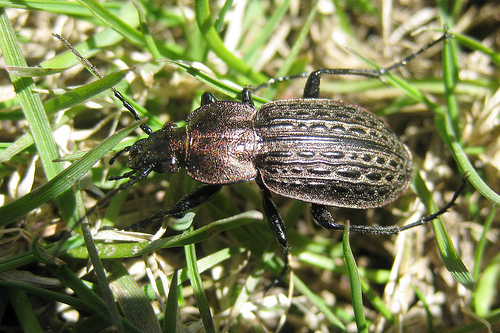
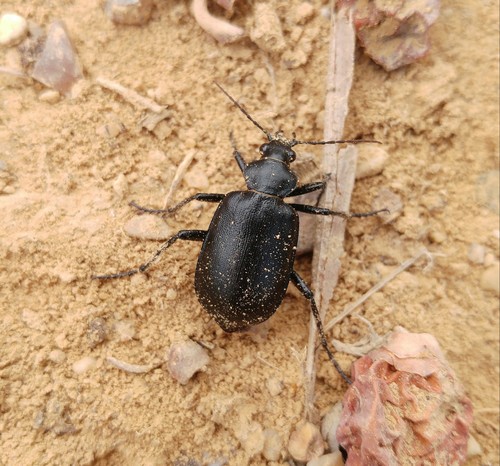
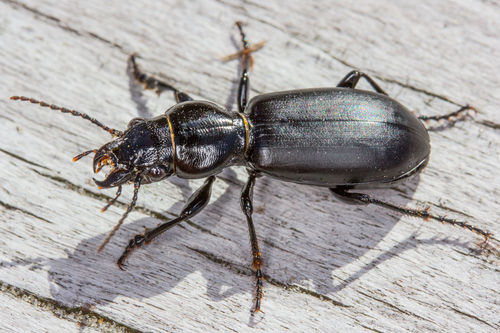
Broscus cephalotes is a dull black flightless beetle with no metallic hue, reaching a body length of 16 to 23 mm. Its overall morphology matches that of other beetles in its family, and it is flatter than many other Carabidae species, a trait that helps it hide in tight spaces such as crevices under stones or bark. While body shape and flight ability can give clues about a beetle’s diet, they do not provide conclusive evidence. Mouthparts are a better indicator of diet, but the most reliable method to determine what a beetle eats is gut dissection. B. cephalotes has asymmetric mandibles that are blunt, twice as long as they are wide, and curve to a rounded point at the tip. The left mandible is slightly longer and wider than the right mandible. These mandibles act as multi-purpose tools: the beetle uses them to dig and maintain the tunnels where it spends most of its life. Opened mandibles work like shovels to move dirt and debris from tunnel walls out of the burrow, and they also function as shovels in the loose sand of this species’ coastal habitat. Another key use of the mandibles is for feeding. B. cephalotes is distributed across temperate western and central Europe, with its range extending into western Siberia. Most specimens are found in coastal regions, though it occurs more rarely inland. On the coast, it inhabits vegetated dunes and prefers areas with sparser vegetation. The first recorded appearance of B. cephalotes in North America was in Nova Scotia in 1978, when the species was already well established in the area but still a relatively new arrival. In North America, the species remains restricted to the eastern seaboard and is less common than it is in Europe. B. cephalotes is mostly nocturnal, though individuals have been observed moving between hiding places during the day. During the day it hides in burrows under logs and stones in loose, dry sand. Individuals have sometimes been found resting in groups, but there is no evidence this is typical behavior, rather than just a result of convenient habitat. Its nocturnal lifestyle may help with prey capture: active at night, B. cephalotes can more easily catch diurnal prey, and being active at night also means fewer predators are active when the beetle is active. Most adults do not survive through the winter. Larvae develop during the winter months and emerge as adults in spring and summer. Fighting has been observed in this species under artificial daylight, but the purpose of this fighting is unknown; it may be over resources such as food, burrows, or mates. B. cephalotes breeds in early autumn, when temperatures are still warm and air is still dry. Females deposit eggs deep into sandy soil during late summer and early autumn, after finding and preparing the oviposition site themselves. No parental care occurs after eggs are laid. Eggs hatch, and larvae develop in tunnels through winter and early spring. Larvae spend all their time below the soil surface, so they are not well studied. Adult beetles emerge from burrows in late spring and early summer, with almost all individuals emerged by early July. The reproductive period generally runs from the end of July to mid-September, with the first larvae developing by the end of August. This timing means some individuals follow a one-year development schedule, while others follow a two-year schedule. Most B. cephalotes die after their first year of life and only reproduce once, though some individuals have been kept alive for much longer in laboratory settings. In many other beetles of this family, higher temperatures are linked to longer reproductive periods and more eggs laid, while lower temperatures correspond to shorter reproductive periods and fewer eggs produced even when food is abundant. However, results from laboratory studies may not accurately reflect conditions for wild populations, and there have been no comprehensive field studies on how temperature affects reproductive success for any carabid beetle species.