About Bromus secalinus L.
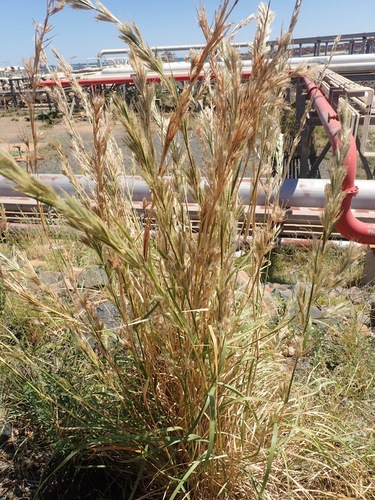
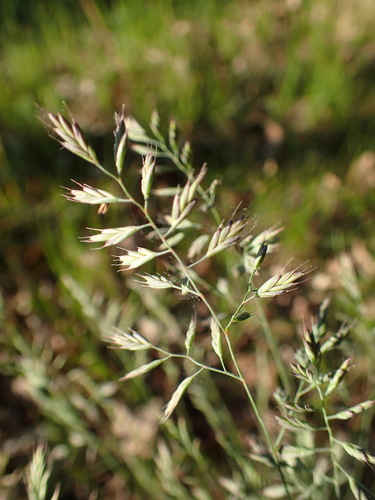
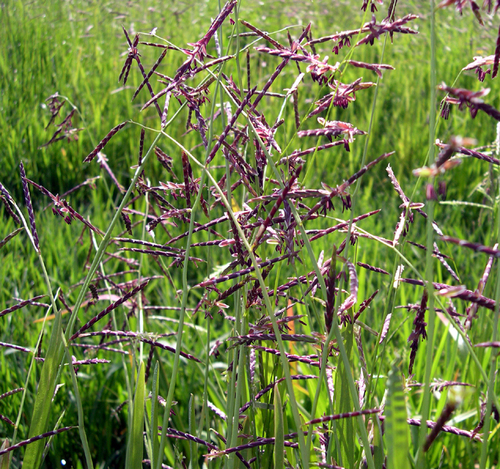
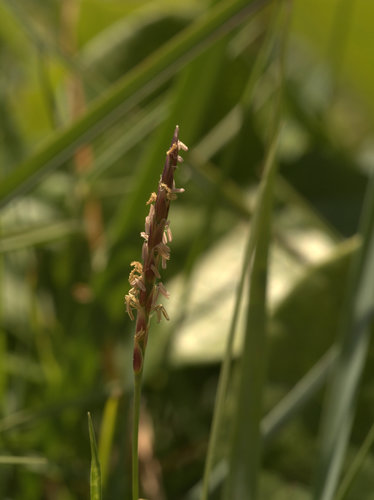
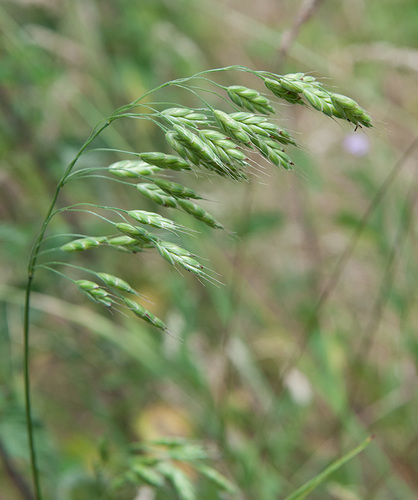
Bromus secalinus L. is an annual grass that reaches a height of 0.1–1.3 m (4 inches – 4 feet 3 inches). Its upper leaf sheaths are smooth and strongly nerved, while the lower sheaths are hairless or slightly covered in fine short hairs. Leaf blades measure 15–30 cm (6–12 inches) long and 2–4 mm (0.1–0.2 inches) wide, and are covered with short hairs. Panicles are 3–20 cm (1–8 inches) long and 2.5–12 cm (1–5 inches) wide, with spreading or ascending branches. When the inflorescence becomes heavy with developing grain, its spreading structure nods; before maturity, the panicle stays erect. Spikelets grow on elongated stalks called pedicels, and each spikelet holds five to fifteen individual flowers. Spikelets are hairless or rough to the touch, and become loose when fully mature. They are ovoid in shape, and measure 10–20 mm (0.4–0.8 inches) long. When young, the rachilla (central axis of the spikelet) is clearly visible, but it becomes hidden as the florets expand with age. The lower glumes have three to five veins and are 4–6 mm long, while the upper glumes have seven veins and are 6–7 mm long. Lemmas spread apart when mature and roll inward strongly. They have seven inconspicuous veins, and measure 5–8 mm long and 1.7–2.5 mm wide. Awns are either straight or curved, and measure 1–6 mm long. The palea is equal to or longer than the lemma, and its tip slightly sticks out once the plant reaches maturity. Anthers measure 1.5–1.8 mm long. Mature caryopses (seeds) are thick and roll inward strongly. This grass flowers from June to September. When young, Bromus secalinus is very similar to the related brome grass Bromus arvensis, but the two species are easy to tell apart when mature. Bromus arvensis has fully hairy leaves, while Bromus secalinus does not have hair-like trichomes on the undersides of its leaves. Bromus secalinus grows in open fields, road verges, and occasionally cornfields, growing best in lightly stony soils. It is native to Europe, but is now widespread across the United States, and also occurs in the Canadian provinces of Quebec and British Columbia. While the grass is not considered very palatable, its grains are edible and starchy. Evidence suggests these grains were used as a food source in Europe from the late Neolithic period through the Iron Age.