About Bromus rigidus Roth
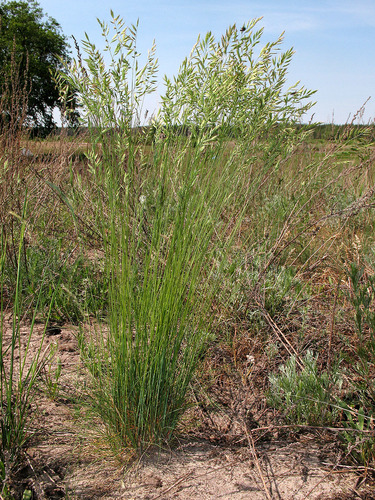
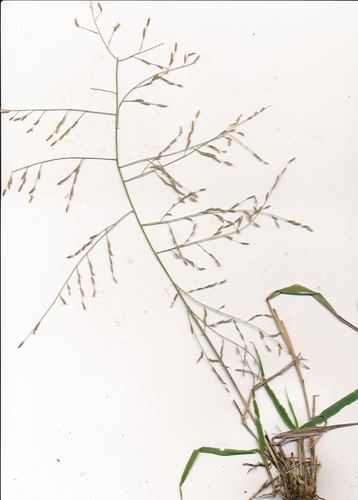
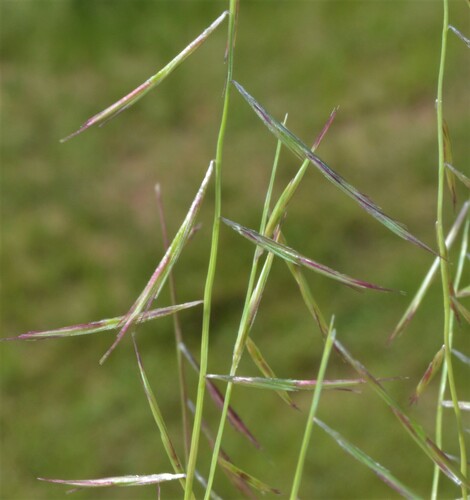
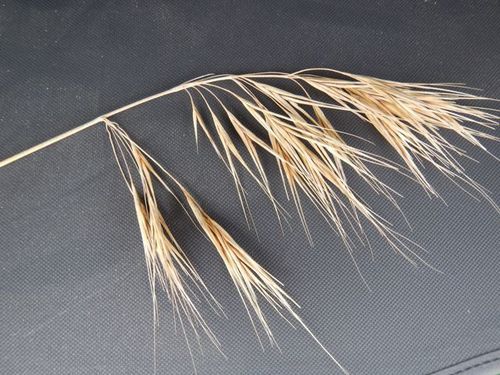
Bromus rigidus Roth is an annual grass that reaches heights of 0.3 to 1 meter (1 foot 0 inch to 3 feet 3 inches). Its culms, leaves, and panicle branches are all pubescent or harsh in texture. The panicle grows either erect or ascending, with short branches that end in spikelets holding four to nine flowers each. The reddish spikelets measure 6 to 10 cm (2.4 to 3.9 in) long, including the awns which are 3 to 4 cm (1.2 to 1.6 in) long. The first glume of Bromus rigidus has one nerve, while the second has three. Its lance-attenuate lemmas are unequal: the lower lemma has a long tooth on each side of the awn, and the upper tapers to a beak. The scabrous lemmas are strongly ciliate, and the anthers are roughly 1 mm (0.039 in) long. The common name "ripgut brome" comes from this species' heavy sclerotization, which makes it a hazard to livestock. The plant's seeds can penetrate livestock skin, and the callus and awns can penetrate livestock mouths, eyes, and intestines. Bromus rigidus can be distinguished from its close relative Bromus diandrus by its shorter laminar hairs and more compact panicle with shorter spikelet branches. Further differences from B. diandrus include Bromus rigidus' elliptical abscission scars on rachillae and elongated lemma calluses, while B. diandrus has shorter, circular scars and calluses. Unlike B. rigidus, B. diandrus is susceptible to rust such as Puccinia bromoides, while Bromus rigidus is not affected by this pathogen. Bromus rigidus is common in waste places and rare near ports in the United States, where it occurs in areas including Maryland, the District of Columbia, and extends north to Massachusetts. In Europe, it is found in the south and west, growing in weedy or disturbed areas, road verges, and ports.