About Bromus madritensis L.
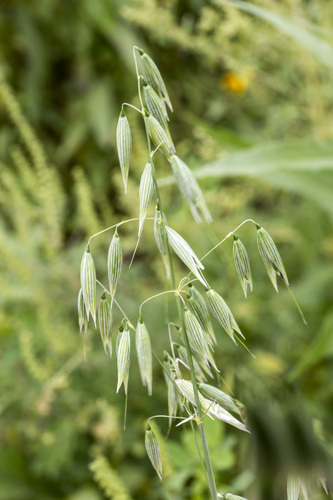
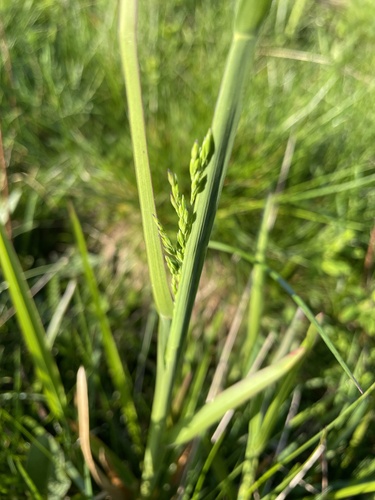
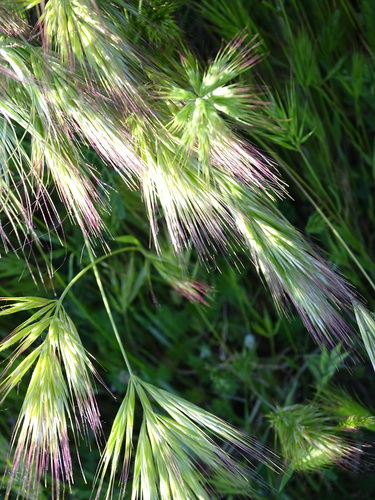
Bromus madritensis L. is a winter annual grass that grows either solitarily or in tufts. Its culms are erect or ascending, reaching heights of 20–70 cm (7.9–27.6 in). Leaf sheaths are downy or slightly hairy; this grass lacks auricles, and its glabrous ligules are 1.5–2 mm (0.059–0.079 in) long. Its flat leaf blades are either glabrous or slightly hairy, measuring 4–20 cm (1.6–7.9 in) long and 1–5 mm (0.039–0.197 in) wide. It produces erect, ellipsoid panicles that are 3–12 cm (1.2–4.7 in) long and 2–6 cm (0.79–2.36 in) wide. The panicles have short, ascending, slightly spreading branches that never droop, and each branch bears one or two spikelets. The spikelets are 4–6 cm (1.6–2.4 in) long, which is longer than the panicle branches, and each holds seven to eleven florets. Spikelets range in color from green to distinctly purplish-red. The lightly hairy glumes taper at their ends and have translucent margins: lower glumes are one-nerved and 5–10 mm (0.20–0.39 in) long, while upper glumes are three-nerved and 10–15 mm (0.39–0.59 in) long. Lemmas are glabrous, slightly rough, 1.5–2 cm (0.59–0.79 in) long, hairier toward their edges, and marked with five to seven veins. The awns are 1.2–2.3 cm (0.47–0.91 in) long, roughly the same length as the lemmas, and curve slightly. Anthers are 0.5–1 mm (0.020–0.039 in) long, and caryopses can grow as long as 11 mm (0.43 in). This grass emerges in early winter and stays dormant until spring, when heavy rainfall and warmer temperatures stimulate growth. Plants typically flower from this growth period until May, when water stress stops their growth. Populations increase during periods of heavy rainfall and can be eliminated during extended drought. This grass negatively impacts native plant populations through both altered soil conditions and direct competition. Its highly flammable tissue increases wildfire occurrence in North American communities where fire was previously rare. Dry florets of this weed can become tangled in animal hair, and can tear the digestive tracts of foraging livestock. Bromus madritensis is native to southern and western Europe, but has been introduced and naturalized across nearly the entire world. In North America, it is found primarily in the western United States, specifically Oregon, California, and Arizona. It was brought to North America in 1848, and had become naturalized by the 1890s. In its native range, it grows in cultivated fields and steppes. In North America, it grows in waste areas, road verges, and disturbed areas. In both its native and introduced ranges, it grows primarily on dry stony or sandy soil. In California, this weedy grass occurs in areas disturbed by wildfires. It grows from sea level up to elevations of 1,300 m (4,300 ft).