About Bromus japonicus Houtt.
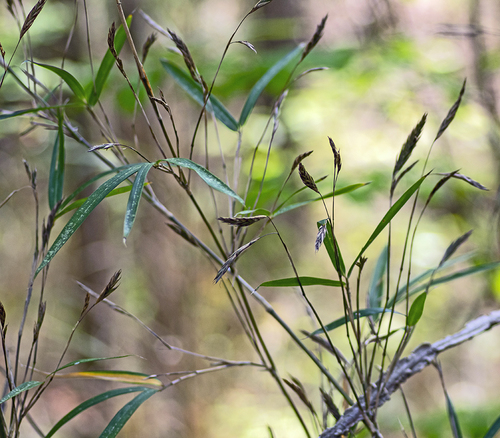
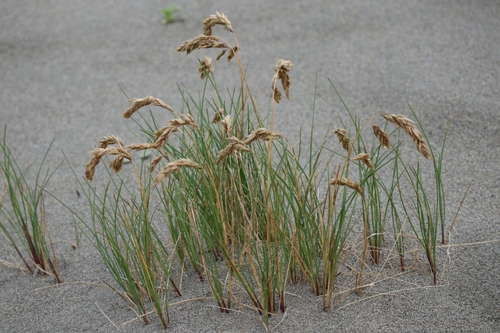
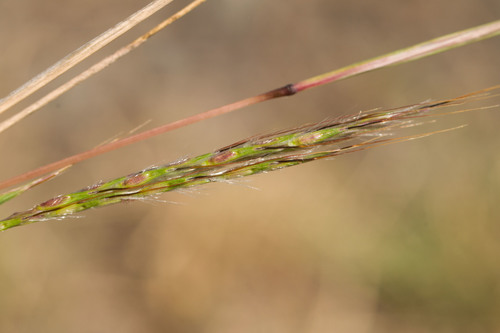
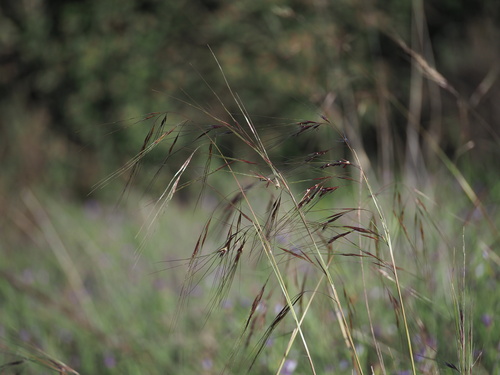
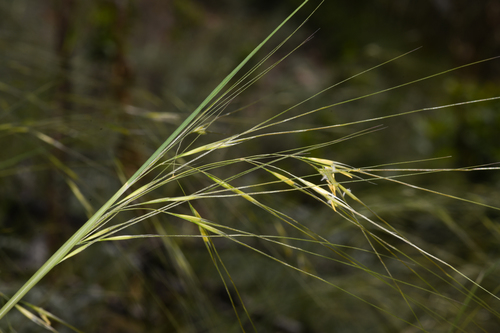
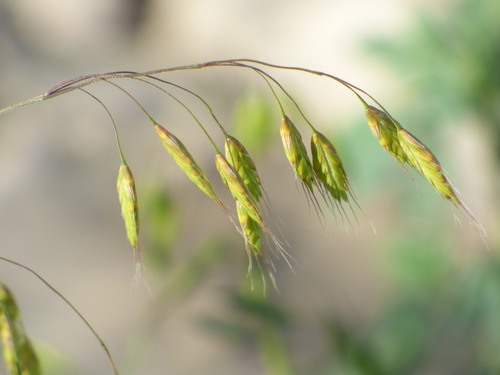
Bromus japonicus Houtt. is an annual or biennial tufted grass that reaches 0.2–1 m (7.9 in – 3 ft 3.4 in) in height. Its culms are either erect or ascending. Leaf sheaths are covered in fine soft hairs, though the uppermost sheaths may occasionally lack hair. Pubescent, obtuse ligules measure 1–2.2 mm (0.039–0.087 in) long. Densely hairy leaf blades are 10–20 cm (3.9–7.9 in) long and 2–4 mm (0.079–0.157 in) wide. This grass produces open, one-sided panicles 10–22 cm (3.9–8.7 in) long and 4–13 cm (1.6–5.1 in) wide, with divergent branches that have drooping tips. These divergent branches are typically longer than the purplish spikelets, and are either ascending or spreading. The lanceolate spikelets are 2–2.5 cm (0.79–0.98 in) long and borne on slender pedicels. Each spikelet holds 6 to 12 florets, whose bases are concealed when the plant reaches maturity. Glumes are either smooth or rough to the touch; the acute lower glumes are three-nerved and 4.5–7 mm (0.18–0.28 in) long, while the obtuse upper glumes are five-nerved and 5–8 mm (0.20–0.31 in) long. Obtuse, firm, nearly leathery lemmas measure 7–9 mm (0.28–0.35 in) long and 1.2–2.2 mm (0.047–0.087 in) wide, with nine inconspicuous nerves. Lemma margins roll slightly inward at maturity, and the twisted, strongly divergent awns are 8–12 mm (0.31–0.47 in) long. The palea is distinctly shorter than its associated glume. Anthers measure 1–1.5 mm (0.039–0.059 in) long. Caryopses are slightly shorter than the paleas, and are thin, flat, and slightly rolled inward. This species flowers from June to August.
Bromus japonicus grows in fields, waste areas, road verges, sand dunes, and other similar open sites. It is a troublesome weed in grain fields and a noxious weed in prairies, where it competes with native perennial plants for water and nutrients. It cannot tolerate alkaline soils. It is native to Eurasia, but has become naturalized across the United States and southern Canada; it is rare in Yukon.