About Bromus hordeaceus L.
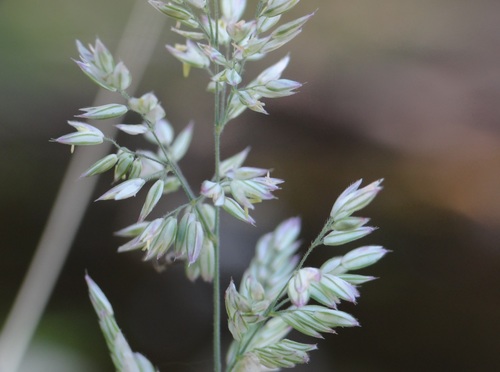
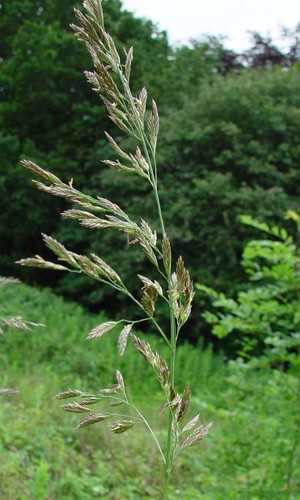
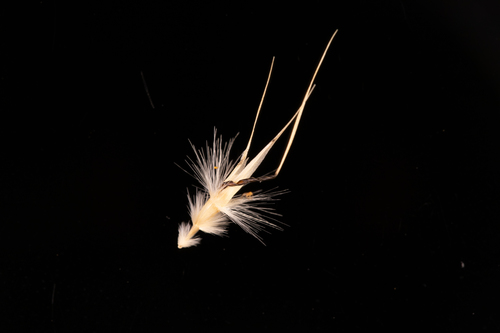
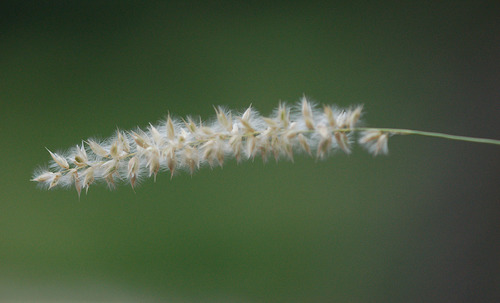
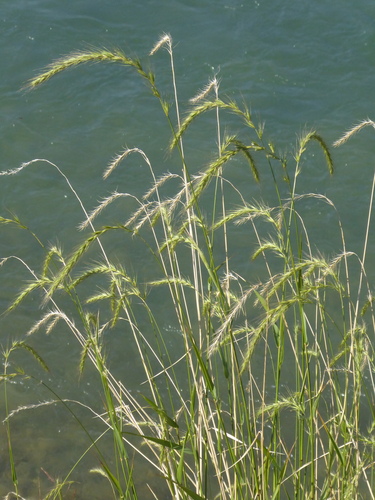
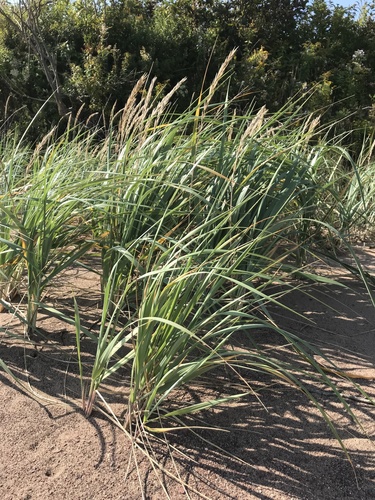
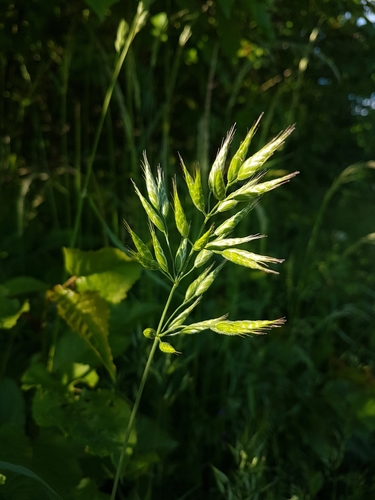
Bromus hordeaceus L. is an entirely pubescent grass that has no rhizomes. It grows 7–110 cm (3–43 in) tall, growing either in tufts or as single individuals. Its culms are smooth and yellowish brown, 0.5–5 mm (0.02–0.20 in) wide at the base, and covered in fine to dense pubescence, with hairs up to 0.6 mm (0.02 in) long. Its moderately to densely pilose leaf sheaths are mostly closed, with hairs 1.2 mm (0.047 in) long, and the species has no auricles. Its membraneous erose ligules are 1–2.6 mm (0.04–0.10 in) long, and are either glabrous or pubescent. Its grey-green leaf blades are 2.2–18 cm (0.9–7.1 in) long and 1–5.3 mm (0.04–0.21 in) wide, with a pubescent adaxial surface; the abaxial surface is also pubescent, with hairs roughly one quarter the length of those on the adaxial surface. Leaf margins are either smooth or serrated. Its panicles range from grey-green to purple, 2.5–14 cm (1.0–5.5 in) long and 1–4 cm (0.39–1.57 in) wide. Panicles can be dense or reduced to only one spikelet. Panicle branches are erect, ascending, or lax, and are scabrous or pubescent, with each branch bearing one spikelet. Its ovate-lanceolate spikelets are 1.7–3 cm (0.67–1.18 in) in length, including 3–8 mm (0.12–0.31 in) long awns. When spikelets mature, their rachillae are visible, and each spikelet holds six to eleven florets. The subequal glumes are minutely to densely pubescent with serrated keels. Lower glumes are 5.2–7 mm (0.20–0.28 in) long with three to five nerves, while upper glumes are 6–8.5 mm (0.24–0.33 in) long with seven to nine nerves. Lemmas are 7.5–9 mm (0.3–0.4 in) long and 1.9–2.5 mm (0.07–0.10 in) wide, with seven to nine visible, conspicuous nerves. Lemmas have hyaline margins 0.3–0.6 mm (0.012–0.024 in) broad. The lemma apex is bifid with a cleft 0.3–0.7 mm (0.012–0.028 in) deep. Awns are 4–7.6 mm (0.16–0.30 in) long, growing 0.4–1.2 mm (0.016–0.047 in) below the lemma. Paleas are shorter than lemmas, with glabrous backs and ciliate keels. Dark brown anthers are 0.3–1.3 mm (0.012–0.051 in) long. This species grows over winter, flowers from late spring onward, matures in summer, and blooms in May and August. Bromus hordeaceus is closely related to Bromus racemosus and difficult to distinguish from it. The only clear distinguishing trait relates to lemma nerve prominence: lemma nerves are raised and conspicuous in B. hordeaceus, while they are smooth and obscure in B. racemosus. Bromus hordeaceus is native to the Mediterranean basin, and is now widely distributed across North America, Europe, Africa, and Australia. It grows in waste areas, road verges, fields, grassy plains, and sandy beaches. It prefers drained or dry soils made of clay loam or sand, especially in less fertile areas. It is resistant to drought and temperature variations.