About Bromus erectus Huds.
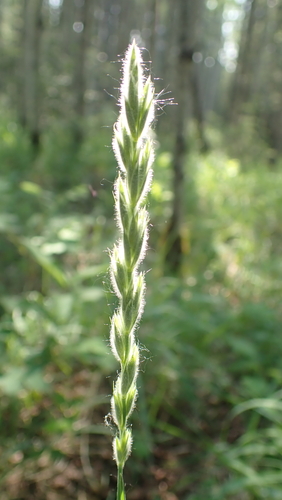
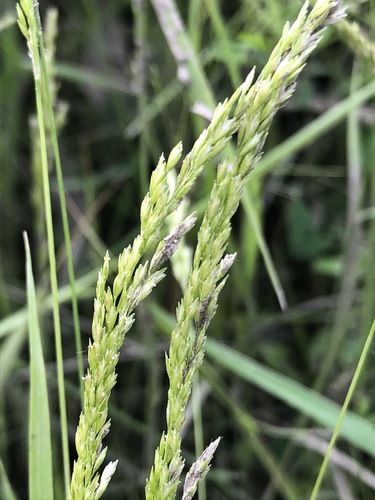
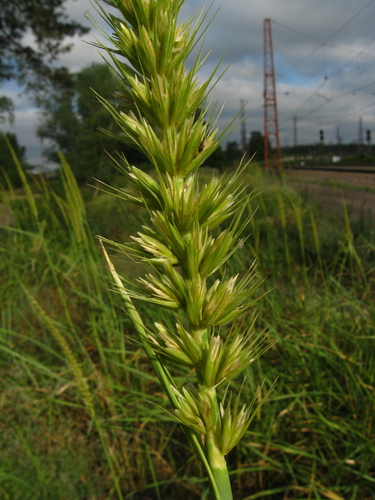
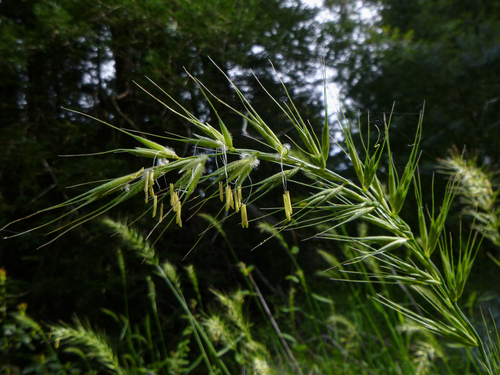
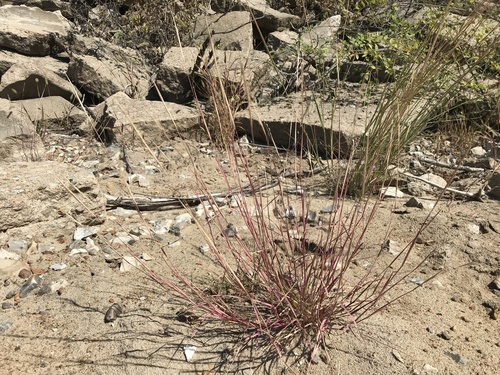
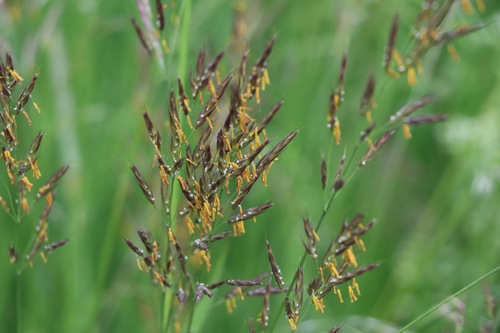
Bromus erectus Huds. is a non-rhizomatous perennial tufted grass, with cespitose leaves forming basal tufts. Its culms reach 0.6–1.2 m (2 ft 0 in – 3 ft 11 in) in height, and its internodes are typically glabrous. The flattened cauline leaves have sheaths that are either pubescent or glabrous. Leaf blades measure 10–20 cm (3.9–7.9 in) long and 2–6 mm (0.079–0.236 in) wide. This grass has no auricles; its ligule is blunt, finely serrated, and sometimes has hairy edges. Its panicle is contracted, ellipsoid, usually upright rather than nodding, and 7–15 cm (2.8–5.9 in) long. The lanceolate spikelets are 1.5–3 cm (0.59–1.18 in) long, and each holds five to twelve flowers. The glumes are acute: the lower one-nerved glume is 7–9 mm (0.28–0.35 in) long, while the upper three-nerved glume is 9–11 mm (0.35–0.43 in) long. Lemmas are glabrous or slightly scabrous, prominently nerved, 10–15 mm (0.39–0.59 in) long, with awns 5–6 mm (0.20–0.24 in) long. Anthers measure 4–6 mm (0.16–0.24 in) long. B. erectus flowers in June and July. Upright brome, the common name of this species, can be identified by its "camel's eyelashes" — the long hairs along the edges of its leaves. B. erectus grows on well-drained calcareous soils in disturbed areas, fields, and roadsides. It is widespread across Europe, South West Asia, and North West Africa, and has been introduced into North America.