About Bromus brevis Steud.
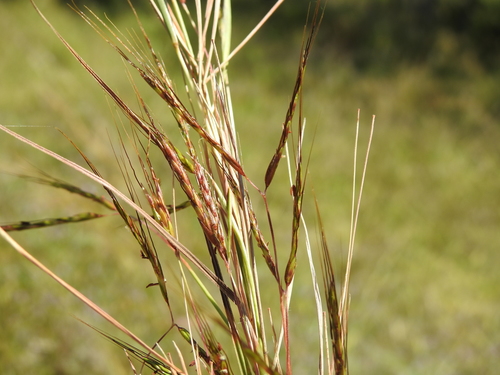
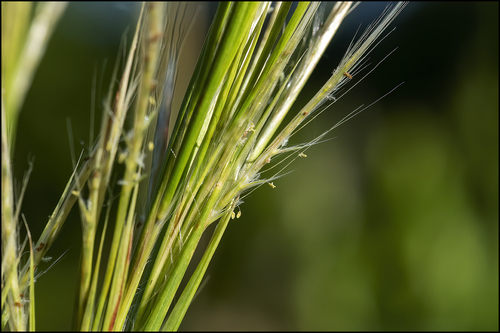
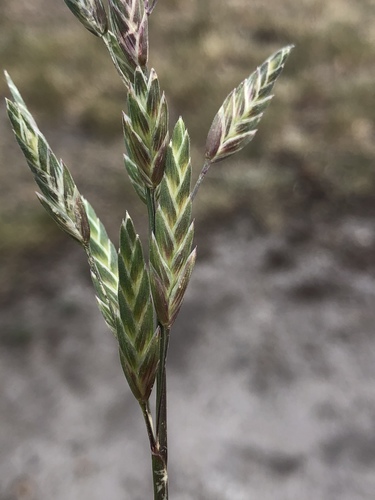
Bromus brevis Steud. is a grass that can be annual, biennial, or perennial depending on growing conditions. It forms short, stiffly erect narrow tufts with pubescent leaves, and reaches a height of 30 to 75 cm. It typically produces short panicle inflorescences that are 8 to 15 cm long, borne on erect culms. Its spikelets measure 1 to 2 cm, are ovate-oblong, and hold light bicoloured yellowish-green florets. The lemmas have 7 to 9 nerves, covered in very short, silky, appressed hairs, and may be awnless, mucronate, or bear short awns 0.5 to 0.8 mm long. The entire distribution of Bromus brevis overlaps with Bromus catharticus, and it can be distinguished from that species by its compact spikelets that are borne on short pedicels 1.5 to 5 mm long, on erect panicles. Bromus brevis spikelets are 9 to 24 mm long, and most often have awnless or mucronate lemmas, or awns shorter than 3 mm. The native range of Bromus brevis in Argentina covers the political provinces of Buenos Aires, Chubut, Córdoba, Entre Ríos, La Pampa, Mendoza, Neuquén, Río Negro, San Juan, San Luis, Santa Cruz and Tucumán. These areas fall within the Pampean, Monte, and Patagonian biogeographical provinces. Bromus brevis has also been introduced and become naturalised on the South Island of New Zealand, and in the Australian states of New South Wales, Tasmania, and Victoria. It is also recorded as adventive in Europe, with confirmed records in the United Kingdom, Spain, Belgium, and the Netherlands. Bromus brevis is a xeric plant adapted to grow in dry habitats, occurring from 0 to 2600 metres above sea level. It is most often found on sandy riverbanks and slopes. It occasionally occurs on forest margins and permanent polyphytic meadows in the semi-arid Pampas and Puna grasslands. In New Zealand, it grows in roadside and waste ground habitats. In Australia, it grows in disturbed areas, particularly on granitic soils. In Australia, Bromus brevis flowers from August to January. In Buenos Aires, Argentina, Bromus brevis first produces chasmogamous flowers, followed by cleistogamous flowers: chasmogamous flowering occurs from September to October, and cleistogamous flowering occurs from October to early January. In arid and semi-arid areas of Argentina, Bromus brevis is an important pasture species, eaten primarily by cattle. It acts as a host for the fungi Ustilago bullata and the powdery mildew fungus Blumeria graminis. It is also a host for the Russian wheat aphid (Diuraphis noxia), and is eaten by the grasshoppers Dichroplus elongatus and Dichroplus maculipennis. As a drought-tolerant grass, Bromus brevis is an important forage and fodder grass in arid and semi-arid regions of Argentina. The Ranquel indigenous people know this species as lanku kachu; they eat it raw, or process it into flour used to thicken meat broth or make bread.