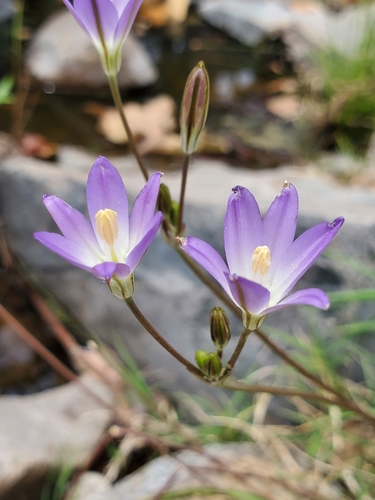
About Brodiaea orcuttii (Greene) Baker
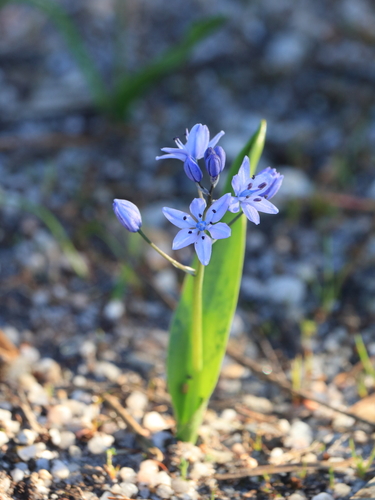
Brodiaea orcuttii is a perennial geophyte that stores nutrients and water in its corm throughout the dormant season. Its dormant season runs from early summer to late fall, and the starch stored in the corm lets leaves and roots develop quickly once dormancy is broken by the first substantial fall rains. During the growing period, 1 to 6 linear leaves emerge from the corm, and these leaves are already withered by the time the plant blooms. Mature plants also produce small cormlets during the winter growing season. Flowering takes place between April and July, and produces a slender flowering stalk (scape) that is 8 to 25 cm (3.1 to 9.8 inches) tall. Flowers attach to the inflorescence via stalks called pedicels that are at most 6 cm (2.4 inches) long. The flowers have a violet perianth 17 to 32 mm (0.67 to 1.26 inches) in size, with a funnel-shaped tube 4 to 10 mm (0.16 to 0.39 inches) long. The perianth lobes are spreading; inner lobes are 3 to 5 mm (0.12 to 0.20 inches) wide, while outer lobes are 5 to 7 mm (0.20 to 0.28 inches) wide. All lobes measure 12 to 19 mm (0.47 to 0.75 inches) in length. Within the Brodiaea genus, B. orcuttii is distinct because it is the only species that lacks staminodes. Its stamens have filaments 4 to 8 mm (0.16 to 0.31 inches) long, topped by anthers 4 to 6.5 mm (0.16 to 0.26 inches) long. The anthers are linear in shape and have a V-shaped notch at their tip. The gynoecium is made up of an ovary 3 to 7 mm (0.12 to 0.28 inches) long, with a style that can reach up to 15 mm (0.59 inches) in length.