About Brighamia insignis A.Gray
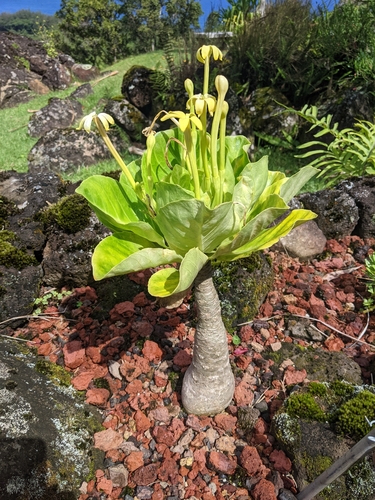
Brighamia insignis A.Gray is a succulent plant that may produce branches. Its stem is bulbous at the base, tapers toward the top, and ends in a compact rosette of fleshy leaves. The stem usually grows 1 to 2 meters (3 to 7 feet) tall, but can reach up to 5 meters (16 feet). This species blooms from September through November, producing clusters of fragrant yellow flowers in groups of three to eight in its leaf axils. The flower scent has been compared to that of honeysuckle. Its petals are fused into a tube 7 to 14 centimeters (3 to 5 and 1/2 inches) long. The fruit is a capsule 13 to 19 millimeters (1/2 to 3/4 inch) long that holds numerous seeds. Historically, Brighamia insignis occurred at elevations from sea level to 480 meters (1,570 feet), in mesic shrublands and dry forests that receive less than 170 centimeters (67 inches) of annual rainfall. It grew on rocky ledges with little soil and steep sea cliffs. Documented associated plants include ʻāhinahina (Artemisia spp.), ʻakoko (Euphorbia celastroides), alaheʻe (Psydrax odorata), kāwelu (Eragrostis variabilis), pili (Heteropogon contortus), kokiʻo ʻula (Hibiscus kokio), ʻānaunau (Lepidium serra), nehe (Lipochaeta succulenta), pokulakalaka (Munroidendron racemosum), and ʻilima (Sida fallax). This species has been extinct in the wild after many years of population decline. In 1994, the United States Fish and Wildlife Service reported five total populations holding 45 to 65 individuals, and listed the plant as an endangered species. The last wild individual was recorded in August 2012, and drone surveys conducted in June 2019 and May 2020 confirmed this final individual had disappeared. While Brighamia insignis is extinct in the wild, it is not difficult to cultivate in nurseries, and is grown as a novel ornamental plant.