About Brenthis hecate (Denis & Schiffermüller), 1775
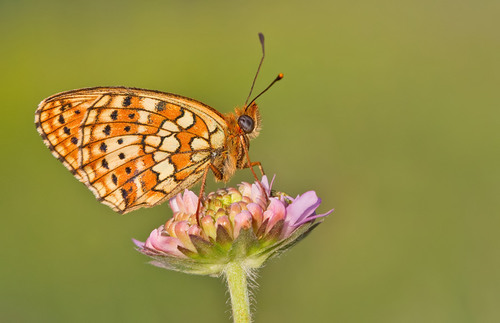
Brenthis hecate, first described by Denis & Schiffermüller in 1775, is a large fritillary butterfly. It has a wingspan of 35–45 millimetres (1.4–1.8 in), with bright orange uppersides to the wings. The underside of the hindwings features a double parallel line of brown spots, which gives the species its common name. Seitz's description notes that B. hecate W. V. (68f) is darker red-brown than most closely related preceding species, and similar above to niobe, with more rounded wings. Its spots are thin but sharply defined, and all spots are separated from each other; only the median dentate line of the hindwing is continuous. The underside is very characteristic: it has no silver markings, and is patterned in alternating light yellow and cinnamon-red. The light yellow median band is shifted somewhat toward the base, and is less curved than the same band in species such as euphrosyne, thore, and amphilochus. Several subspecies forms are recognized: caucasica Stgr. (now classified as B. hecate transcaucasica (Wnukowsky, 1929), 68f) is a relatively large form that is more yellowish brown on the wing upperside and very light yellow on the underside of the hindwing, with much reduced cinnamon-brown patterning; it occurs from the shores of the Black Sea, particularly Armenia. alaica Stgr. (now B. hecate alaica (Staudinger, 1886), 68g) comes from the Pamir and the Ala-Dagh; it has rather strong black edging to the wing uppersides, while black markings are much reduced across the rest of the wing surface, especially in the outer third of the forewing. aigina Fruhst. (now B. hecate aigina (Fruhstorfer, 1908)) from Andalusia is paler on both sides of the wings; the basal half of the hindwing upperside is lighter, and the hindwing underside is more uniformly yellow, with russet-red patterning entirely absent or only present as faint vestigial smears. There are also named individual aberrations: ab. priscilla Schultz is marked by a broad black median band, while ab. avernensis Guill. has a darkened wing upperside with a bluish sheen. Adult butterflies fly from the end of May until July, found on mountain meadows and woodland clearings, and are very local in distribution. This species is distributed across south-western Europe, Lithuania, southern Russia, the Balkans, Asia Minor, Iran and Central Asia; historical records also note it occurring in Central and South Europe, France, Northern Italy, and especially Austria-Hungary. It is typically found in dry flowery meadows with light scrub and woodland margins, at elevations ranging from 25–1,500 metres (82–4,921 ft) above sea level.