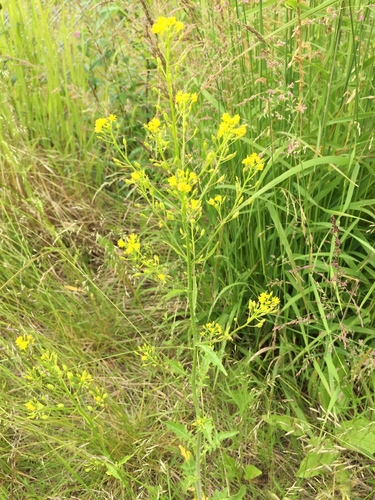
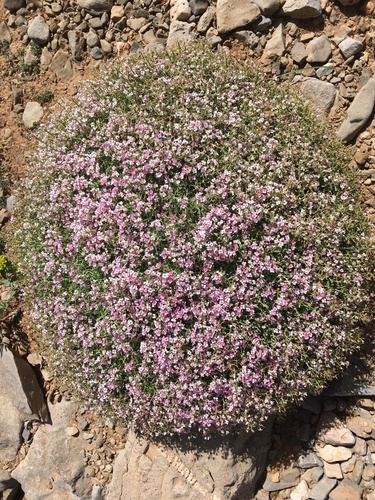
About Brassicaceae
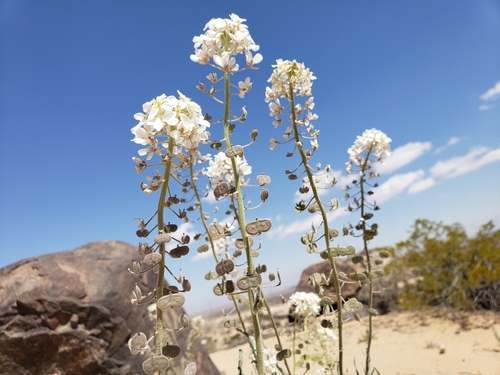
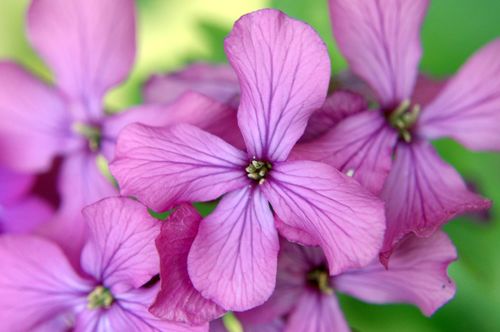
Most species in the Brassicaceae family are annual, biennial, or perennial herbaceous plants. Some are dwarf shrubs or shrubs, and very few grow as vines. While most are terrestrial, a small number of species such as water awlwort live submerged in fresh water. Species may have a taproot or a sometimes woody caudex with few or many branches; some have thin or tuberous rhizomes, and rarely develop runners. Only a few species have multi-cellular glands. All hairs are single-celled, and come in many forms ranging from simple to forked, star-shaped, tree-shaped, or T-shaped. Rarely, hairs take the form of a shield or scale, and they are never topped by a gland. Stems may grow upright, curve upward toward the tip, or lie flat. Most stems are herbaceous, but some are woody. Stems may bear leaves, be leafless (as seen in Caulanthus), and some species lack stems entirely. Leaves do not have stipules, but a pair of glands may grow at the base of both leaf stalks and flower stalks. Leaves may be stalkless or have a leafstalk. The leaf blade is usually simple, either entire or dissected, and is rarely trifoliolate or pinnately compound. A basal leaf rosette may be present or absent. Leaves growing along the stem are almost always alternately arranged, and only rarely appear opposite. Stomata in this family are of the anisocytic type. Compared to other angiosperm families, Brassicaceae have very small to small genome sizes, less than 3.425 million base pairs per cell. Genome size varies from 150 Mbp in Arabidopsis thaliana and Sphaerocardamum spp., to 2375 Mbp in Bunias orientalis. The number of homologous chromosome sets ranges from four (n=4) in some Physaria and Stenopetalum species, five (n=5) in other Physaria and Stenopetalum species, Arabidopsis thaliana and a Mathiola species, up to seventeen (n=17). Approximately 35% of species with counted chromosomes have eight sets (n=8). Due to polyploidy, some species may have up to 256 individual chromosomes, with very high counts found in North American Cardamine species such as C. diphylla. Hybridisation is not uncommon in Brassicaceae, especially in the genera Arabis, Rorippa, Cardamine and Boechera. Hybridisation between species originating from Africa and California, followed by subsequent polyploidisation, is surmised for Lepidium species native to Australia and New Zealand. Brassicaceae can be found across almost the entire land surface of the planet, but the family is absent from Antarctica, and also absent from some tropical areas including northeastern Brazil, the Congo Basin, Maritime Southeast Asia and tropical Australasia. The family likely originated in the Irano-Turanian Region, where approximately 900 species across 150 different genera occur. Around 530 of these 900 species are endemics. The next most species-rich region is the Mediterranean, which holds around 630 species in 113 genera, 290 of which are endemic. The family is less prominent in the Saharo-Arabian region, which has 65 genera and 180 species, 62 of which are endemic, and in North America, covering the North American Atlantic region and Rocky Mountain floristic region, which has 99 genera and 780 species, 600 of which are endemic. South America hosts 40 genera with 340 native species, Southern Africa has 15 genera with over 100 species, and Australia and New Zealand have 19 genera with 114 species between them. Brassicaceae are almost exclusively pollinated by insects. Many species use a chemical mechanism in pollen to avoid selfing. Two well-known exceptions are exclusive self-pollination in closed flowers of Cardamine chenopodifolia, and wind pollination in Pringlea antiscorbutica. Alliaria petiolata (garlic mustard) is self-fertile, although it can also be cross-pollinated. Most species reproduce sexually through seed, but Cardamine bulbifera produces gemmae, and in other species such as Cardamine pentaphyllos, coral-like roots easily break into segments that grow into separate new plants. In some species, particularly in the genus Cardamine, seed pods open with force to catapult seeds a significant distance. Many of these species have sticky seed coats that help with long-distance dispersal by animals, which may explain multiple intercontinental dispersal events in the genus and its near-global distribution. Brassicaceae are common on serpentine and dolomite soils rich in magnesium. Over one hundred species in this family accumulate heavy metals, particularly zinc and nickel, a percentage that is a record for plant families. Several Alyssum species can accumulate nickel up to 0.3% of their dry weight, which may make them useful for soil remediation or even bio-mining. Brassicaceae store glucosinolates and myrosinases inside their cells. When a cell is damaged, myrosinases hydrolyze glucosinolates, triggering synthesis of isothiocyanates, compounds that are toxic to most animals, fungi and bacteria. Some insect herbivores have evolved counter-adaptations, including rapid absorption of glucosinates, quick alternative breakdown into non-toxic compounds, and avoiding cell damage. In the butterfly family Pieridae, one counter-mechanism uses glucosinolate sulphatase to modify glucosinolate so it cannot be converted to isothiocyanate. A second counter-mechanism quickly breaks down glucosinates to form nitriles. There is large variation in glucosinolate mixtures between species, and even within a single species; individual plants may produce more than fifty distinct glucosinolate compounds. The energy cost to synthesize all these glucosinolates can be as high as 15% of the total energy required to produce a leaf. Barbarea vulgaris (bittercress) also produces triterpenoid saponins. These adaptations and counter-adaptations have likely driven extensive diversification in both Brassicaceae and one of its major pest groups, the butterfly family Pieridae. A specific mix of volatile glucosinates triggers egg-laying in many pierid species. This means certain crops can sometimes be protected by planting bittercress as a deadly bait: saponins from bittercress kill caterpillars, but butterflies are still lured to lay their eggs on the bittercress leaves. The diamondback moth (Plutella xylostella), a moth that feeds on a wide range of Brassicaceae, is able to convert isothiocyanates into less harmful nitriles, similar to Pieridae. Managing this pest in crops has become more complicated after it developed resistance to a toxin produced by Bacillus thuringiensis, which is used as a broad-spectrum biological control against caterpillars. Parasitoid wasps that prey on these insect herbivores are attracted to chemical compounds released by damaged Brassicaceae plants, which helps them locate their prey. The cabbage aphid (Brevicoryne brassicae) stores glucosinolates and produces its own myrosinases, which may deter its potential predators. Since its introduction to temperate North America in the 19th century, Alliaria petiolata has become an extremely successful invasive species, in part due to the allelopathic chemicals it secretes. These chemicals inhibit germination of most competing native plants and kill beneficial soil fungi that many plants, including many tree species, need for seedlings to grow to maturity. Garlic mustard forms a dense monoculture herb layer carpet that dramatically alters forests: altered forests become wetter, support fewer trees, and have more vines such as poison ivy (Toxicodendron radicans). Overall herb layer biodiversity is also drastically reduced, especially for sedges and forbs. Research has found that removing 80% of an existing garlic mustard infestation does not lead to particularly significant native diversity recovery. Instead, around 100% removal of the infestation is required. As of yet, none of an estimated 76 species that prey on garlic mustard have been approved for biological control in North America. The plant has multiple mechanisms to maintain dominance without top-down control: high seed production, self-fertility, allelopathy, spring growth that occurs before nearly all native plants grow, roots that break easily when pulled, and a complete lack of palatability for herbivores at all life stages. Because of these factors, it is unlikely that the required high level of control can be established and maintained across the region. It is estimated that adequate control can be achieved by introducing two European weevils, one of which is monophagous. The United States Department of Agriculture's TAG group has blocked these introductions since 2004. In addition to being invasive, garlic mustard also threatens native North American Pieris butterflies such as P. oleracea. Butterflies preferentially lay their eggs on garlic mustard, but the plant is toxic to their larvae, and garlic mustard is toxic to several rarer North American Pieris species. Invasive aggressive mustard species share common traits: they are self-fertile, produce very high numbers of small seeds with a long lifespan, high viability and high germination rate, and are completely unpalatable to both native herbivores and insects in their non-native range. The Brassicaceae family includes many important agricultural crops. It contains many common vegetables: cabbage, broccoli, cauliflower, kale, Brussels sprouts, collard greens, Savoy, kohlrabi, and gai lan (Brassica oleracea); turnip, napa cabbage, mizuna, bok choy and rapini (Brassica rapa); rocket salad/arugula (Eruca sativa); garden cress (Lepidium sativum); watercress (Nasturtium officinale) and radish (Raphanus). It also includes a few spices: horseradish (Armoracia rusticana), wasabi (Eutrema japonicum), and white, brown and black mustard (Sinapis alba, Brassica juncea and B. nigra respectively). Vegetable oil is produced from the seeds of several species such as Brassica napus (rapeseed oil), and rapeseed oil provides one of the largest volumes of vegetable oil of any commercial species. Woad (Isatis tinctoria) was historically used to produce a blue textile dye (indigo), but this use has largely been replaced by indigo obtained from unrelated tropical species such as Indigofera tinctoria. Pringlea antiscorbutica, commonly known as Kerguelen cabbage, is edible and contains high levels of potassium. Its leaves hold a vitamin C-rich oil, which made it very valuable to sailors suffering from scurvy in the age of sailing ships. This use is reflected in the species epithet antiscorbutica, which means "against scurvy" in Low Latin. It was an essential part of whalers' diets on Kerguelen when pork, beef, or seal meat was exhausted. Brassicaceae also includes many ornamental species from genera including Aethionema, Alyssum, Arabis, Aubrieta, Aurinia, Cheiranthus, Erysimum, Hesperis, Iberis, Lobularia, Lunaria, Malcolmia, and Matthiola. Honesty (Lunaria annua) is cultivated for the decorative value of the translucent remains of its fruits after drying, and can be a pest species in areas where it is not native. The small Eurasian weed Arabidopsis thaliana is widely used as a model organism for the study of the molecular biology of flowering plants (angiosperms). Some species serve as food plants for Lepidoptera, including certain wild mustard and cress species such as Turritis glabra and Boechera laevigata, which are used by several North American butterflies.