About Brassica napus L.
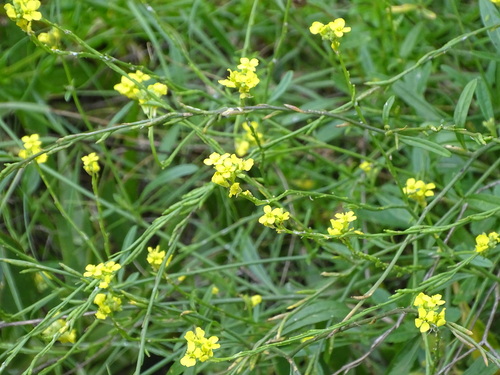
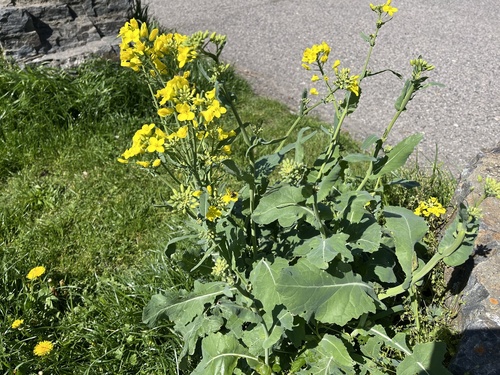
Brassica napus L. (rapeseed) grows up to 100 centimetres (39 inches) tall. Its lower leaves are hairless, fleshy, pinnatifid, glaucous, and stalked, while its upper leaves have no petioles. Rapeseed flowers are bright yellow, around 17 millimetres (3⁄4 inch) across. They are radially symmetric, with four cross-arranged petals alternating with four sepals. Flowering follows an indeterminate racemose pattern, starting at the lowest bud and progressing upward over subsequent days. The flowers have two lateral stamens with short filaments, and four median stamens with longer filaments; the anthers of the longer stamens split away from the flower's center when flowering opens. As the rapeseed pods develop, they are green, elongated siliquae, and eventually ripen to brown. The pods grow on 1 to 3 cm (3⁄8 to 1+3⁄16 inch) long pedicels, and range from 5 to 10 cm (2 to 4 inches) in length. Each pod has two compartments separated by an inner central wall, and a row of seeds develops within this structure. The mature seeds are round, 1.5 to 3 mm (1⁄16 to 1⁄8 inch) in diameter, have a reticulate surface texture, and are hard and black when fully mature. In Northern Ireland, B. napus and B. rapa have been recorded as escaped plants growing on roadside verges and waste ground. Crops in the genus Brassica, including rapeseed, were among the earliest plants widely cultivated by humans, with widespread cultivation starting as early as 10,000 years ago. Rapeseed was already cultivated in India by 4000 B.C., and spread to China and Japan 2000 years ago. In most of Europe and Asia, rapeseed is predominantly cultivated as a winter-type variety, because it requires vernalization to initiate flowering. It is sown in autumn, survives the winter as a leaf rosette resting on the soil surface, grows a long vertical stem the following spring, and then develops lateral branches. It generally flowers in late spring, with pod development and ripening taking 6–8 weeks to complete by midsummer. In Europe, winter rapeseed is grown as an annual break crop in three to four-year rotations with cereals such as wheat and barley, and other break crops such as peas and beans. This rotation practice reduces the risk of pests and diseases carrying over between successive crops. Winter rapeseed is also less likely to suffer crop failure than the summer variety, because it is more vigorous and can compensate for damage caused by pests. Spring rapeseed is cultivated in Canada, northern Europe, and Australia, as it is not winter-hardy and does not require vernalization. It is sown in spring, and stem development begins immediately after germination. Rapeseed can be grown in a wide range of well-drained soils, prefers soil with a pH between 5.5 and 8.3, and has moderate tolerance to soil salinity. It is predominantly a wind-pollinated plant, but bee pollination significantly increases grain yield (often almost doubling final yield), though this effect depends on the specific cultivar. Modern rapeseed cultivation uses high levels of nitrogen-containing fertilisers, and the manufacturing of these fertilisers produces nitrous oxide (N2O). An estimated 3–5% of the nitrogen supplied as fertiliser for rapeseed is converted to N2O. Rapeseed has a high demand for nutrients, and specifically has the highest sulphur demand of all arable crops. Since atmospheric sulphur inputs decreased during the 1980s, sulphur fertilisation has become a standard practice in oilseed rape production. Among micronutrients, boron, manganese, and molybdenum require special attention in rapeseed cultivation. Rapeseed is grown to produce edible vegetable oil, animal feed, and biodiesel. In 2000, rapeseed was the third-leading source of vegetable oil globally, after soybean and palm oil. It is the world's second-leading source of protein meal, ranking after soybean.