About Brasiliopuntia brasiliensis (Willd.) A.Berger
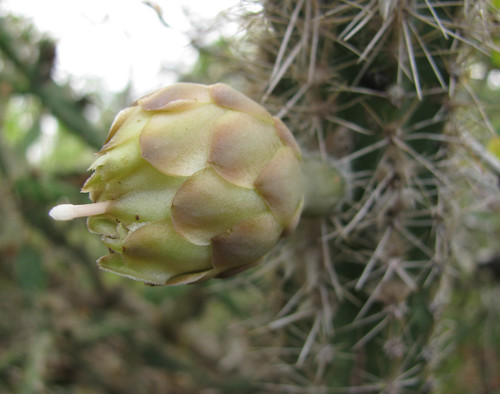
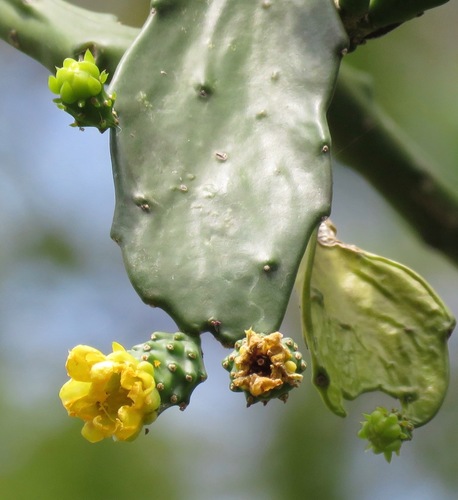
Brasiliopuntia brasiliensis grows thin, upright, tree-like, slightly contracted cladodes on a central cylindrical trunk, and can reach a height of 20 meters or more, making it the tallest species in the Opuntia subfamily. Its intermediate cladode segments are cylindrical, measuring 20 to 100 centimeters long. This species produces small, fleshy, light green leaves that fall off early; young leaves are bright green. Its light to dark green terminal end segments range from rhomboid to ovoid in shape, are unevenly formed, narrow at the base, and produce leaf-like shoots or flax sprouts. Areoles have white hairs and develop glochids over time. White areoles typically bear one or two small brown upright spines; 1 to 3 thin, reddish spines up to 15 millimeters long may occur, or spines may be absent entirely. Flowers only grow on mature plants. Yellow flowers form near the tip or terminally on thin-fleshed segments, or from the pericarpel of older flowers, open during the day, and reach up to 6 centimeters long. Hair-like staminodes are present between the perianth and the stamens. The fleshy fruits are spherical, pear-shaped, or elongated, and range in color from yellow, orange-red, and red to purple. Fruits have a diameter of 3 to 4 centimeters, and feature prominent tufts of dark brown glochids. Each fruit contains 1 to 5 very large, thick, disc-like, laterally compressed, woolly seeds, measuring 6.5 to 10 millimeters. This species is native to Brazil, Paraguay, eastern Bolivia, Peru, and northern Argentina, and has become naturalized in Florida and other locations.