About Branta leucopsis (Bechstein, 1803)
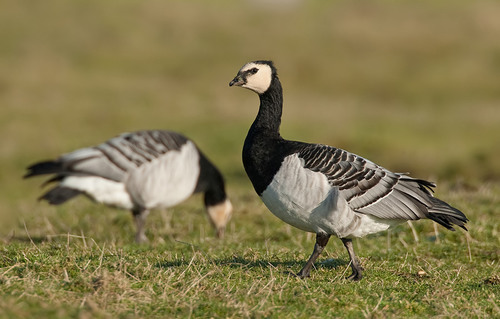
The barnacle goose, scientifically named Branta leucopsis (Bechstein, 1803), is a medium-sized goose. It measures 55–70 cm (22–28 in) in length, has a wingspan of 120–145 cm (47–57 in), and weighs 1.21–2.23 kg (2.7–4.9 lb). This species has a white face, paired with black head, neck, and upper breast. Its belly is white, while its wings and back are silver-grey marked with black-and-white bars that appear shiny when light reflects off them. A V-shaped white rump patch and silver-grey underwing linings are visible when the bird is in flight.
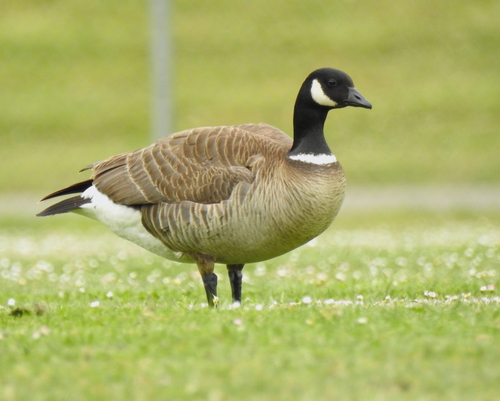
Barnacle geese resemble cackling geese, but differ by having grey and white bodies rather than brown ones, and more extensive white coloration on the head. They can be distinguished from Canada geese by their smaller overall size and smaller beaks. Juvenile barnacle geese look similar to adults, but can be told apart by their rounded rather than square-ended mantle and flank feathers, a trait common to all young geese.
There are three originally established populations of barnacle geese, each with separate breeding and wintering ranges. Since the 1960s, two new breeding populations have become established along migration routes of two of the original populations, bringing the total to five distinct populations:
The first original population breeds in eastern Greenland and winters on the Hebrides of western Scotland and in western Ireland. Its numbers grew from around 7,000 individuals in the 1960s to 44,000 by 2011.
A recently established population derived from the Greenland stock has bred more or less regularly in Iceland since 1964. This population has grown rapidly over the last few decades, reaching more than 4,000 breeding pairs in 2024, and its members winter in the same area as the original Greenland population.
The second original population breeds on Svalbard, Norway, and winters almost entirely in the Solway Firth on the England-Scotland border, with small numbers found elsewhere in the region, particularly around Budle Bay in Northumberland. This population increased from a few hundred individuals in the 1940s to around 34,000 in 2004, and reached 40,000 by the start of the 2020s.
The third original population breeds on Novaya Zemlya, Dolgy Island, the Kanin Peninsula, the Yugorsky Peninsula, and along the Barents Sea coastline in the Russian Arctic. It winters in the Wadden Sea area spanning southwest Denmark, northwest Germany, and the Netherlands. This population grew from approximately 70,000 individuals in 1980 to 1.2 million individuals in 2015.
A second recently established population, derived from the Russian Arctic population with contributions from escaped captive birds, has been established since 1971. It breeds on islands in the Baltic Sea, and on islands and coasts of the southern North Sea, including areas in Estonia, Finland, Sweden, Denmark, the Netherlands, Germany, and Belgium. Individuals either winter in or near their breeding range or move to the Wadden Sea, and there is ongoing genetic exchange with the original Russian Arctic population. This population is growing rapidly: the Danish, Dutch, and Swedish subpopulations each hold several thousand breeding pairs, while the Belgian, Estonian, Finnish, and German subpopulations each hold several hundred breeding pairs.
The species has been recorded as a vagrant in eastern Canada, the northeastern United States, and India. Care must be taken to distinguish wild vagrant individuals from escaped captive birds, as barnacle geese are popular waterfowl kept by collectors.
In terms of ecology and behavior, barnacle geese frequently build their nests high on mountain cliffs. This location keeps them away from predators (primarily Arctic foxes and polar bears), but also places them far from their feeding grounds, which are usually lakes and rivers. Like all geese, adult barnacle geese do not feed newly hatched goslings. Instead of bringing food to the hatchlings, the goslings must jump down from the cliff nests, which may be hundreds of feet high. Unable to fly in their first days of life, the goslings fall all the way to the ground below. Their small size, fluffy down, and very light weight help protect some from serious injury on impact, but many die from the fall. Arctic foxes are attracted to the noise made by parent geese during this event, and capture many dead or injured goslings. Foxes also stalk the young goslings as they are led by their parents to wetland feeding areas. Only around 50% of barnacle goose chicks survive their first month due to these hardships.