About Branta hutchinsii (Richardson, 1832)
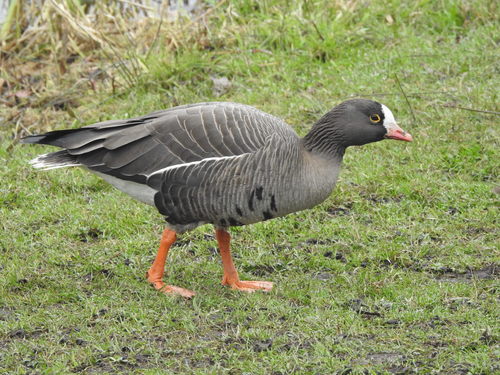
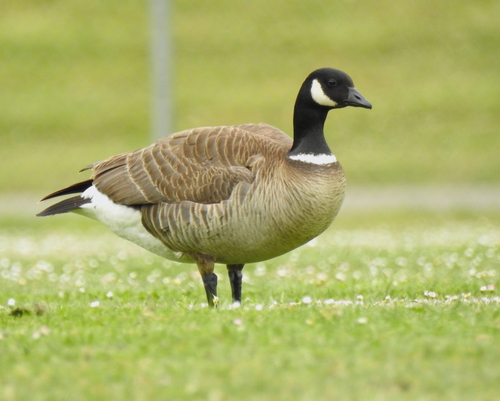
Branta hutchinsii, commonly known as the cackling goose, can be recognized by its black head and black neck marked with a white "chinstrap". This marking pattern distinguishes it from all other geese except two species: the larger Canada goose (Branta canadensis) and the similarly sized barnacle goose (B. leucopsis). Up to five subspecies of cackling goose have been recognized, and these subspecies vary in size and fine plumage details. Females look almost identical to males, but are slightly lighter in weight and have a distinct call. Cackling geese were long classified as a single species together with Canada geese, and cackling geese plus smaller Canada goose subspecies were collectively called the lesser Canada goose. Many cackling geese remain hard to tell apart from Canada geese. The smallest subspecies, B. h. minima, reaches only 1.4 kg (3.1 lb), and is much smaller than any Canada goose. By contrast, the nominate subspecies B. h. hutchinsii can grow up to 3 kg (6.6 lb), which matches the size of some Canada geese. The status of the extinct population B. h. asiatica from the Komandorski and Kuril Islands is debated. The barnacle goose can be told apart from the cackling goose by its black breast and grey body plumage, while the cackling goose has brownish body plumage. Standard measurements for the species are: length 24.8–25.6 in (63–65 cm), weight 49.3–84.0 oz (1,400–2,380 g), and wingspan 42.5–43.7 in (108–111 cm). This species is native to North America, where it breeds in Northern Canada and Alaska across a variety of tundra habitats. Cackling goose nests are usually placed in an elevated location near water. Eggs are laid in a shallow depression lined with plant materials and down. Because nests are built close to or directly on the ground, eggs, lone nesting females, and newly hatched goslings are especially vulnerable to predation by certain mammalian carnivores. Depending on the region, common predators include free-ranging domestic or feral cats and dogs, foxes, coyotes, rats, and some snake species. In response to this risk, both members of a nesting pair (especially the male) become highly aggressive and defensive of their nesting site, and will even chase away passing humans. Cackling goose pairs often mate for life, with pairs staying together for up to around 20 years. Adult geese typically lead their goslings in a single-file line, with one parent at the front of the procession and the other at the back. Like most goose species, the cackling goose is migratory. Its overwintering range covers most of the United States, with local overwintering populations in Western Canada, the U.S. West Coast, and northern Mexico. The calls of large cackling goose flocks flying in their characteristic V-shaped formation signal the arrival of spring and fall migration. In some areas, migration routes have shifted due to changes in available habitat, environmental conditions, and food sources. Cackling geese have naturally occurred as vagrants to Western Europe, confirmed by ringing recoveries and documented sightings. The vagrants recorded in Europe belong at minimum to the subspecies hutchinsii, and may include other subspecies. They also occur naturally as vagrants around the Kamchatka Peninsula in Far Eastern Russia (Siberia), East China, and across the islands of Japan. The IUCN lists the species as extirpated from Japan, where it previously had an established non-breeding winter population. Cackling geese have recently been reintroduced to both Japan and Siberia.