About Branta canadensis (Linnaeus, 1758)
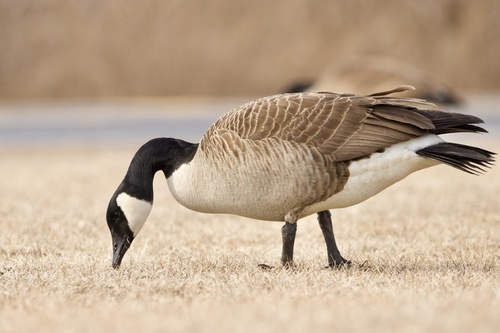
The Canada goose (Branta canadensis) is most easily recognized by its black head and neck paired with a distinctive white "chinstrap" marking. This pattern separates it from all other goose species except the cackling goose and barnacle goose. The barnacle goose differs from the Canada goose by having a black breast and gray body plumage, rather than the brownish plumage of Canada geese. Some Canada geese display pepper-spotted or brown neck coloring paired with brown plumage; these individuals are assumed to be a leucistic variety. Rarely, Canada geese may also be seen with dark cheeks, white foreheads, or white necks. There are seven recognized subspecies of Canada goose, which vary widely in overall size and fine plumage details, but all can be clearly identified as Canada geese. Some of the smaller Canada goose subspecies can be difficult to tell apart from cackling geese, as the two species have a small overlap in average body mass. However, most subspecies of cackling goose (excluding Richardson's cackling goose, B. h. hutchinsii) are noticeably smaller than small Canada geese. The smallest cackling goose subspecies, B. h. minima, is barely larger than a mallard duck. Beyond size differences, cackling geese also have shorter necks and smaller bills, which helps distinguish small Canada geese when they mix with relatively larger cackling goose individuals. Among "true geese" (species in the genera Anser and Branta), the Canada goose is on average the largest living species. Some other birds called geese that are not closely related to true geese are heavier on average, including the spur-winged goose and Cape Barren goose. Canada geese measure 75 to 110 cm (30 to 43 in) in total length, with a wingspan of 127 to 185 cm (50 to 73 in). Standard body measurements for the species range as follows: wing chord 39 to 55 cm (15+1⁄2 to 21+1⁄2 in), tarsus 6.9 to 10.6 cm (2+11⁄16 to 4+3⁄16 in), and bill 4.1 to 6.8 cm (1+5⁄8 to 2+11⁄16 in). The largest Canada goose subspecies is B. c. maxima, commonly called the giant Canada goose. Following the separation of the cackling goose group from Canada geese, the smallest subspecies is B. c. parvipes, the lesser Canada goose. Giant Canada goose males rarely exceed 8 kg (18 lb), but one exceptionally large male of this subspecies weighed 10.9 kg (24 lb) with a 2.24 m (7 ft 4 in) wingspan; this individual is the largest wild goose ever recorded of any species. Across all subspecies, adult male Canada geese usually weigh 2.6–6.5 kg (5+3⁄4–14+1⁄4 lb), with an average weight of 3.9 kg (8+1⁄2 lb). Females are almost identical in appearance, but are slightly smaller and lighter: they weigh 2.4–5.5 kg (5+1⁄4–12+1⁄4 lb) with an average of 3.6 kg (8 lb) across all subspecies, and are generally 10% smaller than males in linear body dimensions. Male Canada geese produce a call called a honk, while females produce a hrink call. The two calls are similar, but the female hrink is shorter and higher in pitch than the male honk. When agitated or defending territory aggressively, Canada geese typically begin encounters with a high-pitched hiss. In total, Canada geese use 10 distinct vocalizations, each used in response to a different situation. This species is native to North America. It breeds across Canada and the northern United States in a wide variety of habitats, and the Great Lakes region holds a large Canada goose population. Canada geese live year-round in the southern portion of their breeding range, which includes the northern half of the United States' eastern seaboard, Pacific Coast, and the areas between these coasts. In the southern United States between California and South Carolina, as well as in northern Mexico, Canada geese occur mainly as winter migrants from breeding grounds further north. By the early 20th century, overhunting and habitat loss in the late 19th and early 20th centuries caused severe population declines of Canada geese across their native range. The giant Canada goose subspecies was thought to be extinct by the 1950s, until a small wintering flock was discovered in Rochester, Minnesota in 1962 by Harold Hanson of the Illinois Natural History Survey. In 1964, the Northern Prairie Wildlife Research Center was constructed near Jamestown, North Dakota. The center's first director, Harvey K. Nelson, convinced Forrest Lee to move from Minnesota to lead the center's Canada goose production and restoration program. Lee quickly established 64 pens holding 64 breeding pairs of screened, high-quality geese. The project combined resources from private, state, and federal groups, and relied on the expertise and cooperation of many people. By the end of 1981, more than 6,000 giant Canada geese had been released at 83 sites across 26 counties in North Dakota. In recent decades, Canada goose populations have grown substantially in some areas, to the point that many people consider them pests. This is due to their droppings, the bacteria present in their droppings, their noise, and their confrontational behavior. The growth of urban Canada goose populations is partially caused by the removal of natural predators and the abundance of safe, human-made water bodies located close to food sources, such as those found on golf courses, public parks, beaches, sports fields, and planned residential communities. Interbreeding between various migratory Canada goose subspecies and the introduced non-migratory giant subspecies also contributes to Canada geese being a year-round presence in these urban environments. Unlike their typical migratory behavior, large flocks of Canada geese have established permanent resident populations along the Pacific coast of North America, from British Columbia's Lower Mainland and Vancouver Island south to the San Francisco Bay area of Northern California. Permanent resident populations also exist along the Atlantic coast, including Chesapeake Bay, Virginia's James River regions, the Triangle area of North Carolina (Raleigh, Durham, Chapel Hill), and nearby Hillsborough. Some Canada geese have even taken up permanent residence as far south as Florida, living in places like retention ponds near apartment complexes. In 2015, Ohio's Canada goose population was estimated at roughly 130,000, and the number was expected to keep increasing. Many geese that were historically migratory have become permanent residents, remaining in Ohio even through the summer. The population increase is attributed to a lack of natural predators, abundant water sources, and plentiful grass on manicured urban lawns. Canada geese were completely eliminated in Ohio after the American Civil War, but were reintroduced in 1956 with 10 breeding pairs. The population was estimated at 18,000 in 1979. Canada geese are a protected species in Ohio, but a hunting season is open from September 1 to 15 with a daily bag limit of five geese. The Ohio Department of Natural Resources recommends a number of non-lethal scare and hazing tactics for nuisance geese. If these methods are not successful, the department may issue a permit that allows destruction of nests, goose roundups, or culling of geese from March 11 through August 31. Canada geese find a mate during their second year of life. They are monogamous, and most pairs stay together for their entire lives; if one partner dies, the surviving bird may find a new mate. The female lays between two and nine eggs, with an average clutch size of five. Both parents protect the nest during incubation, but the female spends more time at the nest than the male. Nests are usually built on elevated ground close to water, such as near streams, lakes, or ponds, and are sometimes built on beaver lodges. Eggs are laid in a shallow depression lined with plant material and down. The incubation period lasts 24–32 days after laying; during this time the female incubates the eggs while the male stays nearby. Canada geese can adjust their laying date to match spring maximum temperatures in response to external climatic conditions, which may improve their nesting success. The annual summer molt occurs during the breeding season, when adults lose their flight feathers for 20–40 days. Adults regain the ability to fly around the same time that their goslings begin to fly. Immediately after hatching, goslings are already capable of walking, swimming, and foraging for their own food (they eat a diet similar to adult Canada geese). Parents are commonly seen leading goslings in a line, with one adult at the front of the line and the other at the back. When protecting their goslings, parent geese will violently chase away any nearby creatures that approach, from small blackbirds to lone humans. They first give a warning hiss, then attack with bites and wing slaps. Although parents are aggressive toward unfamiliar geese, they may join together to form communal groups called crèches, made up of multiple broods of goslings and a small number of adult geese. Goslings enter the fledgling stage between six and nine weeks of age. They do not leave their parents until after the spring migration, when they return to their birthplace.