About Branta bernicla (Linnaeus, 1758)
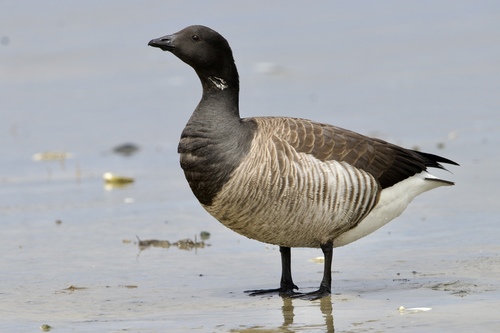
Branta bernicla, commonly called the brant, is a small goose species with a short, stubby bill. It measures 55–66 cm (22–26 in) in length, 106–121 cm (42–48 in) across the wings, and weighs 0.88–2.2 kg (1.9–4.9 lb). Its undertail is pure white, while the tail is black and very short — the shortest tail of any goose species. Three widely recognized subspecies are described, with a fourth proposed but not yet formally described. The nominate dark-bellied subspecies B. b. bernicla has a fairly uniformly dark grey-brown body, with flanks and belly not significantly paler than the back. Its head and neck are black, with a small white patch on each side of the neck. This subspecies has a population of approximately 250,000, breeds on the Arctic coasts of central and western Siberia, and winters in coastal areas of western Europe. Over half of its population winters in southern England, with the rest ranging from northern Germany to south-western France. The pale-bellied subspecies B. b. hrota is blackish-brown with light grey colouration. Its body shows different shades of grey-brown across the whole, with flanks and belly significantly paler than the back, creating a marked contrast. Like the nominate subspecies, it has a black head and neck with a small white patch on each side of the neck. Its total population is around 250,000. The main population of B. b. hrota breeds in northeastern Canada and winters along the Atlantic coast of the U.S. from Maine to Georgia. Two smaller populations exist: one breeds in Franz Josef Land, Svalbard, and northeastern Greenland and winters in Denmark, northeast England, and Scotland; the other breeds in far-northeastern Canadian islands and winters in Ireland, southwest England, and a small but significant area called le havre de Regnéville centered on the Sienne Estuary in Manche, Northern France. In Ireland, winter records of this subspecies come from a number of areas including Lough Foyle, Strangford Lough, Tralee Bay and Castlemaine Harbour. The black subspecies B. b. nigricans is blackish-brown with white colouration, and is a very strongly contrasting black-and-white bird. It has a uniformly dark sooty-brown back and similarly colored underparts, with the dark colour extending further back than it does in the other two subspecies, plus a prominent white flank patch. It also has larger white neck patches that form a near-complete collar. This subspecies has a population of about 125,000 that breeds in northwestern Canada, Alaska and eastern Siberia, and winters mostly on the west coast of North America from southern Alaska to California, with some individuals also wintering in east Asia, mainly Japan, and also Korea and China. The population of B. b. nigricans has been as high as 200,000 in 1981, and as low as 100,000 in 1987. Asian populations of this black brant were previously classified as a separate subspecies B. b. orientalis based on claims of paler upperparts colouration, but this is now generally not accepted, and these populations are assigned to B. b. nigricans. A fourth form, sometimes called the 'gray-bellied brant', has been proposed but not yet formally described as a subspecies. This form corresponds to a population of birds breeding in central Arctic Canada, mainly on Melville Island, that winters on Puget Sound on the American west coast around the U.S./Canada border. These birds are intermediate in appearance between black brant and pale-bellied brant, with brown upperparts and grey underparts that create less contrast with the white flank patch. It has also been proposed that rather than being a separate subspecies, this population is the result of interbreeding between black and pale-bellied brant, because it exhibits mixed characteristics. When wintering, individual brant generally stay in loose family groups alongside other birds of the same subspecies, but overlap occurs in some areas such as Western Europe, and this grouping pattern also holds in breeding colonies. Outside the breeding season, individual birds with characteristics of any subspecies may occasionally appear among regular migrants, and there is debate about whether this is caused by migration routing accidents, breeding range overlap, or interbreeding. Originally, the brant goose was strictly a coastal bird during winter, rarely leaving tidal estuaries, where it primarily feeds on eelgrass (Zostera marina) and the seaweed sea lettuce (Ulva), along with other aquatic plants. On the east coast of North America, including sea lettuce in the diet is a recent change brought about by an eelgrass blight in 1931 that nearly extirpated the local brant population. The few surviving brant changed their diet to include sea lettuce, and brants have maintained this mixed diet as a survival strategy even after eelgrass populations recovered. A similar eelgrass collapse in Ireland in the 1930s also negatively impacted the local brant population. In recent decades, brant have begun using agricultural land a short distance inland, feeding extensively on grass and winter-sown cereals. It has been suggested they learned this behavior by following other goose species. Food resource pressure may also be an important factor driving this change: the global brant population increased over 10-fold to 400,000-500,000 by the mid-1980s, possibly reaching the carrying capacity of traditional estuary feeding grounds. During the breeding season, brant use low-lying wet coastal tundra for both breeding and feeding. Their nest is bowl-shaped, lined with grass and down, built in an elevated location that is often near a small pond.