About Brachythemis impartita (Karsch, 1890)
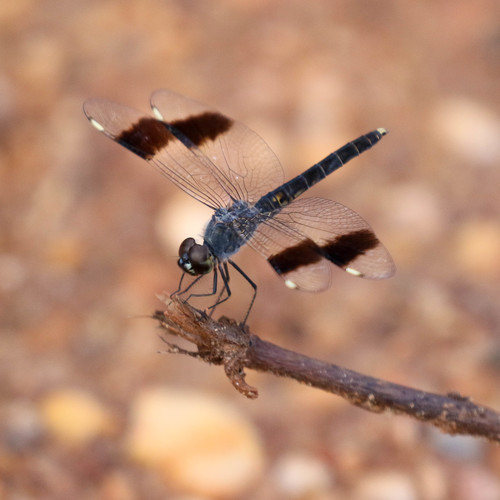
Brachythemis impartita, a species of dragonfly, has pale cream pterostigmata in both sexes, and its eyes have a striped appearance. Females have buff-colored abdomens and thoraces, while males are darker. Mature males develop dark blue to black coloration on their abdomens and thoraces. Males have dark bands on their outer wings that run from the wing node to just before the pterostigma; these bands are paler in newly emerged teneral individuals and darken as the dragonfly matures. Where the range of B. impartita overlaps with that of B. leucosticta, males can be distinguished by vein color, genital lobe shape, and the ventral structure of abdominal segment 8. Females of the two species cannot currently be told apart. This dragonfly has a total body length of 25 to 34 millimetres (0.98 to 1.34 in), and its hindwings span 20 to 26 millimetres (0.79 to 1.02 in).
Brachythemis impartita is distributed from central Africa south to the Democratic Republic of the Congo and Tanzania, extending north across Africa to the Mediterranean Sea. Its range also reaches into the Middle East, where it has been recorded from the Arabian Peninsula, the Levant, Cyprus, and southern Anatolia. It has colonized southern Europe; it was first recorded in Portugal in 1957, and is now also found in Spain, Sardinia, Corsica, Sicily, and by 2015, mainland Italy.
Brachythemis impartita is generally a low-altitude species that inhabits slow-moving rivers, lakes, and still waters in relatively open landscapes. It prefers waters with soft substrates such as sand, and possibly mud. Like B. leucosticta, this species is well known in Africa for its habit of following and flying around larger animals, including humans, to catch insects disturbed by the animals' movement. Where B. impartita occurs, it can be the most common odonate species.