About Brachylomia viminalis Fabricius, 1777
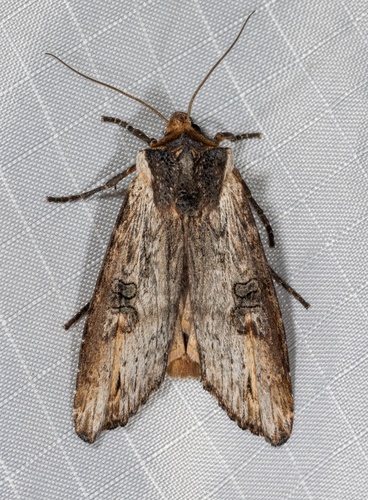
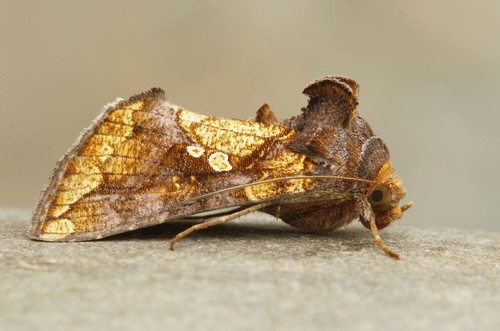
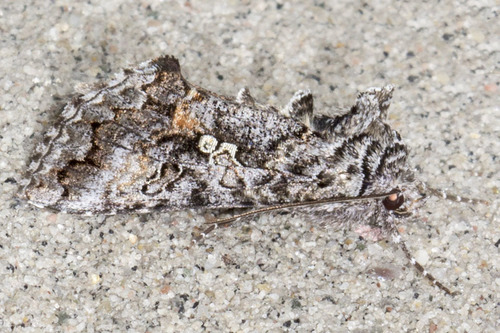
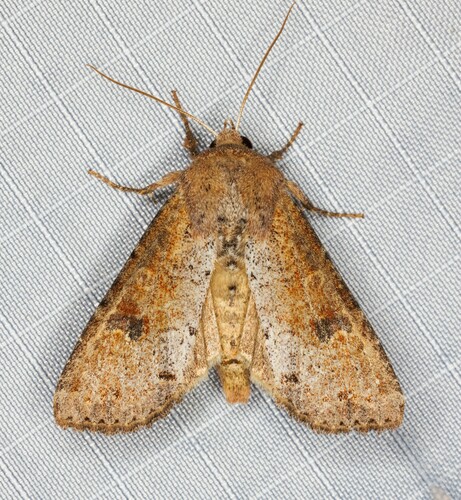
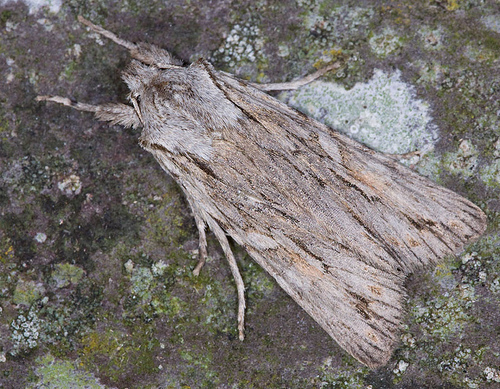
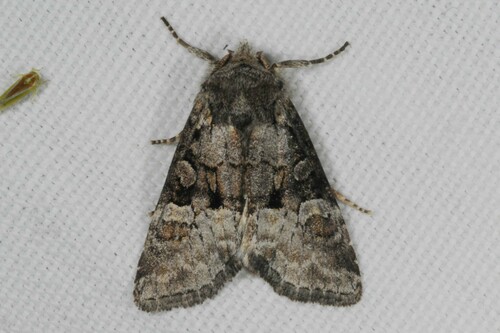
The forewing of Brachylomia viminalis is dark or pale grey, mixed with fuscous coloring. Its base is diffusely darker, and the median shade is broadly blackish. The lines are pale, approaching one another below the middle of the wing, where they are conversely marked with black. A short black streak runs along the base of the submedian fold. The claviform stigma is long, black-edged, and touches or connects with the outer line. The orbicular and reniform stigmas are pale with black outlines; the reniform stigma is sometimes white. The submarginal line is pale, preceded by a rufous grey shade. The hindwing is brownish grey, and the fringe is pale, often rufous — this rufous coloring also appears on the lateral and anal tufts of the abdomen. In the saliceti Bkh. variation, the inner half of the forewing is dark, bounded by the median shade, while the outer half is much paler. The ab. stricta Esp. variation is a grey or brown form, where only the terminal area is pale, and the costal edge is red. A rarer form of this variant, ab. rufescens ab. nov. [Warren], has the whole forewing and the underside of both wings suffused with rufous. Obscura Stgr. is a darker common form that is more uniformly dark grey; unicolor Tutt, from the north of England, is an extreme nearly black development of this form. Scripta Hbn., the commonest form in the south of England, has a white or grey-white ground colour. Ab. suffusa ab nov. [Warren] is a form in which the white forewing is suffused with smoky brown that obscures the lines, leaving only the stigmata, along with their black outlines, visible. The larva is whitish green, with all lines whiter and whitish tubercles. Larvae feed on willows, spinning leaves together and feeding between the united leaves to feed undisturbed. This species overwinters in the egg stage. The flight season information provided refers to the British Isles, and may differ across other parts of the species' range.