About Brachyelytrum erectum (Schreb.) P.Beauv.
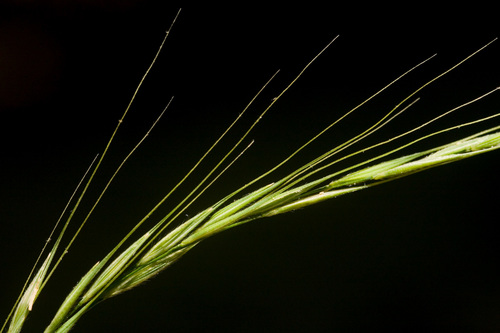
Brachyelytrum erectum (Schreb.) P.Beauv. typically grows with erect culms that reach 30–100 cm (12–39 in) in height, and has pilose nodes. Its hispid leaf sheaths usually bend backwards. Its leaf blades are very scabrous, measuring 3.5–15 cm (1.4–5.9 in) long and 0.6–2 cm (0.24–0.79 in) wide. The abaxial (lower) sides of the leaf blades are pilose along their veins, while the adaxial (upper) sides are glabrous, and the leaf margins are scabrous. It produces a narrow, simple, few-flowered panicle that is 5–20 cm (2.0–7.9 in) long. Its spikelets, which measure 2–4 cm (0.79–1.57 in) long, are borne on capillary pedicels. The first glume is usually obsolete or vestigial, and the second glume is aristate. Its lemmas are approximately 1 mm (0.039 in) long, hispid, and bear hairs up to 6 mm (0.24 in) long. Its awns measure 1.3–2 cm (0.51–0.79 in) long, and its paleas are 7–12 mm (0.28–0.47 in) long. A slender, naked bristle forms the rachilla behind the palea, and is about half to two-thirds the length of the palea. Its anthers are 3.5–6 mm (0.14–0.24 in) long, and its caryopses are 5.5–7.5 mm (0.22–0.30 in) long. This grass flowers from June through August. Brachyelytrum erectum grows in woods and thickets, and occasionally occurs on limestone or other alkaline bedrock. In Canada, it is found from Lake of the Woods east to Newfoundland. In the United States, it occurs from western Massachusetts to Iowa, and south to Alabama, Mississippi, and Louisiana.