About Brachychiton gregorii F.Muell.
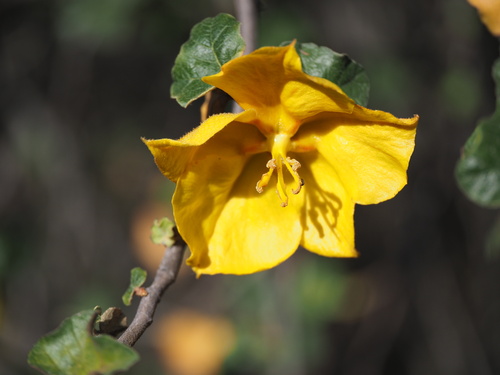
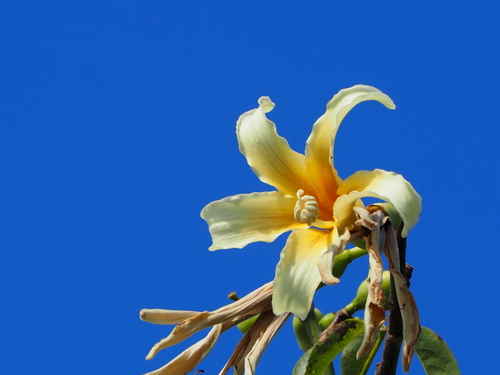
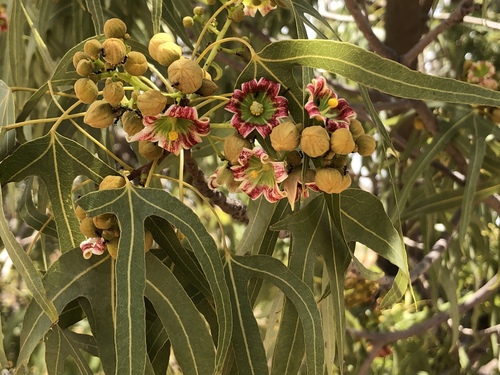
Brachychiton gregorii F.Muell. is a tree that typically grows to a height of 3 to 12 metres (10 to 39 ft), with a canopy width of 2 to 5 metres (7 to 16 ft). It has evergreen leaves that can reach up to 20 centimetres (8 in) long, with three or five lobes growing on a long stalk; the tree sheds these leaves during dry months. Flowering occurs between October and December, producing inflorescences made up of bell-shaped pale-yellow flowers with reddish margins. After flowering, black woody seed pods form, growing up to around 5 centimetres (2 in) long and containing many seeds. This tree has a scattered distribution across arid areas of Australia. It occurs in the northwestern corner of South Australia, where it grows on rock ridges, slopes, and sand dunes. It is also found in the Northern Territory, and in Western Australia it is scattered throughout the Goldfields, Pilbara, and Mid West regions, growing on red sandy or loamy soils. Within its native range, this tree is often associated with granite outcrops. The mistletoe Amyema benthamii commonly parasitizes this species: the parasite is introduced when a bird defecates on a tree branch. The mistletoe is in turn eaten by the caterpillar stage of the moth Comocrus behri. This tree is sold commercially as seed or as seedlings. It is well-suited for planting in arid areas, as it is drought resistant once established. It is also moderately frost tolerant, and can grow in full sun or part shade in well-drained soils. It forms a large tuber from a young age, so it can be cultivated as a succulent bonsai. Its spongy wood makes it suitable for use as wood pulp. Its low height and heavily divided branches form a dense crown that provides good shade. A strong fibre can be obtained from its cambium layer.