About Brachycereus nesioticus (K.Schum. ex B.L.Rob.) Backeb.
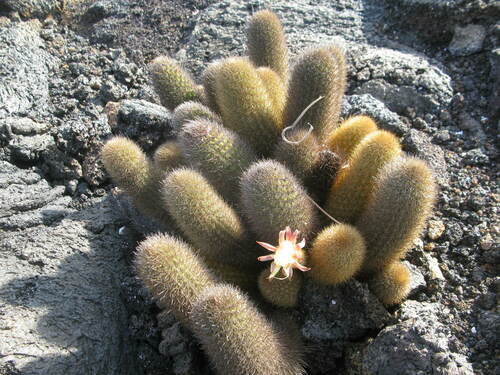
Commonly known as the lava cactus, Brachycereus nesioticus (K.Schum. ex B.L.Rob.) Backeb. is a leafless, clump-forming cactus species. It grows from cylindrical stems that typically reach 50–60 cm (20–24 in) in height; entire clump formations can measure up to 2 m (6 ft 7 in) across. Its stems have 16–22 ribs and are yellow with hints of green or brown. Each areole produces up to 40 spines, which reach up to 5 cm (2 in) in length. The spines are yellowish when new, and darken as they age. The species bears single, narrowly funnel-shaped flowers that grow up to 11 cm (4+3⁄8 in) long and 5.5 cm (2+1⁄8 in) across; the lower portion of each flower has many spines. Flowers open during the daytime, and their inner surfaces are white to yellowish white. Floral remains remain attached to the cactus's fruit, which is a berry that ranges in color from red to brown. The fruit is covered in yellow spines and contains numerous black seeds. This cactus is endemic to the Galápagos Islands, where it occurs on Fernandina, Genovesa, Isabela, Pinta, Santa Cruz, Santiago, and smaller islands including Bartolomé. It grows on barren lava flows of both pāhoehoe and ʻaʻā types, and is one of the first species to colonize new lava flows.