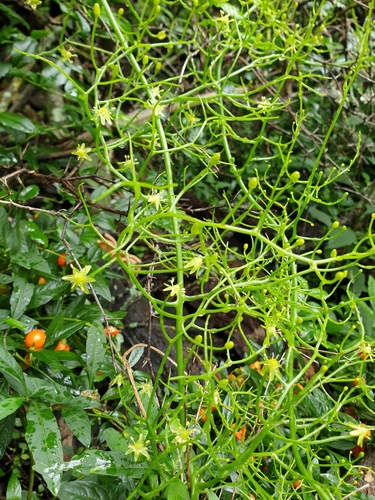
About Bowiea volubilis Harv. ex Hook.f.
Bowiea volubilis Harv. ex Hook.f. is a highly poisonous plant species. All parts of this plant contain multiple active cardiac glycosides, including bufadienolide glycosides. Its bulbs additionally contain specific compounds: boworuboside, bowocryptoside, hellebrigenin, and polysaccharide. Two subspecies of this species have been identified, each with a distinct geographical range. Subspecies Bowiea volubilis subsp. volubilis is distributed from tropical East Africa (Kenya, Tanzania, Uganda) through Mozambique, Zimbabwe, Malawi, Angola, to southeastern South Africa. In South Africa, it grows in Eastern Cape Province, KwaZulu-Natal, Mpumalanga, Gauteng, and Limpopo. Subspecies Bowiea volubilis subsp. gariepensis occurs in southern Namibia and the western part of South Africa’s Northern Cape Province, primarily in the eastern rocky Gariep Desert. Bowiea volubilis subsp. volubilis grows at low to medium altitudes. It is most commonly found along mountain ranges, in densely vegetated river valleys, under bush clumps, and on boulders. It has also been recorded on Karoo edges and in bushy ravines called kloof. This subspecies also grows in open forests or on steep rocky hillsides, usually in well-shaded areas. It tolerates both wet and dry conditions, and grows mainly in summer rainfall regions with 200 to 800 mm of annual precipitation. It flowers in spring and summer. Cultivated individual plants live for approximately 10 years. Bowiea volubilis subsp. gariepensis grows on cooler screes in the Orange River valley. It flowers in autumn and winter. The flowers of both subspecies have an unpleasant scent, and are pollinated by flies from the Tachinidae and Muscidae families, as well as wasps from the Vespidae family. After fruiting, the aboveground portions of both subspecies die back, and the plants enter a dormant period. Traditional healers in South Africa have long used this plant as a herbal remedy for a range of ailments. Specifically, it is used to treat skin diseases, eye irritation, palpitations, headaches, muscle pains, infertility, urinary tract infections, and sexually transmitted diseases. When combined with other plants, it is also used as an infant antiparasitic, and to treat hepatitis, pelvic pain in women, and childhood jaundice. It is also used to induce abortion. An enema made from bulb infusion is used to treat impotence. Xhosa people use a bulb decoction as a laxative, while Mfengu and Mpondo people use ground roasted bulbs for the same purpose. Zulu people use a water extract from fresh outer bulb scales to treat ascites, infertility, urinary tract infections, back pain, and muscle pains. Swazi people use a decoction of Bowiea volubilis and Boophane disticha bulbs to treat scabies. In traditional medicine of the Western Cape Province, bulbs are applied topically to treat skin rashes, acne, cuts, burns, and insect bites. In KwaZulu-Natal, bulbs are used to prepare mixtures that facilitate childbirth, and treat headaches and infertility. The cardiac glycosides in this plant have cardiotonic, laxative, irritant, emetic, anti-inflammatory, antibacterial, and antifungal properties. The effect of cardiac glycosides in the bulbs is 30 times stronger than the glycosides of foxglove, and the glycosides in the flowers are 60 times stronger. The entire plant is highly poisonous due to its cardiac glycoside content. Overdose symptoms include vomiting, hypersalivation, arrhythmia, and spasms, which can lead to death within minutes or hours depending on the dose. Autopsies of people who died from poisoning with this plant show digestive system irritation, congestion of the liver and other internal organs, and cardiac arrest that occurs during the diastolic phase. This plant is described as very easy to grow in cultivation.