About Bouteloua gracilis (Kunth) Lag. ex Griffiths
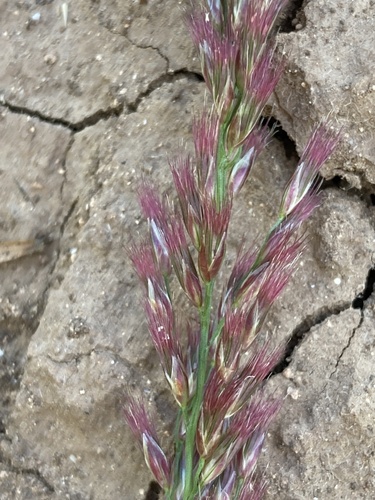
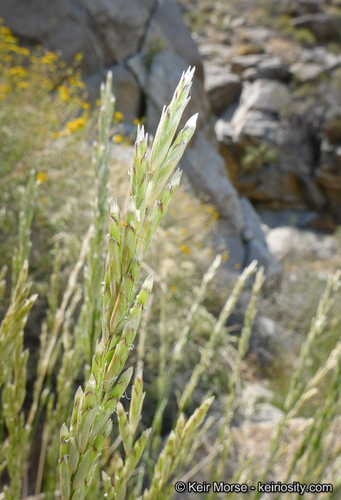
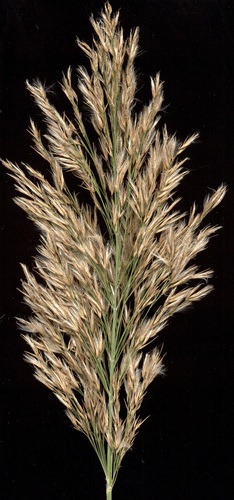
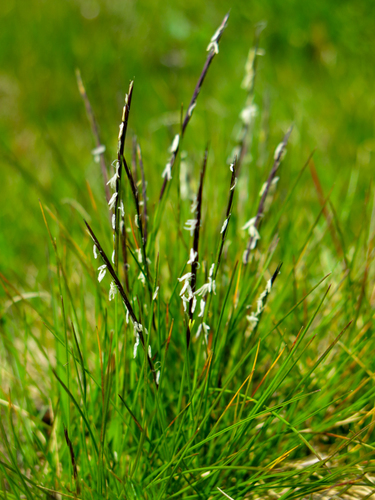
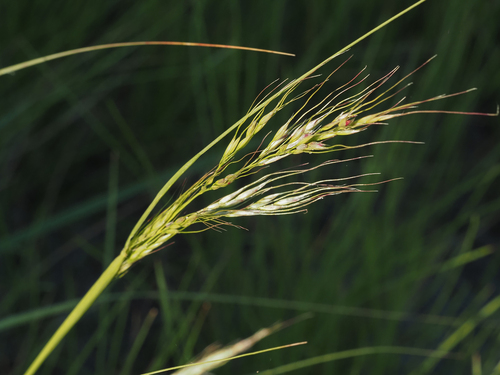
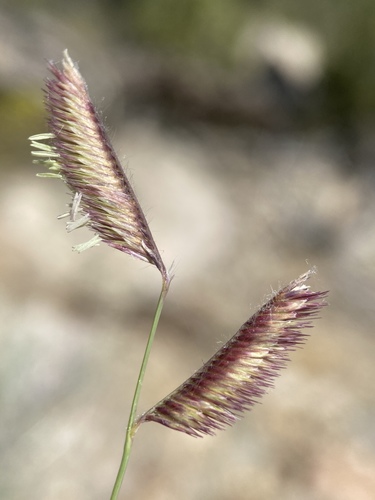
Blue grama, scientifically named Bouteloua gracilis (Kunth) Lag. ex Griffiths, produces green to greyish leaves that are less than 3 mm (0.1 in) wide and 25 to 250 mm (1 to 10 in) long. At maturity, the entire plant reaches an overall height of 15 to 30 cm (6 to 12 in), while its flowering stems (called culms) grow 18 to 46 cm (7 to 18 in) long. One to four (most commonly two) comb-like spikes grow at the tip of each culm, extending outward at a sharp angle from the stem. Each spike holds between 20 and 90 spikelets. Individual spikelets are 5 to 6 mm (0.20 to 0.24 in) long, and contain one fertile floret plus one or two smaller, sterile florets. Two glumes sit below the florets: one measures 1.5 to 3 mm (0.06 to 0.12 in) long, and the other measures 3.5 to 6 mm (0.14 to 0.24 in) long. The fertile floret has a bract (called a lemma) 5 to 5.5 mm (0.20 to 0.22 in) long, with three short bristles (awns) at its tip. The sterile floret has a lemma about 2 mm (0.08 in) long, with three awns around 5 mm (0.2 in) long. If pollinated, the fertile floret develops an oblong-elliptic brown seed that is 2.5 to 3 mm (0.10 to 0.12 in) long. When the seed reaches maturity, the entire spikelet detaches from the plant, leaving the two glumes behind. The roots of blue grama typically spread 30 to 46 cm (12 to 18 in) outward, and grow 0.9 to 2.0 m (3 to 6.5 ft) deep.
Blue grama can be easily established from seed, but it relies more heavily on vegetative reproduction through tillers. Seed production is slow, and depends on soil moisture and temperature. Wind dispersal only carries seeds a few meters (6 ft); longer-distance dispersal occurs via insects, birds, and mammals. Seedling establishment, survival, and growth are highest when seedlings grow isolated from neighboring mature plants, since mature plants effectively take up water from the seedling's root zone. Successful establishment requires a moderate amount of soil moisture while adventitious roots extend and develop. Established blue grama plants tolerate grazing, cold temperatures, and drought, though long-term drought causes a reduction in root number and size. Blue grama uses an opportunistic water-use strategy: it rapidly uses water when water is available, and becomes dormant during unfavorable conditions. In ecological succession, blue grama is a late seral to climax species. It recovers slowly after disturbance, and recovery depends on the type and extent of the disturbance.
Blue grama has the widest native distribution of any grama grass. It can grow on most soil types, and adapts easily to local conditions. Its natural range extends north to Alberta and south to Mexico. It is present across most of the Midwestern United States, reaching east to Missouri and Texas, and west as far as Southern California. It has also been introduced to some eastern U.S. states and to South America.
Blue grama is the dominant plant species of the United States shortgrass steppe ecoregion. Blue grama populations across the Great Plains are genetically differentiated, even at small spatial scales, and show variation in functional traits linked to climate. Blue grama from more arid grasslands also has greater phenotypic plasticity. It acts as a larval host plant for the Garita skipperling, green skipper, Pahaska skipper, Rhesus skipper, Simius roadside skipper, and Uncas skipper butterflies.