About Bouteloua dactyloides (Nutt.) Columbus
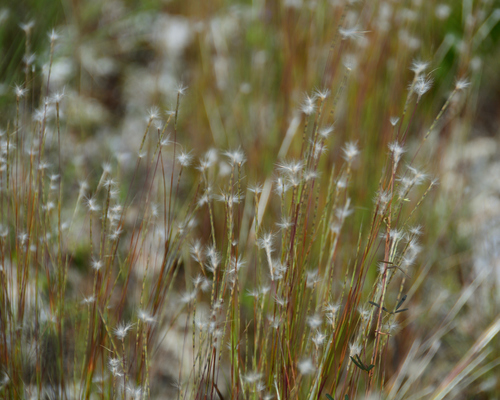
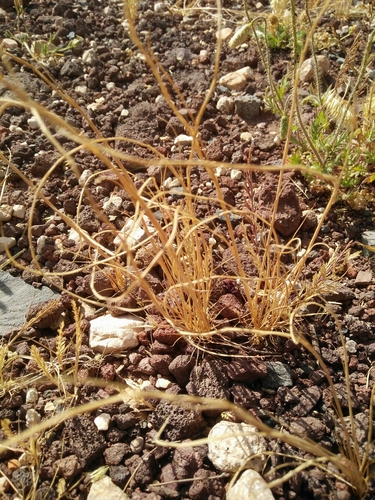
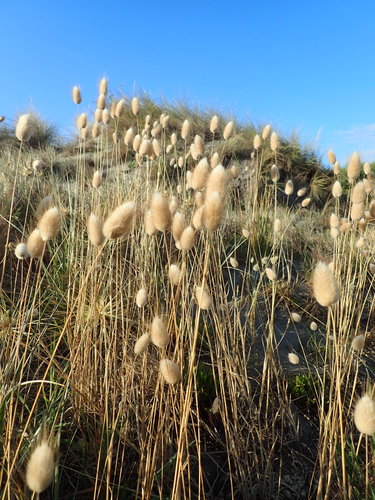
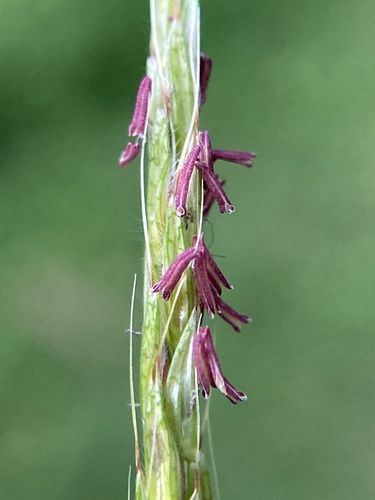
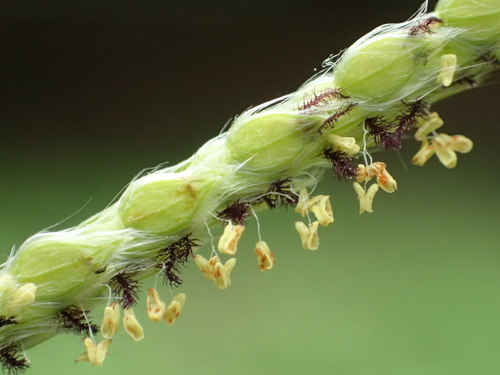
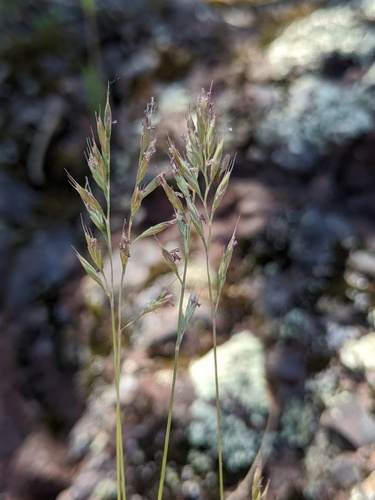
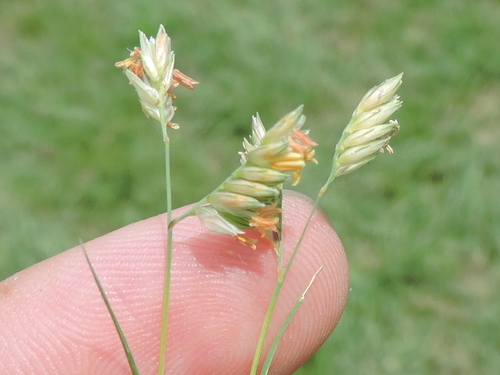
Bouteloua dactyloides, commonly called buffalograss, is a perennial grass that spreads via stolons (runners). By the end of one growing season, a single plant can extend its stolons outward to a length of 15 to 45 centimetres (6 to 18 inches); in ideal experimental conditions, stolons may grow as much as 5.71 centimetres (2.25 inches) per day. When blooming or producing seed, it develops short, upright stalks called culms that range from 1–30 centimetres in height. Buffalograss is a sod-forming species that typically forms a dense, tight mat of vegetation. It has numerous roots that thoroughly occupy the soil; these roots are significantly finer than those of most plains grasses, measuring less than 1 mm (0.039 inches) thick. Despite their narrow diameter, the roots are quite tough and wire-like. While roots may reach depths of 1.2 to 1.8 metres (4 to 6 feet), 70% of the total root mass is located in the top 15 centimetres (6 inches) of soil, and 81% lies in the top 30 centimetres (12 inches). Primary main roots grow almost directly downward, with only very short side roots and very little to no branching. The plant also produces surface roots that grow horizontally out to 24 to 36 centimetres (9 to 14 inches) from the main plant. Buffalograss leaf blades are quite narrow, soft, somewhat curly, hairy on both sides, and usually gray-green in color. Individual blades measure 2–15 centimetres (1–6 inches) long and just 1.0–2.5 millimetres wide. Buffalograss usually produces pollen and seeds on separate individual plants, and because it reproduces via stolons, large patches consisting of only one sex often form. Seed-producing flower stalks are much shorter than pollen-producing flower stalks, and seed heads usually sit at the same level as the grass blades. Compared to other grasses, including other species in the Bouteloua genus, seed-producing inflorescences of buffalograss are highly modified. They form a round globe topped with short structures called spikelets, with three to seven spikelets per seed bur. When ripe, seeds are contained within a hard, round 3–4 millimetre diaspore. Unlike Kentucky blue grass, buffalograss is a warm-season grass, a group that grows best at temperatures above 15 °C (59 °F). As a warm-season grass, it leafs out and turns green late in spring, and dries out early in fall. Dried leaves and inflorescence stalks persist through the dormant season, turning a light golden color. The haploid chromosome number for buffalograss is 10, and the species may be diploid (2n=20), tetraploid (4n=40), or hexaploid (6n=60). Diploid and tetraploid plants are more often found in the southern parts of the species' range, while hexaploids are more often found in the north. Buffalograss is native to shortgrass prairies of North America, ranging from Canada to Mexico. In Canada, it occurs in the provinces of Manitoba and Saskatchewan. In the United States, it is primarily found in the Great Plains, mostly west of the Mississippi River, stretching from Minnesota and Montana in the north to New Mexico and Louisiana in the south. East of the Mississippi, it also grows in Illinois, and in one county each in Virginia and Georgia. While it is found in Wisconsin, POWO lists it as an introduced species there. Similarly, NatureServe lists it as introduced to Virginia, though the World Plants database lists it as native to that state. West of the Rocky Mountains, it is found in Arizona, and in one county each in Utah and Nevada. It grows across much of northern Mexico, from Sonora in the west to Tamaulipas in the east, and south to Morelos and Veracruz; it does not occur on the west coast south of Sonora. Outside of its native range, the grass has become naturalized in Spain, Greece, and south-central to southeastern China, and is recorded growing outside cultivation in New Zealand. Along with blue grama, buffalograss is the co-dominant species in most of the shortgrass prairie ecosystem of the western Great Plains. It is also an important component of mixed grass prairie in drier areas, and in locations where impervious clay soils on slopes prevent the establishment of taller grasses. It rapidly colonizes disturbed areas due to its ability to reproduce vegetatively. In the High Plains, it grows best in fine-textured soils, and grows sparsely on sandy soils, where it may be overgrown by shifting sands. It is a component of the Western Gulf coastal grasslands of Texas, Louisiana, and Tamaulipas. Off the plains, buffalograss occurs as an understory plant in eastern ponderosa pine forests, in the Cross Timbers ecoregion, and in mesquite and oak savannas. In some locations, most often at higher elevations in the semidesert grasslands of New Mexico and northern Mexico, buffalograss is also an important species that grows alongside other grama grass species. At the extreme limits of its habitat, it survives temperatures as low as −34.5 °C (−30 °F) and as high as 49 °C (120 °F). Its elevation range is broad, growing from near sea level up to 1,925 metres (6,300 ft) in Wyoming. Buffalograss is dioecious, meaning individual plants produce only one sex; this is a reproductive strategy that reduces inbreeding for this wind-pollinated species. More monoecious plants (with both sexes on one individual) are found near the edges of the species' range, where it is less dominant. In areas where it forms continuous sod, single-sex populations are more common, with more pollen-producing plants found where resources such as light or nitrogen are increased. When connected via stolons, rooted buffalograss plants avoid competing with each other. After two months of growing independently, connected plants compete for soil resources in the same way as unrelated plants of the same species. Germination rates are low when the seed coat remains undamaged, but germination can occur over a long period of time. In addition to allowing for vegetative spread, stolon connections allow connected plants to communicate defense signals about leaf removal by herbivores. Because of its fine, dense root network, buffalograss is excellent for controlling erosion. Buffalograss is consumed by all types of livestock, and its abundance increases under heavy grazing pressure. The United States Department of the Interior evaluated buffalograss as good to fair forage for elk in Utah and Colorado. While it is not the preferred food of American bison, buffalograss together with blue grama grass is the most commonly consumed plant for bison grazing in the shortgrass biome; at times, these two grasses together make up 80% of bison diet by bulk. In black-tailed prairie dog towns located in mixed grass prairie, buffalograss is typically the dominant plant species, while western wheatgrass (Pascopyrum smithii) and blue grama grass predominate in nearby areas. Buffalograss seeds break dormancy more easily when their outer layers are damaged. This is likely an adaptation to historical grazing by bison, as experiments using cattle as a substitute for bison also find enhanced germination. Seeds that pass through cattle's gut germinate more quickly than untreated seeds. Seeds also germinate during cold stratification rather than requiring warmer temperatures to sprout. Two lepidopteran species feed on buffalograss during their caterpillar life stage. The small butterfly called the green skipper (Hesperia viridis) feeds on buffalograss and other Bouteloua species as a caterpillar. The more specialized buffalograss webworm (Prionapteryx indentella) is only known to feed on its namesake species, and occurs on the plains from Texas to Kansas. In cultivation, buffalograss is particularly noted for thriving in clay soils and full sun. It is intolerant of salt and annual moisture exceeding approximately 750 millimetres (30 inches). Many cultivars have been developed or collected for different uses. While seed is available and less expensive than sod, it is more expensive than seed for common lawn grass species because harvesting seeds that grow very low in the grass canopy is difficult. In addition, the seed-containing bur must be removed or treated to weaken it, otherwise germination rates will be quite low; this further increases the cost of establishment from seed. Buffalograss has greater drought resistance than Kentucky blue grass or perennial ryegrass, and also has better wear resistance under drought conditions than these species, though it suffers more damage from traffic during drought than when it is not water-stressed. Very little research has been conducted on its wear resistance under normal conditions, but preliminary research indicates it has moderate to good damage resistance, though this resistance is not as high as that of healthy Kentucky blue grass. Buffalograss is good quality forage for domesticated animals including cattle, horses, sheep, domestic goats, and rabbits, with a digestible protein content of between 2.7 and 2.9%. The western chinch bug (Blissus occiduus) is a pest of buffalograss across its range in the western United States. To manage chinch bug problems, landscapers reduce the amount of dead thatch in plantings, reduce plant stress with proper irrigation and fertilization, and plant resistant grass cultivars.