About Bouteloua barbata Lag.
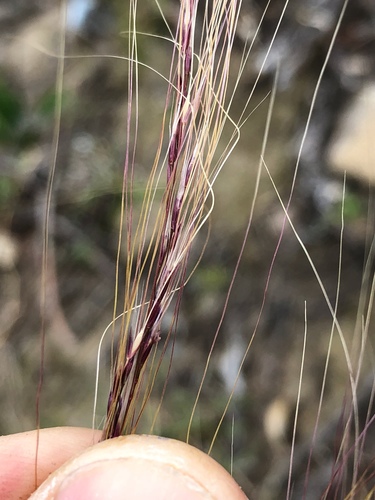
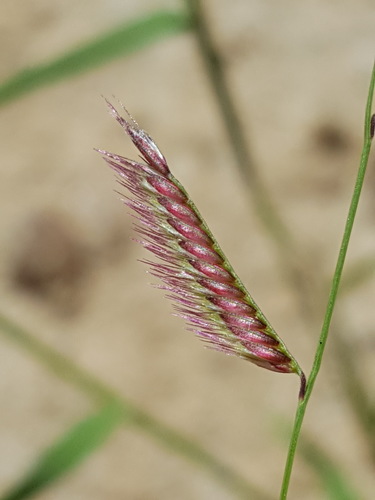
Bouteloua barbata Lag. is an annual or perennial grass that grows in tufts of stems 30 to 75 cm (12 to 30 in) long. Stems may grow prostrate, spreading, or erect. Its inflorescence holds up to 11 branches, each bearing a dense row of up to 40 spikelets. Its fruit (seed) weighs approximately 0.03 milligrams. This lightweight seed is dispersed by wind and animals. The species can be annual or perennial, sprouting from seed or its root crown after summer rainfall. Flowering typically begins around July and continues through October. There are three recognized varieties of this species. Variety barbata is an annual plant with decumbent stems that may root at stem nodes; variety rothrockii, which is sometimes treated as a separate species, is a perennial with erect stems; and variety sonorae, which is restricted to northern Mexico, spreads via stolons. This grass is native to North America, where it occurs in the southwestern United States and extends south to Oaxaca in southern Mexico. It may also be present in Montana, and has been found in Argentina. Variety B. barbata var. barbata grows in a wide range of habitat types, including prairie, grasslands, pinyon-juniper woodland, chaparral, creosote habitat, shrubsteppe, savanna, and Ponderosa pine forest. It grows in the deserts of the American southwest and Mexico, including the Colorado, Mojave, and Chihuahuan Deserts. Variety B. barbata var. rothrockii occurs primarily in subtropical grasslands and adjacent desertscrub, thornscrub, or riparian areas, and is restricted to the Sonoran Desert. Both varieties can also be found in dry disturbed habitats such as roadsides, railroad corridors, and overgrazed pastures. Although this grass is palatable, it is not considered good forage for livestock, because it is small and stays green for only a short period of time. Many other types of animals do use the grass, however. Many birds and small mammals, including prairie dogs and desert kangaroo rats, eat the seeds of this and other grama grasses. Harvester ants in Arizona also consume the seeds of this species.