About Bougainvillea glabra Choisy
Bougainvillea glabra Choisy is an evergreen climbing shrub.
Growth Size
It usually reaches 3–3.5 meters (10–12 feet) tall, and occasionally grows as tall as 9 meters (30 feet).
Stem and Branch Features
It has thick, thorny stems and drooping branches that are hairless, or have sparse hairs.
Leaf Petiole Characteristics
Its leaves have petioles 3 to 10 millimeters (1⁄8–3⁄8 inch) long.
Leaf Blade Shape and Dimensions
Leaf blades are ovate to ovate-lanceolate, with pointed or briefly pointed tips, and measure 5 to 13 centimeters long and 3 to 6 centimeters wide.
Leaf Surface Texture
Leaf blades are sparsely soft hairy on the undersides, and hairless on the upper surfaces.
Bract Characteristics
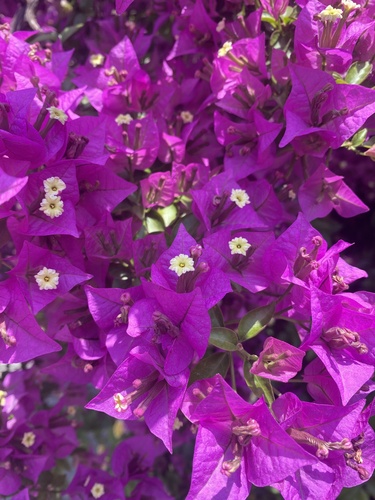
The plant’s leaf-like bracts are purple, oblong or elliptical, and pointed; they measure 65–90 millimeters (2+1⁄2–3+1⁄2 inches) long and about 50 millimeters (2 inches) wide, and grow above the actual flowers.
Flower Arrangement
The flowers grow singly, in pairs, or in groups of three on flower stalks about 3.5 millimeters long.
Raphide Distribution
Raphides have been found in the stems, bracts, and various flower parts of this species.
Cultivation Tolerances
In cultivation, B. glabra tolerates heat and drought, but is sensitive to frost.
Propagation Method
It can be easily propagated from cuttings.
Cultivation Growth Requirements
It requires full sunlight, warm conditions, and well-drained soil to produce abundant flowers.
Cultivation Range
This species is commonly cultivated; it is grown outdoors in areas without frost, and kept in greenhouses in regions that experience frost.
Related Species Comparison
The closely related Bougainvillea spectabilis, which differs from B. glabra by having velvety-felty leaf undersides, is also cultivated, though less commonly.
Medical Application
For medical uses, an infusion made from this plant’s tender leaves and bracts is taken orally to treat gastrointestinal issues including diarrhoea and stomach pain, as well as respiratory conditions including asthma, bronchitis, catarrh, chest pain, fever, pneumonia, and whooping cough.