About Bothriochloa pertusa (L.) A.Camus
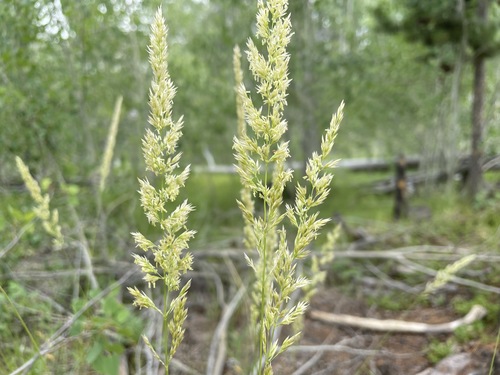
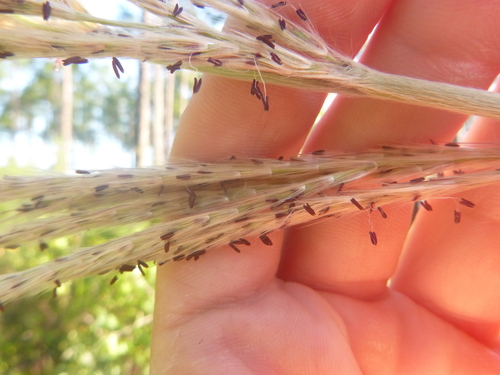
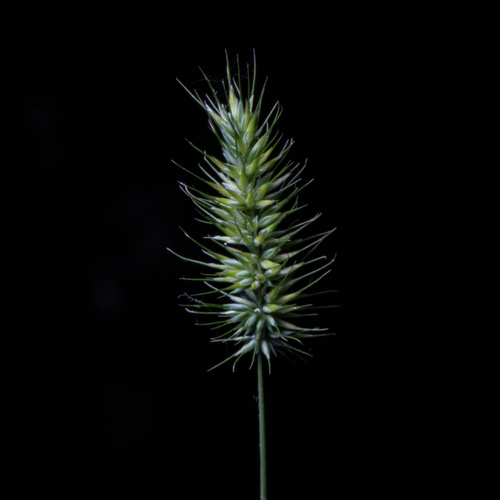
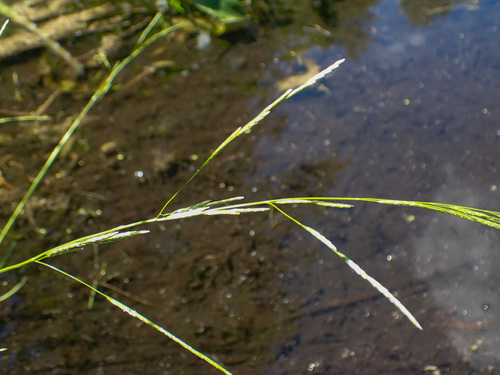
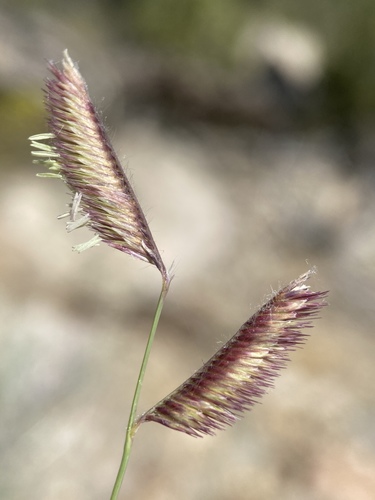
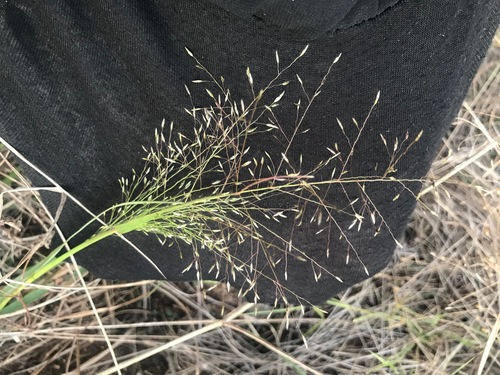
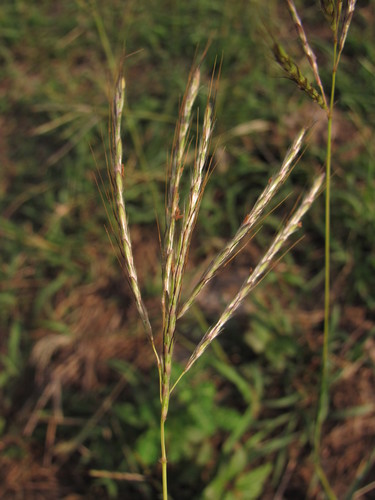
Bothriochloa pertusa (L.) A.Camus is a perennial grass that spreads through stolons, which can be pink or red and are sometimes quite robust; observed stolons have reached 1.6 meters in length. Its stems grow from upright to erect, reaching 60 to 100 centimeters tall, and may sometimes grow along the ground, rooting at nodes that come into contact with soil. Its leaves grow up to 30 centimeters long, with upper leaves longer than lower leaves, and range in color from green to gray-green. The inflorescence is a cluster of very hairy racemes, each a few centimeters long, and parts of the inflorescence may be purplish. Its spikelets have a twisted awn that grows up to 2 centimeters long. The grass is aromatic, and gives off a ginger-like scent when crushed. In terms of habitat, this species needs tropical climates and cannot tolerate frost. It can grow in many different soil types, withstands drought and disturbance, and can grow in dry, degraded habitats such as roadsides. It can also survive short-term waterlogging and fire. As a widely introduced species, Bothriochloa pertusa has become naturalized across many regions, and sometimes becomes a noxious weed. It is especially difficult to control in the Virgin Islands. Its vigorous stoloniferous growth lets it outcompete native plants, forming dense choking mats that shade out other species. Its hairy seeds can spread by sticking to animals. This grass acts as a host for many fungi, including Balansia sclerotica, Claviceps purpurea, Physoderma bothriochloae, Puccinia cesatii, P. duthiae, Sphacelotheca tenuis, Stollia bothriochloae, and Uromyces andropogonis-annulati. Some of these fungi are pathogenic, causing rust and ergot. In New Caledonia, this grass is a food source for the Javan rusa (Rusa timorensis russa), and it has become invasive in this area. For human use, this grass is grown as a lawn because it can form a dense mat. It is occasionally seeded for landscaping projects, for example along roadsides and in degraded fields. It is planted for erosion control and mine reclamation. It has also been used in no-till agricultural systems, where it is grown in a vegetable field, then killed to provide ready mulch for vegetable crops. It is widely used as fodder for livestock, planted as a pasture grass and used for hay and silage. It tolerates trampling, grazing, and cutting. It is favored in heavily grazed fields, and becomes dominant as other grasses are removed by grazing pressure. Its palatability decreases once it begins to flower. Cultivars of the species include 'Ghana Marvel 20', a high-yield variety developed in India, and the rust-resistant 'Dawson', 'Keppel', and 'Medway' varieties from Queensland. It is sometimes planted alongside companion species, including the grasses Cenchrus ciliaris, Urochloa mosambicensis, and Digitaria didactyla, and legumes such as Centrosema pascuorum, Chamaecrista rotundifolia, and Lotononis bainesii.