About Bothia castanella (Peck) Halling, T.J.Baroni & Manfr.Binder
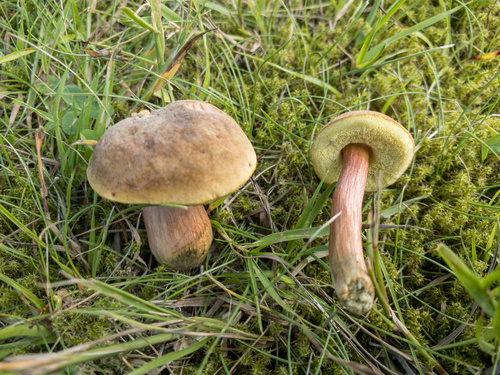
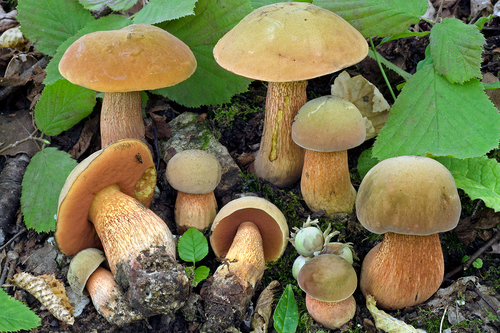
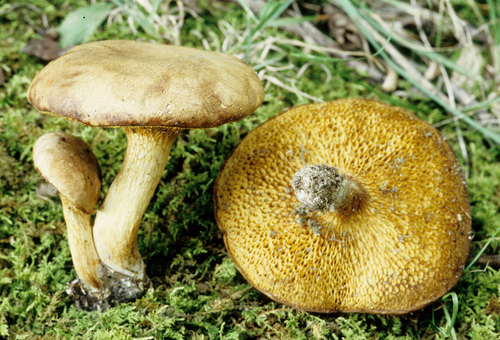
Bothia castanella has a cap that starts convex and flattens with age, reaching 3–8 cm (1.2–3.1 in) in diameter. The center of the cap sometimes develops a shallow depression, and the margin ranges from even to wavy and irregular. The cap surface is dry, initially hairy, and becomes smooth when mature; its color ranges from reddish brown to burgundy-brown to dark yellowish brown. The white flesh does not change color when bruised or injured, unlike that of many other bolete species, and is about 8 mm (0.3 in) thick. The cap undersurface holds pores that are angular to elongated, and measure about 2 mm wide. The pore surface is pinkish brown to tan or buff, turning yellowish brown when mature, and bruised areas of the pores turn ochre-tawny. The tubes, which extend about 6 mm (0.24 in) deep, are somewhat decurrent, meaning they run slightly down the length of the stipe. This mushroom has no noticeable odor or taste. The dry, solid stipe is 2–7 cm (0.8–2.8 in) long by 0.6–2 cm (0.2–0.8 in) thick; it is roughly equal in thickness along its entire length, or slightly tapered at either end. The stipe surface is mostly smooth, except for a reticulate (meshed) area at its apex. The edibility of Bothia castanella is unknown. Fruit bodies produce a yellow-brown spore print. Spores are egg-shaped to ellipsoid, smooth, and thin-walled, measuring 8.4–10.5 by 4.2–4.9 μm. The spore-bearing cells (basidia) are club-shaped, four-spored, and measure 25–35 by 7–9 μm. Cystidia are present both on tube walls (as pleurocystidia) and abundantly on tube edges (as cheilocystidia); they are somewhat spindle-shaped, sometimes with a central swelling, and measure 45–70 by 7–12 μm. Clamp connections are absent from the hyphae, and all hyphae are inamyloid. Several chemical tests can help confirm identification of this species: a drop of ferrous sulfate (FeSO4) turns the cap cuticle grayish; a dilute potassium hydroxide (KOH) solution turns the cap cuticle dark brown to amber, and turns the flesh pale brown; ammonia (NH4OH) turns the flesh pale yellow. Fruit bodies of Bothia castanella grow singly, scattered, or in groups under oak, though other trees including birch, beech, hickory, eastern white pine, and hemlock may also be present in the habitat. Typical habitats include woods and parklands; in Asia, the species has been recorded growing in bamboo forests. In the United States, where the fruiting season runs from July to October, the species' range extends from the Carolinas north to New York and New England, and west to Minnesota. It has also been collected in Costa Rica, China, and Taiwan.